SLS Pune Admission 2026 | SLAT-BasedNIRF #7 Law 2025 | #1 Private Law SchoolPune, Maharashtra | Est. 1977
Symbiosis Law School Admission 2026 | SLAT Eligibility, Fees, Cutoff, Process & Important Dates
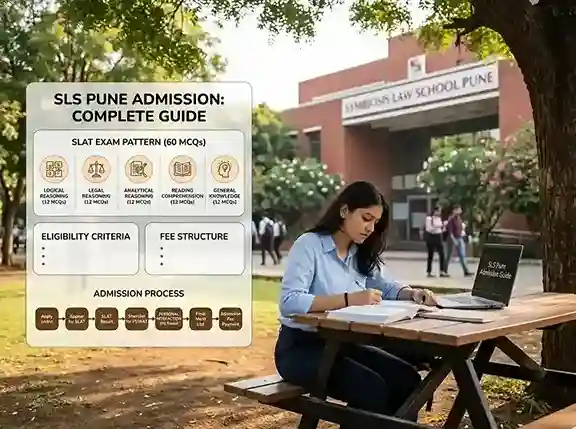
Complete guide to Symbiosis Law School (SLS Pune) admission 2026. Admission to BA LLB, BBA LLB, and BCom LLB (Hons.) is through SLAT (Symbiosis Law Admission Test) | 60 questions, 60 minutes, no negative marking | followed by a Personal Interaction (PI) round. The final merit is SLAT 70% + PI 30%. SLS Pune SLAT cutoff for General category: 45–50 out of 60. Highest domestic placement package: ₹22 LPA.
60
SLAT Questions
60 min
Exam Duration
45–50
Pune Cutoff
₹5.26L
Fee per Year (UG)
1,380
Total SLAT Seats
📅 Updated: May 29, 2026 | SLAT 2026 Admission Cycle
✍️ By Meenakshi Kumari LLM NUJS Kolkata | Senior Law Education Editor
Symbiosis Law School (SLS Pune) Admission 2026 | SLAT Exam, Eligibility, Fees & Process | Source: LawGuru India | Data: slat-test.org, NIRF 2025
⚡ Quick Answer: SLS Pune Admission 2026 at a Glance
Admission to Symbiosis Law School (SLS Pune) for 5-year BA LLB, BBA LLB, and BCom LLB (Hons.) is through SLAT (Symbiosis Law Admission Test) | a 60-question, 60-minute CBT with no negative marking | followed by an online Personal Interaction (PI) round. Final merit = SLAT 70% + PI 30%. The SLS Pune SLAT 2026 cutoff for General category is 45–50 out of 60. Fee: ₹5,26,000 per year for BA/BBA LLB. For 3-year LLB and LLM, the separate AIAT exam is required. The SLAT is accepted across all four SLS campuses (Pune, Noida, Hyderabad, Nagpur).
🎓 5-Yr UG: via SLAT + PI📋 3-Yr LLB: via AIAT + PI✅ No Negative Marking💰 ₹5.26L/Year UG Fee
1. Symbiosis Law School Pune | About & Admission Overview
Symbiosis Law School (SLS), Pune is one of India's most prestigious private law schools, established in 1977 | making it one of the oldest law institutions outside the NLU system. It operates under Symbiosis International (Deemed University) and is recognised by both the UGC and the Bar Council of India (BCI), accredited with NAAC Grade 'A'.
In the NIRF Law Rankings 2025, SLS Pune is ranked #7 nationally | and more importantly, it is consistently ranked #1 among all private law schools in India by India Today and IIRF (ranked #2 by IIRF in 2025). Its placement record is outstanding: the highest domestic package in 2025 was ₹22 LPA, the highest international package was ₹52 LPA, and the average CTC was ₹13.31 LPA. Top recruiters include Trilegal, AZB & Partners, Khaitan & Co., Baker McKenzie, Vedanta, JSA Advocates, and Bharucha & Partners.
Admission to SLS Pune's 5-year integrated law programmes is through the Symbiosis Law Admission Test (SLAT) | a common entrance test for all four Symbiosis Law Schools. The 3-year LLB and LLM programmes use a separate SLS-specific test called the AIAT. The admission process is two-stage: written test + Personal Interaction (PI), with final merit calculated as SLAT 70% + PI 30%.
The eligibility criteria for SLS Pune vary by programme. The criteria are set by Symbiosis International (Deemed University) and are consistent across all four SLS campuses. There is no upper age limit for any programme at SLS Pune.
5-Year Integrated UG: BA LLB, BBA LLB, BCom LLB (Hons.) Via SLAT
Class 12 Pass | Any StreamMin 45% Aggregate (General)Min 40% (SC/ST)No Age Limit
Candidates must have passed Class 12 (10+2) or an equivalent examination from any recognised board in any stream (Science, Commerce, Arts/Humanities) with a minimum of 45% aggregate marks for General and OBC category students. SC/ST candidates need a minimum of 40%. Candidates appearing in their final Class 12 examination are also eligible to apply provisionally, subject to meeting the minimum marks at the time of admission. Admission is through SLAT followed by the Personal Interaction (PI) round.
3-Year LLB (Hons.) Via AIAT
Any Bachelor's Degree | Any DisciplineMin 45% in Graduation (General)Min 40% (SC/ST)
Candidates must hold a bachelor's degree in any discipline from a recognised university with at least 45% aggregate marks (General), 40% (SC/ST). Final-year graduation students are also eligible to apply. Admission is through the AIAT (SLS All India Admission Test) | a 1 hour 45 minute CBT | followed by an online Personal Interaction round. AIAT is separate from SLAT and has its own registration process.
LLM | Master of Laws (1 Year) Via AIAT
LLB (3-yr) or 5-yr Integrated LLBMin 45% in LLB (General)Min 40% (SC/ST)
Candidates must hold a 3-year LLB or 5-year integrated LLB from a BCI-recognised institution with minimum 45% marks (General category), 40% SC/ST. Admission is through AIAT (the SLS-specific entrance test) followed by a Personal Interaction. The LLM at SLS Pune is a 1-year full-time residential programme with a total fee of ₹2,80,000.
PhD in Law Via PET + Interview
LLM from Recognised UniversityNET Qualified Candidates Exempt from PET
Candidates must hold an LLM degree with at least 55% marks. Admission is through the Symbiosis PhD Entrance Test (PET) followed by a Research Proposal presentation and interview. Candidates with UGC-NET/JRF qualifications are directly eligible for the interview without PET.
3. Courses & Intake at SLS Pune 2026
SLS Pune offers a well-structured suite of law programmes at UG, PG, and doctoral levels. The 5-year integrated programmes (BA LLB, BBA LLB, BCom LLB) are the flagship courses and account for the majority of SLAT intake.
Programme
Duration
Intake Seats
Entry Test
Annual Fee
BA LLB (Hons.)
5 Years
120 seats
SLAT + PI
₹5,26,000
BBA LLB (Hons.)
5 Years
120 seats
SLAT + PI
₹5,26,000
BCom LLB (Hons.)
5 Years
Limited
SLAT + PI
₹5,26,000
3-Year LLB (Hons.)
3 Years
60 seats
AIAT + PI
₹3,59,000
LLM | Master of Laws
1 Year
90 seats
AIAT + PI
₹2,80,000 (total)
PhD in Law
3–5 Years
Limited
PET + Interview
Per SIU norms
Total SLAT-based UG seats across all 4 SLS campuses: ~1,380. SLS Pune total SLAT UG seats: ~240 (BA LLB + BBA LLB). Source: SLS Official / Shiksha 2026.
The Symbiosis Law Admission Test (SLAT) is conducted by Symbiosis International (Deemed University) | typically in December each year for the following academic cycle. SLAT 2026 was conducted on December 20 and December 28, 2025. Candidates could appear in both slots; the best score was considered.
Passage-based: inference, author's tone, main idea, vocabulary-in-context, title questions; passages ~300–500 words each
12
12
General Knowledge
Current affairs (last 12 months), Indian polity, Constitution, legal developments, national/international events, science & technology
12
12
TOTAL6060
📐 Marking Scheme
✅+1 mark for each correct answer
⬜0 marks for wrong answer | No negative marking
⬜0 marks for unattempted question
💡 No negative marking | attempt all 60 questions, always.
🖥️ Exam Structure
ModeCBT (Computer-Based)
Duration60 Minutes
Exam Cities68+ across India
Attempts2 slots; best score
LanguageEnglish
📊 SLAT vs CLAT | Key Differences
SLAT and CLAT are closely aligned in pattern but differ in key ways. CLAT has 120 passage-based questions in 120 minutes with −0.25 negative marking; SLAT has 60 direct MCQs in 60 minutes with no negative marking. CLAT is offline (pen-and-paper); SLAT is online CBT. CLAT leads to 25 NLUs across India; SLAT leads to 4 SLS campuses. Both test Logical Reasoning, Legal Reasoning, Reading Comprehension, and GK | making CLAT preparation highly transferable to SLAT. If you are preparing for CLAT 2027, you are simultaneously preparing for SLAT with minor adjustments (no quantitative section in SLAT).
5. SLS Pune Admission Process 2026 | Step-by-Step
The SLS Pune admission process for 5-year integrated BA/BBA LLB programmes is a structured 5-stage sequence. Every stage is mandatory | missing any stage disqualifies the candidate from the merit list. Here is the complete process:
1
SLAT Registration & Programme Registration
At slat-test.org | SLAT fee: ₹2,250 | Programme fee: ₹1,000 per course per campus
Visit the official SLAT portal at slat-test.org and complete your registration. The SLAT registration fee is ₹2,250 (covers both exam slots). Additionally, you must pay a programme registration fee of ₹1,000 for each course at each SLS campus you wish to apply to. These are separate payments. You can register for multiple programmes across multiple campuses | all with a single SLAT registration but individual programme fees. Complete registration well before the deadline as SLAT 2027 applications are expected to open from August 2026.
2
Appear for SLAT Exam (Two Slots Available)
CBT mode | 60 Qs | 60 min | No negative marking | 68+ exam cities
SLAT is conducted in two slots in December. You can appear in both slots | and the best score from the two attempts is used for merit list preparation. The exam is held in CBT (Computer-Based Test) mode at designated Symbiosis test centres in 68+ cities across India. On exam day, carry your admit card and a valid photo ID. The exam is 60 minutes for 60 questions | maintaining an average pace of 1 minute per question ensures you attempt all questions. Since there is no negative marking, never leave a question blank.
3
SLAT Result & PI Shortlisting
SLAT 2026 result: January 15, 2026 | SLS Pune PI shortlist cutoff: ~45–50 marks
SLAT results are typically declared in mid-January. After the result, each SLS campus independently shortlists candidates for the PI round based on their SLAT score. SLS Pune has the highest PI shortlisting cutoff (approximately 45–50 marks out of 60). Being shortlisted for PI at SLS Pune is itself a significant achievement. Once shortlisted, you must book a PI slot within the specified window (PI slot booking opens ~3 days after result declaration). Upload all required documents before the PI date.
4
Personal Interaction (PI) Round | Online
Online PI | Evaluates SOP, personality, motivation | Carries 30% in final merit | Feb 2026
The PI is conducted online (video call format) by a panel of SLS Pune faculty. It is approximately 10–15 minutes long and evaluates: Statement of Purpose (submitted before the PI), communication skills and articulation, current awareness and legal knowledge, career motivation and clarity of purpose, and overall personality and confidence. The PI is not a knowledge quiz | it is a personality assessment. The final merit score = SLAT score (scaled to 50) × 70% + PI score × 30%. A strong PI performance can significantly improve your rank. It is mandatory to attend the PI | absence results in disqualification.
5
Merit List, Seat Confirmation & Admission
Multiple merit lists released | Document verification | Fee payment to confirm seat
Each SLS campus releases its own merit list based on the composite SLAT + PI score. SLS Pune typically releases 3–4 merit lists as seats move through upgradation. If your name appears in the merit list, you must complete the admission process within the deadline: upload required documents for verification and pay the seat confirmation fee. Failure to pay within the deadline results in automatic seat forfeiture. If you are on the waiting list, monitor the official SLS Pune admissions portal and complete the process as soon as your name appears.
6. SLAT 2026 Important Dates | SLS Pune Admission Timeline
The following timeline covers the completed SLAT 2026 admission cycle. The SLAT 2027 cycle (for 2027–28 academic year) is expected to begin with applications opening in August 2026 and the exam in December 2026.
📝
SLAT 2026 Registration Opens
August 2025
✓ Completed
⏰
Last Date for SLAT Registration
December 2025
✓ Completed
🖥️
SLAT 2026 Exam | Slot 1
December 20, 2025
✓ Conducted
🖥️
SLAT 2026 Exam | Slot 2
December 28, 2025
✓ Conducted
📊
SLAT 2026 Result Declaration
January 15, 2026
✓ Declared
📅
SLS Pune PI Slot Booking
January 18–20, 2026
✓ Completed
📂
Document Upload Deadline
January 25, 2026
✓ Completed
🎤
SLS Pune PI Round
February 1–15, 2026
✓ Completed
🏆
1st Merit List | SLS Pune
February 2026
✓ Released
🏆
3rd Merit List | SLS Pune
March 10, 2026
✓ Released
🎓
SLS Pune Academic Year Begins
July–August 2026
⏳ Upcoming
📋
SLAT 2027 Registration (Expected)
August 2026
⏳ Next Cycle
7. SLAT Cutoff 2026 | All 4 Campuses (Category-Wise)
The SLAT cutoff for shortlisting to the PI round differs significantly across the four Symbiosis Law School campuses. SLS Pune consistently requires the highest cutoff due to its superior ranking, placement record, and limited seats. Below are the expected and historical cutoff ranges:
Campus
General Category
OBC
SC/ST
Difficulty
SLS Pune Most Competitive
45–50 / 60
42–47
35–40
High
SLS Noida
42–46 / 60
38–43
32–36
Moderate-High
SLS Hyderabad
38–42 / 60
34–38
28–33
Moderate
SLS Nagpur
35–40 / 60
30–35
25–30
Lower
* Expected cutoffs based on SLAT 2025 data and SLAT 2026 analysis. Official cutoffs released by each SLS campus separately after result declaration. Final merit is composite: SLAT 70% + PI 30%.
🎯 What Score Do You Need for SLS Pune BA LLB (Hons.)?
For SLS Pune specifically, aim for a SLAT score of 48+ out of 60 to be comfortably shortlisted for the PI round and have a realistic chance at the final merit list. SLAT 2025 SLS Pune cutoff was 44–48 (General). Given the 2026 SLAT result analysis, 45+ guarantees PI shortlisting and 50+ puts you in a strong position for merit. Strong PI performance can offset a SLAT score of 44–46 | but you cannot get into SLS Pune without clearing the PI shortlisting threshold. Target 50/60 as your preparation benchmark.
8. SLS Pune Fee Structure 2026 | All Programmes
The SLS Pune fee structure covers tuition, development fees, and other institutional charges. Hostel and mess are additional. Below is the complete fee breakdown for the 2026–27 academic year:
Programme
Duration
Annual Fee
Total Fee
BA LLB (Hons.)
5 Years
₹5,26,000
₹26,30,000
BBA LLB (Hons.)
5 Years
₹5,26,000
₹26,30,000
BCom LLB (Hons.)
5 Years
₹5,26,000
₹26,30,000
3-Year LLB (Hons.)
3 Years
₹3,59,000
₹10,77,000
LLM (1 Year)
1 Year
|
₹2,80,000 (total)
SLAT Registration
One-time
₹2,250 (SLAT) + ₹1,000/programme
Hostel (per year)
Optional
₹1,75,000–₹2,25,000
Varies by hostel building
Source: SLS Pune Official / LawPrepTutorial 2026. NRI/PIO/OCI fees are significantly higher. Government taxes applicable. Fees subject to revision | verify at sls.edu.in.
💰 Scholarships at SLS Pune
SLS Pune offers merit-based scholarships through the Symbiosis Society Foundation. Scholarships are awarded based on SLAT rank and academic performance. The scholarship amount and criteria are announced at the time of admission. Additionally, students from economically weaker sections can apply for Symbiosis University's financial assistance programme. Scholarship withdrawal may occur in cases of academic underperformance or misconduct. Always apply for scholarships during the admission process | do not wait until after joining.
9. AIAT | Admission to 3-Year LLB & LLM at SLS Pune
The SLS All India Admission Test (AIAT) is a separate entrance test conducted by SLS Pune for admission to the 3-year LLB (Hons.) and LLM programmes. It is entirely distinct from SLAT and requires a separate registration and fee payment.
📋 AIAT Exam Pattern
Duration1 Hour 45 Minutes
ModeCBT (Centre-Based)
SectionsLegal Aptitude, GK, Reasoning
DifficultyModerate | Not Very Hard
Next StepPI (Online) after shortlisting
📌 Key AIAT Facts
Required for 3-year LLB and LLM | not for 5-year UG
Eligibility: graduation degree (any discipline) for LLB
AIAT application fee: ₹1,000 per programme
The exam is not very difficult | preparation focused on current legal developments, general awareness, and basic reasoning
Merit: AIAT score + PI (same 70:30 weightage as SLAT)
Registration at official SLS Pune website (sls.edu.in)
Typically conducted March–May for July intake
10. All 4 Symbiosis Law Schools | Campus Comparison 2026
A single SLAT registration opens doors to all four SLS campuses. Here is a comparative overview to help you decide which campus to preference when filling your SLAT application:
1
SLS Pune | Symbiosis Law School, Pune
📍 Viman Nagar, Pune | Est. 1977 | NIRF #7 Law 2025
UG Seats: ~360 | More accessible cutoff; expanding infrastructure
11. SLS Pune PI Round 2026 | How to Prepare & What to Expect
The Personal Interaction (PI) round at SLS Pune carries 30% weightage in the final merit | making it a decisive factor for candidates with similar SLAT scores. The PI is conducted online (video call) by a panel of 2–3 SLS faculty members and typically lasts 10–15 minutes. Here is what to expect and how to prepare:
1
Statement of Purpose (SOP) | Submit Before PI
The SOP is a written statement explaining why you want to study law at SLS Pune, your career goals, and what you bring to the campus. It must be submitted online before the PI date. The SLS panel reads your SOP before the interview and may ask questions based on it. Write a specific, genuine SOP | avoid generic statements like "I have always loved justice." Instead, cite a specific legal issue, case, or experience that motivates your law career. 300–400 words, professionally formatted.
2
Common PI Questions at SLS Pune
Typical SLS Pune PI questions: Why law? Why Symbiosis specifically? What area of law interests you and why? Tell us about a recent Supreme Court judgment that interested you. What is the biggest legal challenge facing India today? Tell us about your Class 12 academic performance. What are your strengths and weaknesses? Where do you see yourself in 10 years? What was your SLAT preparation strategy? Are you applying to other law schools? Preparing thoughtful, specific answers to all these questions significantly boosts your PI score.
3
Technical Setup for Online PI
The PI is held via video call. Ensure you have: a stable internet connection (minimum 2 Mbps), a laptop or desktop with a working webcam and microphone, a quiet, well-lit room with a plain background, formal attire (shirt/kurta for males, formal wear for females), printed copies of all your documents for quick reference, and your SLAT scorecard visible. Test your video and audio at least 30 minutes before the scheduled PI time. Log in 10 minutes early to avoid technical delays.
12. Documents Required for SLS Pune Admission 2026
SLAT 2027 is expected in December 2026. If you are targeting SLS Pune with its cutoff of 45–50/60, you need approximately 3–4 months of focused preparation. Given SLAT's 60-minute, 60-question format and no negative marking, the strategy is markedly different from CLAT | speed with accuracy and full coverage.
Logical Reasoning in SLAT uses standard reasoning patterns: syllogisms, analogies, series completion, coding-decoding, blood relations, and statement-conclusion. Use R.S. Aggarwal's Verbal and Non-Verbal Reasoning for foundational practice. Practice 20 reasoning questions daily | within 18 minutes (12 Qs in exam should take ~11–12 minutes). For SLAT, the questions tend to be moderate difficulty: not as complex as LSAT-type analytical games, but faster-paced than CLAT.
Legal Reasoning in SLAT includes principle-fact application (similar to CLAT but simpler), constitutional provisions (Fundamental Rights, DPSPs), landmark Supreme Court cases (Kesavananda Bharati, Maneka Gandhi, Vishaka, Puttaswamy), and basic legal maxims. No prior legal knowledge is assumed, but familiarity with legal principles gives a clear advantage. Solve CLAT PYQ Legal Reasoning sections from 2020–2026 | they are directly applicable to SLAT. Target to complete all 12 Legal Reasoning questions in 14 minutes.
Analytical Reasoning covers seating arrangements, scheduling puzzles, direction problems, and data sufficiency | similar to CLAT Logical Reasoning. Draw diagrams immediately for arrangement-type questions. Use SLAT previous year papers and CLAT PYQs. This section is manageable but time-sensitive: mark questions you find complex and return to them after completing the easier ones. Target 10+ marks here as it's the most practice-dependent section.
RC passages in SLAT are 300–500 words on legal, social, or policy themes. Questions test inference, main idea, vocabulary in context, and author's tone. Read one English newspaper editorial daily (The Hindu, Indian Express) and time yourself to finish a 400-word passage + 4 questions in 6 minutes. This builds the speed-accuracy combination SLAT demands. SLAT RC is generally less complex than CLAT's passage-based reading | a strong score here is highly achievable.
GK in SLAT covers current affairs (past 12–18 months), Indian polity, Constitution, major government schemes, national/international events, and legal developments. Use a monthly current affairs PDF and maintain a running note of legal news (new laws, Supreme Court judgments, government policies). For SLAT 2027, cover current affairs from January 2026 to November 2026. Static GK | focus on Indian Constitution, national symbols, major awards, and important historical events rather than obscure trivia.
14. Frequently Asked Questions | SLS Pune Admission 2026
What is the eligibility for Symbiosis Law School Pune admission 2026?
+
For the 5-year BA LLB, BBA LLB, and BCom LLB (Hons.) at SLS Pune: pass Class 12 with minimum 45% aggregate (General/OBC) or 40% (SC/ST). No age limit. Appear for SLAT and the PI round. For the 3-year LLB: graduation in any discipline with 45% (Gen) / 40% (SC/ST). For LLM: LLB degree with 45% (Gen) / 40% (SC/ST). Final-year students are eligible to apply provisionally.
What is the SLAT exam pattern for SLS Pune admission?
+
SLAT 2026 exam pattern: 60 MCQs in 60 minutes, CBT mode at 68+ cities. Five equal sections: Logical Reasoning (12 Qs), Legal Reasoning (12 Qs), Analytical Reasoning (12 Qs), Reading Comprehension (12 Qs), and General Knowledge (12 Qs). Each correct answer = +1 mark; no negative marking. Exam conducted in two slots; best score considered. Results within approximately 4 weeks.
What is the SLAT cutoff for SLS Pune 2026?
+
The expected SLAT cutoff for SLS Pune General category for BA/BBA LLB (Hons.) is 45–50 marks out of 60 for PI shortlisting. In SLAT 2025, the SLS Pune cutoff ranged from 44–48 (General). Final merit = SLAT 70% + PI 30%. SLS Pune has the highest cutoff among all four Symbiosis Law Schools. A score of 50+ puts you in a strong merit position; aim for 48+ as your preparation target.
What are the fees at Symbiosis Law School Pune for BA LLB 2026?
+
SLS Pune BA LLB (Hons.) fee 2026: ₹5,26,000 per year, totalling approximately ₹26.30 Lakh for the full 5-year programme. BBA LLB fee is the same. SLAT registration: ₹2,250. Programme registration: ₹1,000 per course. Hostel: ₹1.75–2.25 Lakh per year (additional). Total investment for 5 years including hostel and living expenses is approximately ₹35–40 Lakh.
Does SLS Pune accept CLAT scores for admission?
+
No. SLS Pune does not accept CLAT scores for admission to its BA LLB or BBA LLB programmes. Admission to the 5-year integrated UG programmes is exclusively through SLAT (Symbiosis Law Admission Test). The 3-year LLB and LLM require the AIAT. CLAT and SLAT are separate exams | candidates targeting both NLUs and SLS Pune must appear for both CLAT (for NLUs) and SLAT (for SLS Pune). CLAT preparation does, however, substantially overlap with SLAT preparation.
Is SLAT accepted at all 4 Symbiosis Law Schools?
+
Yes. A single SLAT registration and scorecard is accepted by all four Symbiosis Law Schools: SLS Pune, SLS Noida, SLS Hyderabad, and SLS Nagpur. However, you must register for each campus separately (₹1,000 per programme per campus). The PI rounds are conducted separately by each campus. Merit lists and cutoffs differ significantly | SLS Pune being the most competitive and SLS Nagpur the most accessible in terms of cutoff requirements.
Is SLS Pune better than NLUs for law?
+
SLS Pune is India's #1 private law school and ranked #7 nationally (NIRF 2025), behind only NLUs in the top 6. For candidates who cannot secure admission to NLSIU, NLU Delhi, NALSAR, NUJS, or GNLU through CLAT, SLS Pune offers comparable placement quality (₹13.31 LPA average vs ₹16 LPA for NLSIU), a strong alumni network, and a highly competitive peer group. It is a genuine alternative to Tier-2 NLUs (ranks 6–10) for students who score 45–50 in SLAT with a good PI. SLS Pune's corporate law placement record particularly rivals that of several NLUs.
LLM from NUJS Kolkata. 7+ years covering law college admissions, SLAT, CLAT, and NLU rankings across India. Admission and fee data sourced from slat-test.org, SLS Pune Official (sls.edu.in), Shiksha, Careers360, and NIRF India Rankings 2025. SLAT cutoff analysis based on 2025 official result data and 2026 provisional data. Updated: May 29, 2026.
Targeting SLS Pune via SLAT 2027? Start Preparation Now.
SLS Pune cutoff for General category is 45–50/60. Your target: score 50+ in SLAT 2027 and nail the PI round. Use LawGuru India's free resources | SLAT guides, mock tests, and PI preparation tips.