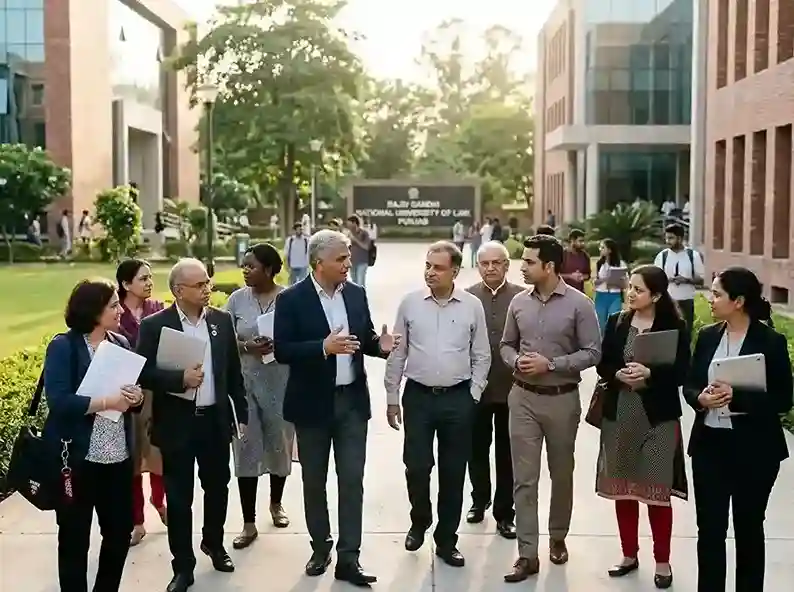
RGNUL Patiala (Rajiv Gandhi National University of Law, Punjab) is a separate and independent National Law University from NLSIU Bengaluru (National Law School of India University). RGNUL is located at Sidhuwal, Patiala, Punjab and was established in 2006. NLSIU Bengaluru was established in 1986. Both are NLUs, both admit students via CLAT, but they are entirely different universities. This page covers RGNUL Patiala's faculty specifically.
1. RGNUL Patiala | University & Faculty Overview
Rajiv Gandhi National University of Law (RGNUL), Patiala is one of India's 26 National Law Universities, established under Punjab Act No. 12 of 2006 by the State Legislature of Punjab. Located on a 50-acre campus at Sidhuwal, Bhadson Road, Patiala, it is governed by the Chief Justice of the Punjab and Haryana High Court as Chancellor and headed by a Vice-Chancellor appointed by the Governor of Punjab.
RGNUL is approved by the UGC under Section 2(f) of the UGC Act, 1956, and by the Bar Council of India for imparting professional legal education. It holds NAAC Grade A accreditation and is ranked #24 in Law by NIRF 2024. The institution accommodates approximately 900 undergraduate and 30 graduate students | making it among the NLUs with the largest student intake, with 6 boys' and 5 girls' hostel blocks on campus.
| Full Name | Rajiv Gandhi National University of Law, Punjab |
| Abbreviation | RGNUL |
| Established | 2006 (Punjab Act No. 12 of 2006) |
| Type | Government / Public (NLU) |
| Location | Sidhuwal-Bhadson Road, Patiala, Punjab |
| Campus | 50 Acres |
| NAAC Grade | Grade A |
| NIRF 2024 Rank | #24 (Law) |
| Official Website | rgnul.ac.in |
- 30+ core faculty members across 6 departments
- Primary department: Department of Law
- Supporting: English, Economics, History, Sociology, Political Science
- Faculty trained at Oxford, Harvard, Queen Mary, Leiden
- Teaching quality review system | student evaluations every semester
- Faculty accessible as residential NLU | office hours daily
- Visiting practitioner-faculty from Punjab and Haryana High Court Bar
- Research culture growing through multiple research centres
2. Vice-Chancellor | Prof. (Dr.) Jai Shankar Singh
Prof. (Dr.) Jai Shankar Singh joined RGNUL Patiala as its Vice-Chancellor on March 28, 2024. His appointment by the Governor of Punjab brought to RGNUL a leader with deep legal academic credentials | he previously served as Dean of the Department of Law at the University of Allahabad, one of India's oldest and most respected central universities with a law faculty dating back to 1886.
Prof. Jai Shankar Singh is an expert in International Law and Constitutional Law with over two decades of academic and administrative experience. His research and publications span international humanitarian law, public international law, fundamental rights jurisprudence, and comparative constitutional law | areas that directly inform RGNUL's academic focus and research priorities.
Upon joining RGNUL, the Vice-Chancellor articulated a vision centred on interdisciplinary research | emphasising that legal education must be understood through the lens of politics, economics, sociology, and technology to produce graduates who can address the complex legal challenges of contemporary India. This vision shapes how the faculty is evaluated, recruited, and professionally developed at RGNUL.
- Strengthening interdisciplinary research across law and social sciences
- Improving teaching quality through the existing faculty review system
- Expanding visiting faculty from active practice (High Courts, Supreme Court)
- Developing research output and UGC/Scopus-indexed publications by faculty
- Building international academic exchange partnerships for faculty development
3. Department of Law | Core Faculty Profiles
The Department of Law is RGNUL's flagship academic department and the largest. It houses all core and specialisation law faculty members. Here are the known core faculty members of the RGNUL Department of Law:
Dr. Anirudh Prasad is one of RGNUL's senior faculty members in the Department of Law. With a comprehensive academic background | M.A. + LLM + PhD | he brings both breadth (social sciences grounding through his M.A.) and depth (specialised legal research through his PhD) to his teaching. His research and publications have contributed to the academic legal discourse in his specialisation areas. As a senior Professor, he has played a significant role in shaping RGNUL's law curriculum and mentoring junior faculty and student researchers.
Prof. Krishan Mahajan is a Professor in the Department of Law at RGNUL Patiala. His academic qualifications | BA + LLB + LLM | reflect a traditional legal education pathway with a combined Arts-and-Law foundation, which he brings to his teaching approach. Prof. Mahajan is noted for a teaching style that bridges legal doctrine with its practical application, drawing on a combination of academic understanding and awareness of legal practice. His experience enriches the classroom with insights that help students appreciate how law operates beyond textbooks.
Dr. Anand Pawar serves as Associate Professor in the Department of Law. With an LLM and PhD as his primary qualifications, Dr. Pawar represents the research-oriented strand of RGNUL's faculty. His PhD training has given him specialised expertise in a legal domain with a research methodology that he brings into postgraduate supervisions and advanced courses at RGNUL. He actively contributes to the university's research output through journal publications and conference presentations, and mentors research scholars in their dissertation work.
Ms. Renuka Salathia is an Assistant Professor in the Department of Law at RGNUL. As part of the junior faculty cohort, she represents the new generation of legal academics that RGNUL is building | typically holding LLM qualifications with NET/SLET clearance, and often pursuing or having completed their doctoral research. Assistant Professors at RGNUL are primarily responsible for teaching foundational and intermediate law courses, and are closely mentored by senior faculty members in curriculum development and research.
4. Social Sciences Departments | Faculty Profiles
What makes RGNUL's academic structure unique | and aligned with the best NLUs | is its genuine integration of social sciences into legal education. The first two years of the BA LLB curriculum are structured to give students a strong interdisciplinary foundation across multiple disciplines, taught by specialist faculty in each field.
Dr. Tanya Mander teaches English language, communication, and legal writing at RGNUL. With a PhD in English alongside her BA and MA, she is a subject-specialist academic who plays a critical role in developing students' written and oral communication abilities | skills that are foundational to legal advocacy, drafting, and negotiation. At NLUs, English is taught not as a general language course but as an applied communication tool for legal work | moot memorials, legal opinions, case briefs, and client-facing documents.
Ms. Brindpreet Kaur teaches Economics in the Department of Economics at RGNUL | a discipline that is foundational to understanding competition law, taxation, corporate regulation, and economic policy analysis in legal contexts. Her qualifications | BA, MA, MPhil | represent a progressive specialisation in economics. At RGNUL, economics is introduced in the first year to help students understand the economic dimensions of legal rules, economic rationale behind regulatory frameworks, and the quantitative tools used in policy analysis. This is especially relevant for students targeting careers in SEBI, RBI, competition law, and economic regulatory bodies.
Dr. Rachna Sharma teaches History at RGNUL | a discipline that provides law students with critical historical perspective on India's legal development, colonial legal legacy, constitutional history, and the socio-political contexts that shaped Indian law. Understanding how laws evolved is essential to interpreting them correctly. Historical methods also train students in archival research, document analysis, and evidence-based argumentation | skills directly transferable to legal practice. The integration of history into law education is one of the reasons NLUs produce well-rounded legal thinkers rather than mere practitioners.
Dr. Jasleen Kewlani teaches Sociology at RGNUL, contributing a sociological lens to legal education. Sociology helps law students understand how social structures, power relations, identity, caste, gender, and inequality shape both the creation and application of law. For students targeting careers in public interest law, criminal justice, social welfare law, or judicial services, a sociological understanding of law is invaluable. At RGNUL, sociology courses build students' ability to critically analyse law-in-action versus law-on-paper | a distinction that distinguishes excellent lawyers from merely competent ones.
5. Faculty Qualifications | UGC Standards & RGNUL Profile
RGNUL faculty appointments are governed by the University Grants Commission (UGC) Regulations 2018 on minimum qualifications for appointment to teaching positions. Here is the framework that RGNUL follows and how its faculty measures up:
| Position | UGC Minimum Qualification | Additional Requirements | RGNUL Faculty Status |
|---|---|---|---|
| Professor | PhD + 10 years experience (8 as Assoc. Prof. / Asst. Prof.) + 7 publications in UGC-listed/peer-reviewed journals; Research Score 120 | 8 years teaching/research in equivalent academic position | Drs. Prasad, Prof. Mahajan | meet criteria with LLM/MA + PhD + experience |
| Associate Professor | PhD + 8 years experience + publications; Research Score 75 | Strong publication record in law journals | Dr. Anand Pawar | LLM + PhD; meeting criteria |
| Assistant Professor | LLM (for Law) or MA (for social sciences) + NET/SLET/SET; or PhD | No experience requirement for fresh appointments | Ms. Renuka Salathia, Dr. Tanya Mander, Ms. Brindpreet Kaur, Dr. Jasleen Kewlani | all meet criteria |
International Academic Pedigree of RGNUL Faculty
One of RGNUL's distinguishing features is that several of its faculty members hold academic qualifications or have research experience from international institutions. Student reviews and institutional records confirm that faculty have been trained at or held visiting positions at:
Faculty research fellowship and academic training
LLM / research programmes
Postgraduate legal studies
International law specialisation
6. Research Specialisations | Department-Wise
RGNUL faculty research specialisations represent the core academic disciplines pursued at the institution. Here is the subject-wise research landscape:
7. Research Centres Led by Faculty
RGNUL has established several research centres and clinics that are led and staffed by faculty members. These centres serve as the primary vehicles for applied legal research, policy work, and community outreach:
8. Visiting Faculty & Practitioners
RGNUL supplements its core faculty with visiting faculty drawn from diverse professional backgrounds. This mix of full-time academic faculty and part-time practitioner-faculty is a deliberate pedagogical choice that mirrors the best law schools globally | where theory and practice are taught side by side.
Senior Advocates and practitioners from the Punjab and Haryana High Court Bar, Patiala District Court, and occasionally the Supreme Court Bar deliver guest lectures, take elective modules, and participate in moot court coaching. This brings live caselaw and practice insights directly into the classroom.
Retired High Court and district judges deliver sessions on judicial decision-making, evidence law, sentencing, and constitutional interpretation. Their perspective on how courts actually apply legal principles is invaluable for students who will appear before these forums professionally.
In-house counsels, compliance officers, and legal managers from corporations address students on corporate governance, transactional law, IPR management, and legal risk. These sessions bridge the gap between the academic corporate law taught in classrooms and the corporate law practiced in boardrooms.
Faculty members from other NLUs, central universities, and occasionally international law schools deliver short courses, intensive workshops, and research seminars at RGNUL. This cross-pollination of academic thought enriches students' exposure to diverse legal philosophies and methodologies.
RGNUL has hosted visiting scholars from international institutions under academic exchange and MOU programmes. These visitors bring global legal perspectives | particularly on international law, comparative law, and international human rights | directly to RGNUL students.
Arbitrators, mediators, and conciliators from recognised arbitral institutions conduct training sessions and practical workshops on dispute resolution. RGNUL's Moot Court and negotiation programmes benefit from this practitioner input | alumni consistently perform well in national ADR competitions.
9. Teaching Methodology at RGNUL
RGNUL's teaching methodology is deliberately mixed | reflecting both the academic diversity of its faculty and the different pedagogical demands of law courses versus social science courses. Here is a comprehensive account of how teaching happens at RGNUL:
| Teaching Method | Courses / Faculty Using It | Student Benefit |
|---|---|---|
| Socratic Questioning / Lecture Discussion | Law courses | Constitutional Law, Criminal Law, Contract Law | Develops analytical reasoning, forces students to think through legal arguments in real-time |
| Case Study Analysis | Case-based subjects | Evidence Law, Company Law, Contract Law | Applies statutory provisions to real judgments; mirrors actual legal practice |
| PPT-based Lectures | Structured courses | International Law, Tax Law, Social Sciences | Clear visual organisation of complex material; facilitates note-taking and revision |
| Journal Article Review | Advanced law courses, research-oriented faculty | Develops academic legal research skills; exposes students to cutting-edge legal scholarship |
| Classroom Debates & Discussions | Constitutional Law, Political Science, Sociology | Builds oral advocacy skills; exposes students to multiple legal viewpoints |
| Moot Court Practice | All years, supervised by law faculty | Real-time application of legal arguments in a simulated courtroom; the most important practical skill-builder |
| Clinical Legal Education | Faculty of the Legal Aid Clinic; senior year students | Real client-case experience; drafting for actual community legal issues |
| Research Projects & Dissertations | Supervised by individual faculty with area expertise | Develops original thinking, research methodology, and academic legal writing |
| Internship Feedback Integration | All faculty | informal integration into course discussions | Students who have interned bring practical insights back; faculty encourage this feedback loop |
10. Faculty-Student Dynamics & Accessibility
RGNUL is a fully residential university | both students and (for the most part) faculty live on or near the 50-acre Sidhuwal campus. This residential character fundamentally transforms the faculty-student relationship, creating the kind of informal mentorship and intellectual engagement that defines the best law school experiences.
- Faculty members are accessible during day hours due to residential nature
- Most faculty available for project guidance, moot coaching, assignment help
- Teaching review system creates accountability and responsiveness
- Faculty actively involve students in research projects and conferences
- Strong moot court coaching culture | faculty actively prepare teams for competitions
- Office hours are respected by most faculty members
- Teacher-student ratio needs improvement as student intake has grown
- More visiting and practitioner faculty would enrich practical legal skills
- Variation in teaching quality across faculty | some professors significantly better
- Research output could be strengthened through more dedicated research time
- Interdisciplinary research between law and social sciences departments could grow
11. RGNUL Faculty Recruitment | Process & Standards
RGNUL follows the UGC Regulations 2018 for faculty recruitment, with applications invited through advertisements in national newspapers and the official RGNUL website. The recruitment process is transparent and merit-based:
| Stage | Process | Evaluation Criteria |
|---|---|---|
| Advertisement | National and local newspaper advertisements + rgnul.ac.in | Open application | all eligible candidates may apply |
| Shortlisting | Academic Performance Indicator (API) score calculation | Publications, research, teaching experience, awards | all quantified via UGC API norms |
| Selection Committee | Committee comprising VC, external experts, Registrar | Presentation / demonstration lecture + interview; external subject expert evaluates domain knowledge |
| Academic Track Record | PhD, publications, conference presentations reviewed | Quality of publications | peer-reviewed vs grey; research impact; PhD thesis quality |
| Appointment | Appointment letter from RGNUL; Governor (Punjab) approval for senior positions | Contract terms per UGC 7th Pay Commission; probation period applies |
12. Student Reviews on Faculty Quality
Student perspectives on RGNUL faculty, drawn from reviews by enrolled and graduated students, provide an authentic ground-level assessment of the academic environment:
"Our university has well-qualified and well-trained faculty members with an average teaching experience of 5 years. As our university is a residential university, the majority of faculty members are accessible during day hours for any sort of project, assignment, moot courts, etc." | Student Review, RGNUL Batch of 2026
"The faculty members at our university are experienced and have been alumni from universities such as Oxford University, Harvard Law School, Queen Mary University, Leiden University, and various NLUs. The methods of teaching adopted by the faculties are of mixed nature where some prefer PPT, while others prefer journal articles." | Student Review, RGNUL
"Teachers here are really helpful. Their qualifications are mixed. Some of them are PhD holders, while some are pursuing PhDs. Most of them have in-depth knowledge of the law and try to explain them. The way of teaching is mixed including classroom debates and discussions. Some professors are very friendly to students and help them not just academically." | Student Review, RGNUL
"In order to maintain the teaching standards, our university has instituted a teaching quality and review management system wherein all the students are requested to present their reviews and suggestions which are taken into account." | Student Review, RGNUL
13. Frequently Asked Questions | RGNUL Patiala Faculty
The Vice-Chancellor of RGNUL Patiala is Prof. (Dr.) Jai Shankar Singh, who joined on March 28, 2024. He previously served as Dean of the Department of Law at the University of Allahabad. He is an expert in International Law and Constitutional Law with over two decades of teaching, research, and administrative experience. As VC, he has prioritised interdisciplinary research, improved teaching quality, and international academic engagement at RGNUL.
RGNUL Patiala has the following academic departments: Department of Law (the primary department | all core and specialisation law courses); Department of English (legal communication, language skills); Department of Economics (law and economics, economic policy); Department of History (legal history, constitutional history); Department of Sociology (law and society, social justice); and Department of Political Science (political theory, public policy, governance). The interdisciplinary structure | with law at the centre and social sciences supporting | is integral to the NLU model of legal education.
RGNUL Patiala has approximately 30+ core faculty members across its departments (primarily Law, and supporting social sciences departments). The core faculty is supplemented by visiting faculty, practitioner-teachers from the Punjab and Haryana High Court Bar, and guest lecturers. For the exact current faculty count and names, check the official RGNUL website at rgnul.ac.in under the "People → Core Faculty" section, which is updated as faculty appointments and changes occur.
RGNUL Patiala faculty have academic training from a range of domestic and international institutions. According to student reviews and available institutional data, faculty members have been trained at or hold qualifications from: Oxford University, Harvard Law School, Queen Mary University London, Leiden University, various National Law Universities (NLSIU, NALSAR, NUJS, etc.), and Indian central universities. Domestic faculty qualifications include LLM, MPhil, and PhD from UGC-recognised universities across India.
No. RGNUL Patiala and NLSIU are two entirely different institutions. RGNUL (Rajiv Gandhi National University of Law) is located in Patiala, Punjab, established in 2006. NLSIU (National Law School of India University) is located in Bengaluru, Karnataka, established in 1986 and ranked #1 in India. Both are National Law Universities that admit students through CLAT, but they are independent universities with separate campuses, administration, faculty, and programmes. "NLSIU Patiala" is not a standard academic term | RGNUL is the correct full name for the National Law University in Patiala.
Yes. RGNUL Patiala has institutionalised a Teaching Quality and Review Management System where all students formally evaluate their faculty members every semester. Feedback covers lecture clarity, course relevance, accessibility, and student engagement. This system | relatively rare among Indian NLUs | creates formal accountability for teaching quality and provides data for faculty development. Student surveys inform the academic administration's assessment of teaching standards and guide professional development decisions.