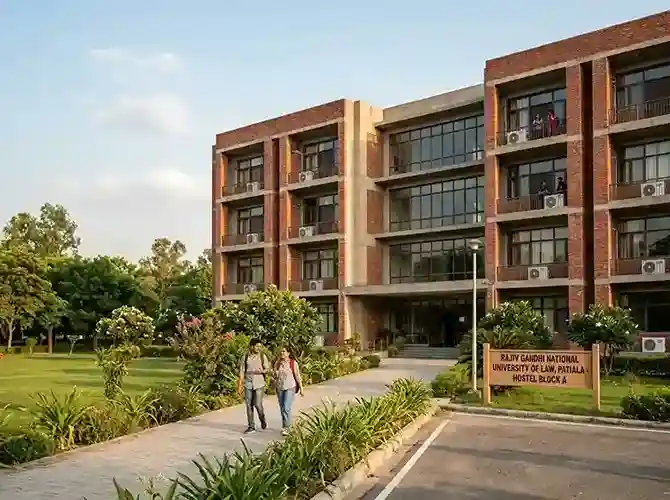
1. RGNUL Patiala Hostel Overview | Why It's the Best in the NLU System
Rajiv Gandhi National University of Law (RGNUL), Patiala is consistently cited by students, alumni, and educational reviewers as having the best hostel infrastructure in the entire National Law University system. This distinction rests on a single defining feature that no other NLU can claim: every single hostel room on campus is fully air-conditioned.
In a country where law school hostels range from basic shared rooms with fans to spartan dormitory-style accommodation, RGNUL's 11 purpose-built hostel blocks | each equipped with individual room ACs, modern bathrooms, round-the-clock housekeeping, and Wi-Fi | represent a genuine leap in student living standards. For students coming from Punjab, Haryana, Delhi, Rajasthan, and other hot-climate states, this infrastructure difference is practically transformative during the April–June summer period when temperatures in Patiala can touch 45°C.
The university was established in 2006 and its campus was designed from the ground up on 50 acres in the outskirts of Patiala city. Because the hostels were purpose-built rather than retrofitted to an older campus, they reflect modern design principles | larger room sizes, clean sanitation facilities, proper ventilation, and space for common areas | that older NLU campuses built in the 1990s and early 2000s often lack.
2. Hostel Buildings | Boys & Girls Block Details
RGNUL Patiala has 11 hostel blocks in total | 6 buildings designated for male students (boys' hostel) and 5 buildings designated for female students (girls' hostel). A 6th girls' hostel building was reported to be under construction to accommodate the growing student intake at the university.
Hostel rooms at RGNUL are allotted automatically upon admission | all enrolled students are provided hostel accommodation as the university follows a fully residential model. Students are allocated rooms based on their year of study: first to third year students share double occupancy rooms; fourth and fifth year students and LLM students receive single occupancy rooms. Students are given a 14-day window to request a room change if they have a specific need or concern | after which the initial allotment is considered final. This room-change provision is a thoughtful student welfare measure that acknowledges that initial random pairings may not always work out.
3. Room Types & Occupancy | Year-Wise Allocation at RGNUL
RGNUL follows a structured room allocation policy that rewards seniority with single occupancy rooms. Here is the exact breakdown:
| Student Category | Room Type | AC | Room Features |
|---|---|---|---|
| BA LLB Years 1, 2, 3 | Double Occupancy Shared with one roommate |
✅ Yes | Individual AC; study desks for both students; cupboards; window; adequate lighting; sensor-operated bathroom access on the floor |
| BA LLB Years 4 & 5 | Single Occupancy Private room |
✅ Yes | Individual AC; personal study space; cupboard; full privacy; ideal for moot court prep, internship applications, and focused studying |
| LLM Students | Single Occupancy Private room from day one |
✅ Yes | Single rooms for all LLM students from Year 1; recognises postgraduate maturity and need for independent study space |
| PhD Scholars | Single Occupancy (where available) | ✅ Yes | Research scholars given priority for single rooms; dissertation and academic work needs accommodated |
The structured transition from double occupancy (junior years) to single occupancy (senior years) is pedagogically deliberate. In the first three years, shared rooms build peer relationships, study partnerships, and community bonds essential to law school culture. By Year 4, when students are managing moot court finals, dissertation research, internship applications, and Bar Council preparation, the private room significantly reduces friction. LLM students get single rooms from day one because postgraduate study requires uninterrupted concentration from the start.
4. RGNUL Patiala Hostel Fees 2026 | Complete Breakdown
| Fee Component | Amount (Annual) | Semester Equivalent | Notes |
|---|---|---|---|
| Hostel Rent + Charges | ₹40,000 | ₹20,000 per semester | Includes double occupancy (Yr 1–3) or single occupancy (Yr 4–5 / LLM); AC, water, common area maintenance |
| Mess Advance | ₹40,000 | ₹20,000 per semester | Advance amount adjustable against actual mess bill; balance returned or carried forward each semester |
| Electricity (AC-related) | Variable (included or billed separately | verify at rgnul.ac.in) | Variable | AC electricity charges may be billed separately in some academic years | always verify at official RGNUL website |
| Refundable Security Deposit | One-time (on admission) | Refundable | Returned on departure from hostel in good condition; deductions for damage if any |
| Total Estimated Annual Hostel Cost | ~₹80,000 | ~₹40,000 per semester | Hostel rent + mess advance, excluding potential AC electricity charges |
* Fee data is approximate based on latest available information. Always verify current hostel fees at the official RGNUL website (rgnul.ac.in) before admission and each academic year.
At approximately ₹80,000 per year (hostel + mess), RGNUL's residential cost is among the lowest for an AC-equipped NLU hostel in India. Compare this to: private university hostels (₹2–3 Lakhs per year), Symbiosis Law School (₹2.76 Lakhs/year), JGLS Sonipat (₹2.76 Lakhs/year). The combination of fully air-conditioned rooms at ₹40,000/year is, in practical terms, a subsidised residential arrangement | the actual cost of maintaining 11 AC hostel buildings is far higher than what students pay.
5. Hostel Amenities at RGNUL Patiala | Complete List
Each of RGNUL's 11 hostel buildings is equipped with a range of student welfare amenities that go beyond simple room and board. Here is a comprehensive breakdown of what is available:
6. Mess Facilities at RGNUL Patiala | Food, Timings & Quality
The RGNUL mess is managed by a contracted caterer and provides four meals per day: breakfast, lunch, evening snacks/tea, and dinner. All students staying in the hostel are required to use the mess facilities, with the mess advance (₹40,000/year) adjustable against the actual bill.
| Meal | Typical Timing | Options Available |
|---|---|---|
| Breakfast | 7:30 AM – 9:00 AM | Paratha/poori/idli/upma, tea, coffee, juice; variety changes daily |
| Lunch | 12:30 PM – 2:30 PM | Dal, sabzi, rice, roti, salad, curd; both vegetarian and non-vegetarian options available |
| Evening Snacks / Tea | 5:00 PM – 6:30 PM | Samosa, sandwich, pakoda, biscuits, tea/coffee; light snacks with hot beverages |
| Dinner | 7:30 PM – 9:30 PM | Dal, sabzi, rice, roti, dessert on special days; similar structure to lunch with variation |
Students and alumni are consistent in their assessment of RGNUL's mess food: the quantity and variety are adequate to good (four meals a day with diverse options), but the quality is considered average compared to outside restaurants or home-cooked food. Some students note inconsistency in contractor performance. This is a common theme across NLU messes | food services managed by contractors rarely match home standards. Students with specific dietary requirements (medical, religious, or lifestyle) should connect with the RGNUL hostel warden well in advance to discuss accommodation.
Mess Billing: How the Adjustable Advance System Works
The ₹40,000 annual mess advance at RGNUL is an advance payment, not a fixed charge. Here is how it works in practice:
- Students pay ₹20,000 at the start of each semester as mess advance
- The actual mess bill is calculated based on daily mess usage | a rate per meal is charged for each day you actually eat in the mess
- At the end of each semester, the actual bill is reconciled against the advance paid
- If your actual consumption is lower than the advance, the balance is refunded or carried forward to the next semester
- If your actual consumption exceeds the advance, you are required to pay the difference
- Students who are away for extended periods (internships, family emergencies) can notify the mess in advance to avoid charges during absence
7. Sports & Recreation at RGNUL | Campus Facilities
RGNUL Patiala's sports and recreation infrastructure is a defining feature of student life on campus. The university has invested significantly in an Olympic-size sports complex and a full range of outdoor sporting facilities | all within walking distance of the hostel buildings.
Law school is intense | five years of continuous academic pressure, moot courts, seminars, internships, and competitive exams. Physical activity is not a luxury; it is a mental health necessity. RGNUL's investment in world-class sports facilities reflects an institutional understanding that holistic development | not just academic excellence | defines a great law education. Students who maintain an active sports routine through law school consistently report lower stress levels, better time management, and stronger peer bonds than those who do not.
8. Security, Rules & Hostel Management at RGNUL
RGNUL Patiala maintains a structured hostel management system with clearly defined rules, security protocols, and welfare measures to ensure a safe and productive residential environment for all students.
9. Campus Life & Day-to-Day Student Experience at RGNUL
Understanding hostel facilities is incomplete without understanding the quality of daily life they enable. Here is an honest picture of what a typical day looks like for an RGNUL hostel resident:
A Typical Weekday for an RGNUL Hostel Student
Most RGNUL students begin their day between 7:00–7:30 AM for breakfast at the mess. Morning classes typically run from 8:30 AM to 1:00 PM (roughly five periods). Lunch is in the mess between 12:30–2:30 PM. The afternoon is devoted to self-study in the air-conditioned hostel room or the hostel reading room, library research (RGNUL's library is one of Asia's largest single-subject law libraries | it stays open late during exams), moot court practice, and club activities. Evening sports or gym from 5:00–7:00 PM break the academic rhythm. Dinner at the mess (7:30–9:30 PM) is a social time, and evenings in the hostel common room with indoor games round out the day.
What Students Say About RGNUL Hostel Life
10. RGNUL Hostel vs Other NLU Hostels | Infrastructure Comparison
RGNUL's hostel consistently comes out on top when compared objectively to other NLU hostels. Here is a comparative assessment:
| NLU | Hostel Buildings | AC Rooms | Annual Hostel Fee | Student Review (Hostel) |
|---|---|---|---|---|
| RGNUL Patiala | 11 blocks (6M + 5F) | ✅ ALL Rooms AC | ₹40,000/yr | Consistently rated best hostel infrastructure in NLU system |
| NLSIU Bengaluru (#1 NLU) | Multiple blocks | Partial (fans in many rooms) | ₹60,000–80,000/yr (est.) | Older infrastructure; some rooms need upgrades |
| NALSAR Hyderabad (#3 NLU) | 8+ blocks | Partial | some AC rooms | ~₹1,10,000/yr (est.) | Good overall; Hyderabad heat without universal AC is a challenge |
| WBNUJS Kolkata (#4 NLU) | Multiple blocks | Partial | ₹40,000–60,000/yr (est.) | Urban campus; city location compensates for infrastructure gaps |
| GNLU Gandhinagar (#5 NLU) | Multiple blocks | Partial to good | ₹50,000–80,000/yr (est.) | Modern campus; comparable to RGNUL in some respects |
| HNLU Raipur (#22 NLU) | Multiple blocks | Partial (AC in some rooms) | ~₹60,000–90,000/yr (est.) | Newer campus; developing infrastructure |
* Other NLU hostel data is approximate and based on published student reviews, aggregated portal data. RGNUL data from official records. Fees and facilities at all NLUs are subject to change | verify at each university's official website.
RGNUL Patiala's hostel edge | 11 fully AC blocks at ₹40,000/year | is a genuine differentiator that matters for daily quality of life during a 5-year programme. When you're living in Patiala during summer or winter studying for semester exams, the comfort of an AC room at minimal cost is not trivial. For CLAT aspirants choosing between RGNUL (ranked #7 in CLAT preference, NIRF #24) and slightly higher-ranked NLUs with inferior hostel infrastructure, the hostel factor deserves serious weight in the decision. The campus is the second home you inhabit for five formative years | its quality shapes your daily experience, academic performance, and ultimately your professional formation.
11. Frequently Asked Questions | RGNUL Patiala Hostel
The annual hostel fee at RGNUL Patiala is ₹40,000 per year (₹20,000 per semester), which includes hostel rent and associated charges. This covers a double occupancy room (for Years 1–3) or single occupancy room (for Years 4–5 and LLM) | both fully air-conditioned. A separate mess advance of ₹40,000 per year is charged, adjustable against actual mess usage. Total estimated residential cost: approximately ₹80,000 per year. Always confirm the current fee structure at the official RGNUL website (rgnul.ac.in) as fees may be revised annually.
RGNUL Patiala has 11 hostel buildings in total | 6 buildings for male students (boys' hostels) and 5 buildings for female students (girls' hostels). All 11 hostel buildings are fully air-conditioned. A 6th girls' hostel block was reportedly under construction to accommodate the expanding student intake. Each hostel block has its own common room with indoor games, a reading room, and modern bathroom facilities.
Yes | every single hostel room at RGNUL Patiala is air-conditioned. This is RGNUL's most celebrated infrastructure achievement and the feature that most distinguishes it from other NLU hostels. Unlike many top NLUs where AC is available only in some rooms or blocks, RGNUL's fully AC hostel system covers all 11 buildings without exception. Given Punjab's extreme summer heat (temperatures reaching 45°C in May–June), this is a significant quality-of-life advantage.
RGNUL allocates hostel rooms based on year of study. BA LLB students in Years 1, 2, and 3 are given double occupancy rooms (shared with one roommate). BA LLB students in Years 4 and 5 and all LLM students receive single occupancy rooms. All rooms | both double and single | are air-conditioned. Students who are unsatisfied with their initial room allotment may request a room change within the first 14 days of joining. After this window, the initial allocation is finalised.
Yes. RGNUL Patiala follows a fully residential model | all enrolled students are expected to reside in the university's hostel facilities. The university does not support or facilitate off-campus private accommodation arrangements. In exceptional circumstances, senior students (Year 4–5) may be permitted to live off-campus with specific warden and administrative approval. The residential model is fundamental to the NLU experience: the community, peer learning, late-night study sessions, and campus culture that define law school education happen in and around the hostel.
The RGNUL campus is located on the outskirts of Patiala city, somewhat away from the main urban centre. Students note this as a minor inconvenience, particularly in the first few weeks of joining. However, the campus is essentially self-sufficient: a bank/ATM, grocery shops, fruit vendors, stationery shops, and a salon are all located within the campus facility zone. The campus's somewhat isolated nature is also an advantage | it creates a focused, distraction-free study environment that many students come to appreciate deeply by Year 2. Public transport and shared cabs to the city centre are readily available for weekend outings.