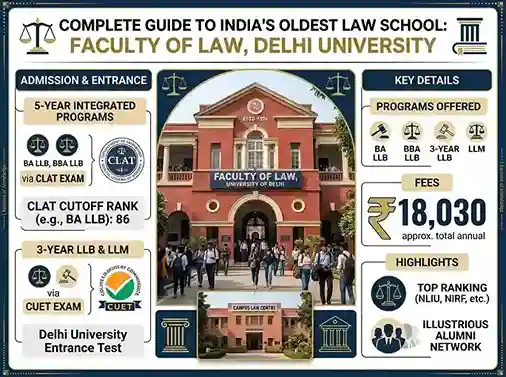
🏛 Faculty of Law DU Admissions 2026 | BA LLB & BBA LLB via CLAT | 3-yr LLB & LLM via CUET PG📅 CLAT 2027: Registration opens July 2026 | DU BA LLB 2025 Closing Rank: 86 (General)💰 India's Most Affordable Law School: 3-Year LLB at just ₹18,030 total | NAAC A+ Accredited🎓 Legacy: 100+ Years | IIRF Rank #7 | Alumni: CJI DY Chandrachud, Law Minister Kiren Rijiju
College Profile | Delhi University Law 2026NAAC A+ | Est. 1924Updated: May 2026
Faculty of Law, Delhi University 2026 | Admission, Courses, Fees, Cutoff, Ranking & Placements
India's oldest continuously operating law school — established in 1924 at the heart of the national capital. From the BA LLB via CLAT to the affordable ₹18,030 three-year LLB via CUET, this is the complete guide to everything you need to know about the Faculty of Law, University of Delhi — cutoffs, fees, campus life, legendary alumni, and honest assessment.
1924
Year Established
10,000+
Students Enrolled
₹18,030
LLB Full Course Fee
Rank 86
CLAT 2025 Closing (Gen)
IIRF #7
Law Ranking 2025
📅 Updated: May 28, 2026 | Faculty of Law DU — Complete Guide 2026
✍️ By Vikram Nair, LLM Delhi University | Senior Law Education Editor
🔍 Sources: lawfaculty.du.ac.in, NTA CUET, Consortium of NLUs, IIRF, NAAC
Faculty of Law, University of Delhi | India's Oldest Law School Since 1924 | Complete 2026 Guide | LawGuru India
⚡ Quick Overview: Faculty of Law Delhi University
The Faculty of Law, University of Delhi, established in 1924, is one of India's oldest and most prestigious law schools. It operates three centres — Campus Law Centre (CLC), Law Centre I (LC-I), and Law Centre II (LC-II) — with over 10,000 students enrolled. Admission to its 5-year BA LLB and BBA LLB (Hons.) is via CLAT (closing rank ~85–86 for General category in 2025); the 3-year LLB and LLM are via CUET PG (CLC UR cutoff ~213 in 2025). Fees are among India's lowest — just ₹18,030 for the full 3-year LLB. Alumni include Chief Justice of India Dr DY Chandrachud and law minister Kiren Rijiju.
🏛 Est. 1924 | NAAC A+📝 5-yr via CLAT | 3-yr via CUET💰 LLB Fee: ₹18,030 total🎓 10,000+ Students | IIRF Rank #7
Faculty of Law, DU — At a Glance
Full Name: Faculty of Law, University of Delhi
Established: 1924 | Type: Public / Central University
Accreditation: NAAC Grade A+ | Funded by UGC & Ministry of Education
1. About Faculty of Law Delhi University — History & Legacy
The Faculty of Law, University of Delhi is not merely a law school — it is a century-old institution that has shaped India's legal landscape. Established in 1924, it is one of the oldest continuously operating law faculties in India, predating the modern NLU system by six decades. Housed within the University of Delhi — itself one of Asia's premier universities — the Faculty of Law holds a unique position at the intersection of academic excellence, national prestige, and extraordinary affordability.
The faculty has been, in the words of its own website, a place that has produced "many legal luminaries, Supreme Court and High Court judges, leading advocates, political leaders, policy makers and trend-setters in all walks of life." From former Chief Justice of India Dr DY Chandrachud to sitting ministers, the alumni roster reads like a who's who of Indian public life. And yet — it is completely funded by UGC and the Ministry of Education, making it one of the few genuinely world-class law schools accessible to students of all economic backgrounds.
Today, the Faculty of Law operates across three centres — Campus Law Centre, Law Centre I, and Law Centre II — collectively enrolling over 10,000 students across LLB, LLM, and PhD programmes. Its North Campus location places it at the heart of Delhi's intellectual life, minutes from the Delhi High Court, the Supreme Court of India, and the country's most vibrant student community.
100+
Years of legal education legacy
3
Law Centres (CLC, LC-I, LC-II)
10,000+
Students enrolled currently
5
Programmes: LLB, LLM, PhD, BA LLB, BBA LLB
₹18,030
Complete 3-year LLB cost
2. The Three Law Centres — Understanding CLC, LC-I & LC-II
One of the most unique aspects of the Faculty of Law, Delhi University is its three-centre structure. Understanding the difference between Campus Law Centre, Law Centre I, and Law Centre II is crucial for CUET applicants who fill in institute preferences during counselling.
Campus Law Centre (CLC) Most Competitive
North Campus, DelhiCUET UR Cutoff: ~213LLB + LLM offered
Campus Law Centre is the flagship centre — the most sought-after and most competitive of the three. Located on the University of Delhi's main North Campus, CLC has the highest CUET cutoff (UR ~213 in Round 1, 2025). Classes at CLC run from 8 AM to 2 PM. CLC has the most active student societies, strongest alumni network, and is widely considered the most prestigious of the three centres. First-choice fill for most aspirants.
Law Centre I (LC-I) North Campus
North Campus, DelhiCUET UR Cutoff: ~188LLB + LLM offered
Law Centre I is also on the North Campus and offers the same LLB and LLM programmes as CLC. Classes at LC-I run from 1 PM to 7 PM, which suits students who prefer afternoon scheduling or have morning commitments. CUET UR cutoff in Round 1 (2025) was approximately 188 — lower than CLC, making it more accessible. LC-I has its own active moot court competition — the R.N. Mittal Memorial National Moot Court Competition is a flagship annual event.
Law Centre II (LC-II) South Campus
South Campus, DelhiCUET UR Cutoff: ~193LLB + LLM offered
Law Centre II is located on the South Campus of Delhi University — a different, quieter academic environment from the bustle of North Campus. CUET UR cutoff was approximately 193 in Round 1 (2025). For students seeking a calmer study environment while still accessing DU Law's faculty quality and brand, LC-II is an excellent option. The South Campus also hosts several other DU colleges like Lady Shri Ram, creating a rich interdisciplinary social environment.
✅ Choosing Between CLC, LC-I & LC-II
All three centres offer the same DU Law degree of identical academic value — there is no official distinction in the degree certificate. The differences are in CUET cutoff (CLC > LC-II > LC-I in 2025), timing (CLC: morning | LC-I: afternoon), and campus environment (North vs South Campus). During CUET counselling, always list your preference order carefully — you can list all three and get the best available. Most employers and the legal profession treat all three DU Law degrees equally.
3. Courses Offered at Faculty of Law Delhi University
The Faculty of Law offers five distinct programmes spanning undergraduate, postgraduate, and doctoral levels. Each has different eligibility, admission routes, and duration:
BA LLB (Hons.) — 5-Year Integrated Via CLAT
5 Years | 10 SemestersAdmission: CLATClosing Rank 2025: 86 (Gen)
The 5-year BA LLB (Hons.) integrates humanities and social science subjects with core law subjects. Admission is through CLAT, and the Faculty of Law is a participating institution in the CLAT counselling consortium. The 2025 closing rank was 86 for General category. Subjects include constitutional law, criminal law, contract law, family law, property law, international law, and jurisprudence alongside arts subjects. This is ideal for students coming straight from Class 12 with strong CLAT scores who want the complete integrated experience.
BBA LLB (Hons.) — 5-Year Integrated Via CLAT
5 Years | 10 SemestersAdmission: CLATClosing Rank 2025: 85 (Gen)
The 5-year BBA LLB (Hons.) integrates business administration with law — covering management, finance, and economics alongside core law subjects. Admission is via CLAT (closing rank 2025: 85 for General, 1 rank better than BA LLB). Ideal for students interested in corporate law, M&A, commercial litigation, and business law. The BBA LLB from DU gives the prestige of a Delhi University degree with a commerce-law combination at a fraction of the cost of private colleges offering similar programmes.
LLB — 3-Year Postgraduate Law Degree Via CUET PG
3 Years | 6 SemestersAdmission: CUET PGFee: ₹18,030 (complete)
The 3-year LLB is Delhi University's flagship postgraduate law programme — one of the most sought-after 3-year law degrees in India. It is open to graduates from any discipline with a minimum 50% aggregate. Admission is through CUET PG (paper code COQP11), with CLC cutoff around 213 for UR in 2025. The fee — just ₹18,030 for the complete 3-year course — is exceptional value. Mandatory internships include a lawyer, judge, law firm, and NGO posting. Classes are held at all three centres at different timings.
LLM — 2-Year & 3-Year Master of Laws Via CUET PG
2 or 3 YearsAdmission: CUET PGFee: ₹12,040 (complete)
DU offers both a 2-year and 3-year LLM. Admission is through CUET PG. The 2-year LLM 2025 cutoff for General category was 217 (Round 1) and 211 (Round 2). The LLM fee of ₹12,040 for the complete course is extraordinary — comparable programmes at private law schools cost ₹3–8 lakh. LLM specialisations include Constitutional Law, Criminal Law, Business Law, International Law, and Labour Law. The DU LLM degree carries significant weight in academia and senior law practice.
PhD (Doctor of Laws) Research Programme
3+ YearsAdmission: NET / PhD Entrance + Interview
The PhD programme at DU Faculty of Law is for advanced legal scholars pursuing original research. Admission requires an LLM from a recognised university plus a valid UGC-NET score (or clearing DU's PhD entrance exam) followed by an interview. Research areas span constitutional law, international law, criminal justice, family law, commercial law, and more. The DU PhD is nationally and internationally recognised, and PhD holders from DU's Faculty of Law are highly sought after for academic positions at law schools across India.
4. Fee Structure — Why DU Law is India's Best-Value Law School
The Faculty of Law, University of Delhi is entirely funded by UGC and the Ministry of Education, making its fees the lowest among any comparable law school in India. The contrast with private law colleges is stark:
Programme
Duration
Annual Fee
Total Course Fee
SC/ST Fee (Annual)
3-Year LLB
3 years
~₹6,010
₹18,030
~₹5,400/yr
LLM (2-Year)
2 years
~₹6,020
₹12,040
Marginally lower
LLM (3-Year)
3 years
~₹4,013
~₹12,040
Marginally lower
BA LLB (Hons.)
5 years
~₹1.9 lakh
~₹9.5 lakh
Reservation waiver available
BBA LLB (Hons.)
5 years
~₹1.9 lakh
~₹9.5 lakh
Reservation waiver available
ℹ️ Context: DU LLB vs Private Law School Fees
The 3-year LLB at DU costs ₹18,030 in total — less than what many private colleges charge as a single semester application fee. Symbiosis Law School charges ₹3–4 lakh per year; Jindal Global Law School charges ₹5–6.5 lakh per year. For a student securing a DU Law 3-year LLB at ₹18,030 and entering practice on the Delhi High Court, the return on investment is unmatched anywhere in Indian legal education. Additional costs to budget: examination fees (₹1,100–1,300/semester), registration fee (₹800), moot court fee (₹100), and accommodation (varies widely — DU hostel vs private PG).
5. Eligibility Criteria — Course-Wise
Programme
Minimum Qualification
Min. Marks (General)
Min. Marks (SC/ST)
BA LLB (Hons.) / BBA LLB (Hons.)
10+2 from any recognised board
45% aggregate
40% aggregate
3-Year LLB
Graduate from recognised university (any discipline)
50% aggregate
45% aggregate
LLM
LLB (3-year or 5-year) from recognised university
55% in LLB
50% in LLB
PhD
LLM from recognised university
55% in LLM + UGC-NET / DU PhD entrance
50% in LLM
6. Admission Process — CLAT & CUET Step-by-Step
The admission process differs significantly depending on which programme you are applying for. Here are the complete step-by-step processes for each route:
Route A: 5-Year BA LLB / BBA LLB via CLAT
1
Register & Appear for CLAT
Register on the Consortium of NLUs portal (consortiumofnlus.ac.in) when CLAT registration opens (expected July 2026 for CLAT 2027). Appear for the CLAT examination — 120 MCQs in 120 minutes covering English, Current Affairs, Legal Reasoning, Logical Reasoning, and Quantitative Techniques. Faculty of Law DU participates in CLAT counselling as a non-NLU institution. The 2025 closing rank was 85–86 for General category — target a rank within the top 75 for a safety buffer.
2
Register on DU's Admission Portal Using CLAT Application Number
After CLAT results are announced, visit Delhi University's admission portal (du.ac.in/admissions). Register using your CLAT Application Number — ensure the name and date of birth match exactly as on your CLAT form. Fill in personal details, stream, and category information accurately.
3
Fill Programme Preferences & Pay Application Fee
Select BA LLB (Hons.) or BBA LLB (Hons.) at Faculty of Law, University of Delhi as your programme preference. Pay the online application fee. You can also list multiple programmes and multiple DU departments — follow DU's specific instructions for inter-college preference allocation carefully.
DU releases merit lists / seat allotment based on CLAT score and DU's category-wise cut-offs. Multiple rounds are released. If allotted, complete document verification online and pay the semester fee to confirm your seat. Required documents: Class 10 & 12 certificates, CLAT admit card and scorecard, category certificate (if applicable), ID proof, medical certificate, and migration certificate.
Route B: 3-Year LLB / LLM via CUET PG
1
Register & Appear for CUET PG
Register on the NTA CUET PG portal (pgcuet.samarth.ac.in). For 3-year LLB, select paper code COQP11. The CUET PG Law paper consists of 75 questions (300 marks total) covering English, Mathematics/Reasoning, and Law subject knowledge. Eligibility: graduation with 50%+ marks for LLB; LLB with 55%+ for LLM. Application fee: approximately ₹800–1,000.
2
Register on DU Admission Portal with CUET Score
After CUET PG results are announced, visit du.ac.in/admissions and register. Use a valid email address — OTP verification is required. Fill in your CUET PG score, personal details, graduation marks (for LLB eligibility), and category. Submit all required documents in digital format.
3
Fill Centre Preferences (CLC / LC-I / LC-II)
This is the critical step for CUET LLB aspirants. Select your preference order among Campus Law Centre, Law Centre I, and Law Centre II. List all three in your preferred order (CLC first if you have a strong score). Allotment is based on CUET score and centre availability. Filling preferences carelessly can result in getting a lower-preference centre when you may have qualified for a higher one.
4
Counselling, Document Verification & Confirmation
DU releases multiple counselling rounds (typically 3 main rounds + spot rounds). Check the merit list after each round. If allotted, report online for document verification and pay the course fee to lock in your seat. In spot rounds, seats are allocated to fill remaining vacancies — don't give up if you miss the first rounds; DU has historically run 4+ spot rounds for LLB.
7. CLAT & CUET Cutoffs — 2025 Data & 2027 Targets
Here is the most current and detailed cutoff data for Faculty of Law, Delhi University across both admission routes:
CLAT 2025 Cutoff — Faculty of Law DU (5-Year Programmes)
Programme
Gen (UR)
OBC-NCL
SC
ST
BA LLB (Hons.)
86
78
70
61
BBA LLB (Hons.)
85
76
66
57
Note: These are CLAT 2025 Round 2 closing ranks (not scores). A lower number = more competitive (fewer people ahead of you).
CUET PG 2025 Cutoff — 3-Year LLB at DU (Out of 300)
Centre
UR Round 1
UR Round 2
OBC-NCL
SC
Campus Law Centre (CLC)
213
~205
~170
~120
Law Centre II (LC-II)
193
~183
~155
~105
Law Centre I (LC-I)
188
~178
~150
~100
CUET PG 2025 Cutoff — LLM at DU (Out of 300)
Programme
UR Round 1
UR Round 2
OBC Round 1
EWS Round 1
LLM 2-Year
217
211
~165
~200
LLM 3-Year
216
208
~160
~198
⚠️ What Score to Target for CUET LLB 2027 (CLC General)
Based on 2025 data and historical trend analysis, target a CUET PG score of 220+ out of 300 for a comfortable shot at Campus Law Centre (CLC) in the General category. For Law Centre II, 200+ should be sufficient; for LC-I, 195+ is the safe zone. Cutoffs typically move within a 5–8 mark range year on year. Higher scores also protect you in later rounds when seats from round 1 get redistributed through upgrades. The CUET PG paper (75 questions, 300 marks) requires approximately 72–75% accuracy to score in the 215–220 range.
8. Ranking — IIRF, Collegedunia & NAAC
Ranking Body
Rank / Score
Year
Category
IIRF (Indian Institutional Ranking Framework)
#7
2025
Law Colleges in India
IIRF
#9
2024
Law Colleges in India
Collegedunia
#9
2025
Law (Government Colleges)
NAAC Accreditation
Grade A+
Current
University-wide (University of Delhi)
NIRF
Inconsistent participation
2022–2025
The faculty has not consistently appeared in NIRF law rankings
ℹ️ The NIRF Paradox — Why DU Law Doesn't Always Rank Formally
The Faculty of Law's inconsistent NIRF participation is a much-discussed topic. Despite being one of India's most prestigious law schools with alumni at the Supreme Court and in Parliament, it has historically underperformed in formal rankings due to documented challenges: faculty shortages, infrastructure limitations, and administrative gaps. However, a critical distinction must be made: brand recognition and alumni network power, which drive actual career outcomes, far exceed what formal metrics capture. A DU Faculty of Law degree in 2026 continues to command enormous respect in courts, law firms, and the legal profession — particularly in Delhi. Rankings are one input; the DU Law alumni network is a powerful career asset that no ranking fully captures.
9. Faculty & Academic Environment
The Faculty of Law's academic strength lies in its teaching community — a blend of full-time academic professors and distinguished practitioners. Several unique features define the teaching environment:
👨⚖️ Retired Judges as Faculty
One of DU Law's most distinctive features is its tradition of having retired High Court and Supreme Court judges teach at the faculty. Former judges like Belu Gupta (an ex-judge who teaches at the faculty) bring genuine courtroom wisdom into the classroom — a type of legal mentorship that no textbook can replicate. Students consistently cite this as one of the most valuable aspects of their DU Law education.
👩🏫 Distinguished Academic Faculty
Senior faculty members include Professor Kamala Sankaran (Labour Law), Professor Usha Tandon, Professor Raman Mittal, Professor Vandana Bhandari, and Dean Professor Anju Vali Tikoo — all with extensive research and academic credentials. The faculty publishes the journal De'jure and hosts national seminars regularly, including events on emerging areas like Animal Law, prisoner rights, and technology law.
📚 Research & Policy Engagement
The Faculty actively engages in policy research and legal scholarship. Events like the Animal Law Cell seminar (March 2026), national conferences on constitutional law, and the R.N. Mittal Memorial Moot Court Competition (LC-I) signal a genuine research culture. The faculty also operates an Alumni Association that recently held its inaugural ceremony (February 2026), signalling growing institutional investment in alumni engagement.
⚠️ Known Challenge: Faculty Shortage
Students and observers have historically noted faculty shortages at DU Law — with over 10,000 students across three centres and limited full-time positions, student-to-teacher ratios are high. This is a structural challenge of large public universities. Prospective students should factor this in: DU Law rewards self-directed learners who maximise the brand name, alumni network, and Delhi's legal ecosystem — rather than expecting the small-cohort, faculty-intensive experience of a private law school.
10. Campus Life — The North Campus Advantage & Facilities
Campus Law Centre and Law Centre I are located on Delhi University's iconic North Campus — considered one of India's most vibrant university campuses. The North Campus advantage is a major factor in why DU Law offers an educational experience far beyond what its fee suggests.
🏛 Delhi Legal Ecosystem Access
North Campus is minutes from the Delhi High Court and 30 minutes from the Supreme Court of India. DU Law students have unparalleled access to court internships, senior advocate chambers, government legal offices, and policy institutions — all within the national capital. This proximity is the single greatest experiential advantage of studying at DU Law.
⚖️ Moot Court Room
A dedicated moot courtroom supports practical learning and competition practice. The LC-I Moot Court Society runs the R.N. Mittal Memorial National Moot Court Competition — a prestigious inter-college event. CLC also runs its own moot competitions. Moot court culture at DU Law is strong, and students regularly participate in national and international competitions.
📚 Library & Digital Resources
The faculty has a law library with access to legal journals, bare acts, and reference material. Students also benefit from DU Central Library — one of the largest university libraries in India. Digital access to SCC Online and Manupatra is increasingly available for academic research.
🎓 Student Life & Societies
DU Law's location on North Campus means students participate in the broader DU student culture — college festivals, student elections (Delhi University Students' Union elections are a highly contested annual event), and inter-college events across Miranda House, St. Stephen's, Hindu College and other iconic DU institutions. The Faculty has a Moot Court Society, legal aid clinic, and the Animal Law Cell.
🏥 Enabling Unit & Facilities
The Faculty has an Enabling Unit supporting differently-abled students with accessible ramps and disability-friendly infrastructure. Facilities include a canteen/cafeteria, communication centre, auditorium for seminars, security, and computer labs. Medical facilities are available through Delhi University's student health centre.
🌐 Multicultural, Pan-India Student Body
DU Law attracts students from every state in India — engineers, BCom graduates, science students, humanities students, and working professionals who choose the 3-year LLB. The diverse background of the student body (given that 3-year LLB is post-graduation) creates a uniquely enriching peer environment — understanding law from multiple disciplinary perspectives.
11. Placements & Internships — What to Realistically Expect
Placements at Faculty of Law, Delhi University are characteristically different from NLUs or premium private law schools. The faculty functions more as a gateway to Delhi's enormous legal market than as a structured placement institution. Honest assessment:
📊
Formal Placement Statistics
Placement & Internship Committee facilitation
Approximately 95 students were placed through formal channels with a median package of ₹6 LPA. The highest package recorded is ₹18 LPA. Around 10% of students secure placements through the college's Placement and Internship Committee. Notable recruiters include HDFC Bank, Hero Group, Wipro, and various law firms. These are conservative figures — the majority of DU Law graduates leverage Delhi's legal ecosystem and alumni network independently rather than through formal campus placements.
💼
Mandatory Internship Programme
4 structured internships across the 3-year LLB
All 3-year LLB students must complete at least 4 mandatory internships in their second and third years: (1) with a Lawyer/Advocate, (2) with a Judge, (3) with a Law Firm, and (4) with an NGO. These mandatory internships expose students to the full spectrum of legal practice — from courtroom work to transactional advisory to legal aid work. Given DU's location in Delhi, students have access to interning with the most senior advocates in the country and in the Supreme Court and Delhi High Court.
🏛
Alumni Network-Driven Career Outcomes
The real placement advantage of DU Law
DU Law's genuine career advantage is its alumni network — not formal placements. When your seniors include Chief Justices, Senior Advocates of the Supreme Court, and sitting ministers, the network for career references, internship introductions, and professional mentorship is profound. Students who actively leverage the DU alumni network during their studies — through the Alumni Association, moot competitions, and Bar Association connections — consistently secure better outcomes than the formal placement statistics suggest.
12. Notable Alumni — Legal Luminaries of DU Faculty of Law
The Faculty of Law, Delhi University has produced generations of India's most impactful legal and political figures. Its alumni roster is arguably its greatest asset:
DY
Justice Dr DY Chandrachud
50th Chief Justice of India (2022–2024) | Former Supreme Court Judge
The most prominent DU Law alumnus of the modern era, Dr DY Chandrachud served as Chief Justice of India before retiring in November 2024. His landmark judgments — Puttaswamy (Right to Privacy), Navtej Singh Johar (Section 377), and numerous others — reshaped Indian constitutional law. His DU Law education is a powerful symbol of the faculty's legacy of producing transformative legal minds.
KR
Kiren Rijiju
Union Minister of Earth Sciences | Former Minister of Law & Justice
Kiren Rijiju, who served as India's Law Minister, studied at the Faculty of Law, Delhi University. His career exemplifies the faculty's tradition of producing leaders at the intersection of law and public policy. As Law Minister, he was at the centre of many significant judicial reform discussions — including debates about the collegium system.
SC
Multiple Sitting & Former SC/HC Judges
Supreme Court of India | High Courts across India
The Faculty of Law's website documents its production of "many Supreme Court and High Court judges." Several sitting High Court judges — particularly in the Delhi High Court, Allahabad High Court, and Bombay High Court — are DU Law alumni. This judicial alumni network creates an unmatched mentorship pipeline for students interested in judiciary careers.
SA
Eminent Senior Advocates
Senior Advocates of the Supreme Court | Leading Constitutional and Criminal Lawyers
Numerous Senior Advocates of the Supreme Court of India — the highest formal recognition in the Indian Bar — studied at the Faculty of Law, DU. Their proximity to the North Campus during their studies, and the Supreme Court and Delhi HC later in their careers, is a direct reflection of DU Law's strategic positioning within Delhi's legal geography.
EP
Saurav Rana & Belu Gupta (Former Judge, Now Faculty)
Alumni who returned to teach — Former Judge & Current Faculty Member
In a remarkable reflection of institutional loyalty, former judge Belu Gupta (frequently mentioned in student reviews) and other practitioners have returned to the faculty as teachers. This "alumni-as-faculty" tradition is one of DU Law's most powerful academic assets — students learn from those who have actually sat on the bench.
13. Honest Assessment — Pros & Cons of DU Faculty of Law
✅ Strong Arguments FOR DU Law
100+ year legacy — India's oldest law faculty with unmatched historical prestige
Alumni network: CJIs, ministers, SC/HC judges — extraordinarily powerful for career mentorship
Lowest fees in India: ₹18,030 for complete 3-year LLB — unbeatable ROI
Delhi location = direct access to SC, Delhi HC, senior advocate chambers
Retired judges as faculty — rare and invaluable courtroom wisdom in classroom
North Campus environment — vibrant student life, interdisciplinary peer learning
NAAC A+ accreditation — University of Delhi's overall academic quality assurance
Government-funded: no commercial pressures, genuine academic focus
⚠️ Honest Limitations to Know
Faculty shortage: 10,000+ students, limited full-time faculty — high student-teacher ratio
Inconsistent NIRF ranking participation — affects formal national visibility
Infrastructure gaps: students note administrative challenges and learning process irregularities
Self-directed learning essential — not suited for students who need structured hand-holding
Competition is intense: CLAT rank 85–86 / CUET 213+ required — not easy to get in
CLC (most prestigious centre) fills quickly — others have lower cutoffs but same degree
✅ The Bottom Line: Is DU Faculty of Law Right for You?
DU Faculty of Law is exceptional for self-driven students who actively leverage Delhi's legal ecosystem. If you secure admission (CLAT top-86 or CUET 213+ for CLC), attend consistently, secure strong internships at the Delhi HC and SC, participate in moot courts, and build your alumni network — your DU Law degree will open doors that credentials from significantly more expensive schools cannot match. The key is active agency. DU Law does not spoon-feed outcomes; it provides the platform and the brand. What you build on it is your own.
14. How to Prepare for DU Law Admission — CLAT & CUET Strategy
CLAT 2027 is passage-based — 40 questions each for Legal Reasoning and English/Reading Comprehension. For DU's closing rank of 85–86, you need a CLAT score in the top 0.1% of approximately 70,000–80,000 candidates. Read 3–4 editorials daily from The Hindu and Indian Express. Practice CLAT legal passages from official mock tests and previous papers. Target 35+ correct in each of Legal Reasoning and English sections. Current Affairs (30 questions) must be contemporary and legally relevant — follow Bar & Bench, LiveLaw, and The Hindu Law section.
📊 CUET PG LLB Strategy (3-Year LLB / LLM)
CUET PG Law paper: 75 questions, 300 marks (4 marks each correct; -1 wrong). Target 70+ correct answers (280+ marks) for CLC. The paper covers: Legal Knowledge (constitutional provisions, important cases, bare act concepts), Language/English (comprehension, grammar), and Reasoning. For legal knowledge: focus on Constitution of India, Indian Contract Act, IPC/BNS basics, CPC fundamentals, and landmark Supreme Court cases. Use DU CUET PG LLB previous year papers from 2022–2025 as the core practice resource. Coaching institutes like LegalEdge and KG Law Institute offer CUET LLB-specific courses.
📅 Timeline — 6-Month Preparation Plan
Months 1–2: Build foundational reading habits (daily newspaper), start CUET/CLAT concept study (legal reasoning, reasoning, English). Months 3–4: Topic-wise practice — 30 questions per day on legal reasoning and comprehension. Start constitutional law and Contract Act for CUET. Month 5: Full mock tests — 2 mocks per week. Detailed analysis of every wrong answer. Month 6: Intensive mock practice (4+ per week), revision of current affairs, and centre preference strategy for CUET counselling. Aim: CUET 210+ for a safe shot at all three centres.
15. Frequently Asked Questions — Faculty of Law Delhi University 2026
All three centres — Campus Law Centre (CLC), Law Centre I (LC-I), and Law Centre II (LC-II) — are part of the Faculty of Law, University of Delhi and award the same DU LLB degree of identical academic value. The differences are: CLC is on North Campus, has morning classes (8 AM–2 PM), and has the highest CUET cutoff (~213 UR in 2025) — it is the most prestigious centre by reputation. LC-I is also on North Campus with afternoon classes (1 PM–7 PM) and a lower cutoff (~188). LC-II is on South Campus with a cutoff of approximately 193. Employers and the legal profession treat all three DU Law degrees equally — the centre name does not appear on the degree.
This is one of the most debated questions in Indian legal education. The honest answer: it depends on the NLU and the career path. For top-5 NLUs (NLSIU, NLU Delhi, NALSAR, WBNUJS, GNLU), the NLU degree typically has an edge in formal placements, structured curriculum, and peer quality due to the residential NLU environment and smaller class sizes. However, the DU 3-year LLB is significantly more affordable (₹18,030 vs ₹10–15 lakh at NLUs), provides unmatched access to Delhi's legal ecosystem (SC, DHC, senior advocates), has a more powerful alumni network in certain judicial and policy circles, and is a perfectly valid path to a distinguished legal career. Many Senior Advocates, HC judges, and government law officers are DU LLB graduates. The DU degree is a strong choice for students who specifically want to build a Delhi-based practice, are cost-conscious, or are older graduates transitioning into law.
Yes — and you should. CLAT applies only to the 5-year BA LLB and BBA LLB (Hons.) at DU. CUET PG applies to the 3-year LLB and LLM. These are completely separate entrance exams for different programmes. If you are appearing for Class 12 and aspire to the 5-year programme, prepare for CLAT (December 2026 for 2027 admission). If you have already completed graduation and want the 3-year LLB, prepare for CUET PG (typically held in February–March). There is no bar on appearing for both if you are appearing in Class 12 and also hold a graduation degree (unlikely but technically possible).
The Faculty of Law, Delhi University has over 2,500 seats across its three centres (Campus Law Centre, Law Centre I, and Law Centre II) combined for the 3-year LLB programme. This makes it one of the largest law programmes in India by seat count. Seats are distributed category-wise as per central government reservation norms. Despite the large total seat count, competition remains intense for General category students at the more prestigious Campus Law Centre, where the UR cutoff was 213 (out of 300) in Round 1 of CUET PG 2025.
Class timings at the three centres are: Campus Law Centre — 8 AM to 2 PM (morning batch); Law Centre I — 1 PM to 7 PM (afternoon/evening batch); Law Centre II — timings vary but generally similar to CLC morning schedule. The afternoon timing at LC-I is a significant practical advantage for working professionals or those managing other commitments alongside their LLB. Many DU Law LLB students are graduates who work part-time — the 6-hour class schedule at a single centre gives enough remaining time for internship and self-study.
Yes — the University of Delhi has hostel facilities available through the university's central accommodation system, though hostel seats are limited and competed for. Students at CLC and LC-I (North Campus) can apply for hostel accommodation at DU's North Campus hostels. Most students who do not get hostel accommodation find PG accommodation (paying guest) in the areas surrounding North Campus (Kamla Nagar, Mukherjee Nagar, Hudson Lane) at reasonable rates. The North Campus area is very student-friendly with affordable accommodation options.
The DU LLM (2-year or 3-year) is one of India's most respected postgraduate law degrees for academic careers in law. Faculty positions at NLUs, state law universities, and private law schools regularly see DU LLM graduates being appointed — particularly with NET/JRF qualifications. The DU LLM fee of just ₹12,040 (complete) makes it an extraordinary value proposition. Specialisations include Constitutional Law, Criminal Law, Business Law, International Law, and Labour Law. For those who want to pursue an academic law career or research-oriented practice, the DU LLM followed by a DU PhD is one of the strongest possible credential combinations at a tiny fraction of the cost of private LLM programmes.
Aiming for Faculty of Law, Delhi University? Start Preparing Now.
A CLAT rank of 85 or a CUET score of 213+ is your gateway to one of India's most prestigious law schools at just ₹18,030. Use LawGuru India's free resources to maximise your chances in 2027.