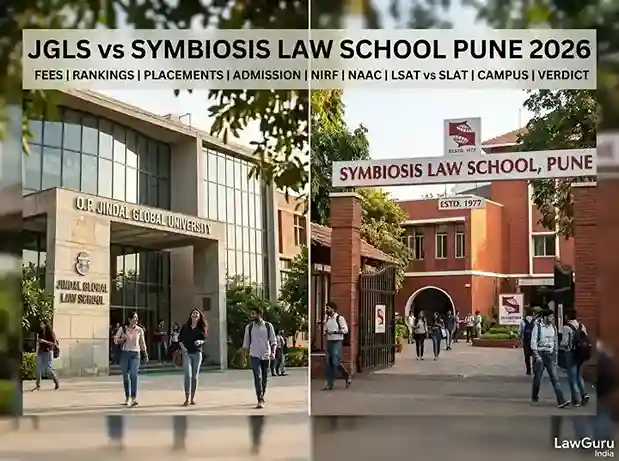
JGLS wins 7 of 12 comparison rounds | SLS Pune wins 5 of 12 | Scroll through each section for the full breakdown
1. Overview | Who Are JGLS and SLS Pune?
The choice between Jindal Global Law School (JGLS) and Symbiosis Law School Pune (SLS Pune) is one of the most commonly debated decisions in Indian private law school admissions | and for good reason. Both schools sit consecutively in the NIRF Law Rankings (JGLS at #6, SLS Pune at #7 in 2025), both attract Tier-1 law firm recruiters, and both offer the prestige of a private university law education. Yet they are fundamentally different institutions with different philosophies, price points, admission routes, and student profiles.
Jindal Global Law School (JGLS) was established in 2009 as a constituent school of OP Jindal Global University (JGU) in Sonipat, Haryana | approximately 40 km from Delhi. In just 16 years, JGLS has built a remarkable global profile: it is India's only QS World-ranked law school (Top 150 globally), holds the highest NAAC grade of A++, and has 300+ international academic partnerships including arrangements with Yale Law School, Harvard Law School, New York University School of Law, and University College London. JGLS is deliberately modelled on elite global law schools | with a research-intensive faculty, an international curriculum, and a strong emphasis on global legal exposure.
Symbiosis Law School Pune (SLS Pune) is one of India's oldest private law institutions | established in 1977 under the Symbiosis International (Deemed University) umbrella. With 48 years of legacy and an NIRF Rank of #7, SLS Pune is consistently among India's top 10 law schools and is the flagship campus of four Symbiosis Law Schools spread across Pune, Noida, Hyderabad, and Nagpur. Symbiosis has built its reputation on a rigorous academic foundation, an active moot court culture, strong corporate law placements, and a fee structure that | while premium for a private institution | remains significantly more affordable than JGLS.
2. Rankings | NIRF, NAAC & Global Recognition
NIRF Law 2025: #6 | Score: ~76
NAAC: A++ (Highest Available)
QS World: Top 150 Law Schools Globally (2025)
Times Higher Education: Recognised
India Today & Outlook: Consistently Top 5 Private
Rankings
NIRF Law 2025: #7 | Score: 74.07
NAAC: A
QS: Not currently globally ranked
India Today & Outlook: Consistently Top 10
Collegedunia 2025: #5 Law
| Ranking Body | JGLS | SLS Pune | Edge |
|---|---|---|---|
| NIRF Law 2025 | #6 | #7 | JGLS (slight) |
| NAAC Grade | A++ | A | JGLS (clear) |
| QS World (Law) | Top 150 Globally | Not ranked | JGLS (significant) |
| NIRF Overall University | #25 (JGU) | #26 (SIU) | Essentially tied |
| BCI Recognition | ✓ Permanent | ✓ Permanent | Tie |
| UGC Recognition | ✓ Deemed University | ✓ Deemed University | Tie |
| Legacy / Years of Operation | 16 years (est. 2009) | 48 years (est. 1977) | SLS Pune |
JGLS holds a clear edge in formal rankings | NAAC A++ vs A, QS World-ranked vs unranked, NIRF #6 vs #7. For students who prioritise formal ranking credentials (especially for international opportunities or foreign employer recognition), JGLS is the stronger choice. However, SLS Pune's 48-year legacy creates a deep alumni network that is older and in more senior positions across Indian law firms and corporate legal departments than JGLS's 16-year-old network. Rankings matter, but so does the age and depth of alumni influence in the Indian legal market.
3. Fee Structure | Tuition, Hostel & Total 5-Year Cost
BA LLB / BBA LLB: ₹7,00,000/yr
BCom LLB / LLB (3-yr): ₹7,00,000/yr
LLM: ₹5,00,000/yr
Residential: ₹3,10,000/yr
5-Year All-In: ~₹50–52 Lakh
Fees
BA LLB / BBA LLB: ₹4,78,000/yr
LLB (3-yr): ₹2,39,000/yr
LLM: ₹1,25,000/yr (per semester)
Hostel + Mess: ~₹1.2–1.5L/yr
5-Year All-In: ~₹29–33 Lakh
| Fee Component | JGLS (Per Year) | SLS Pune (Per Year) |
|---|---|---|
| Tuition | BA LLB / BBA LLB | ₹7,00,000 | ₹4,78,000 |
| Residential / Hostel Fees | ₹3,10,000 (mandatory on-campus) | ₹1,20,000–₹1,50,000 (approx.) |
| Mess / Food | Included in residential | ₹40,000–₹55,000 (approx.) |
| Other Academic Fees | ₹20,000–₹40,000 | ₹10,000–₹20,000 |
| All-Inclusive Annual Cost | ~₹10,30,000–₹10,50,000 | ~₹6,48,000–₹7,03,000 |
| 5-Year Total (All-Inclusive) | ~₹50–52 Lakh | ~₹29–33 Lakh |
| LLM (1-Year) | ₹5,00,000 | ₹2,50,000 (both semesters) |
Both JGLS and SLS Pune apply an annual fee increase. JGLS's programme fee and residential fee are subject to an annual increase of up to 10% as per official information | meaning your actual 5-year cost could be significantly higher than the first-year fee multiplied by five. SLS Pune also applies incremental fee revisions. Always obtain the official current fee schedule from the respective institution's admissions office before finalising your decision, and factor in the escalation into your financial planning.
4. Admission Process | LSAT/JSAT vs SLAT+PI
Primary: LSAT-India (by LSAC, USA)
Also accepts: JSAT-Law, CLAT UG, CUET-UG
Two-stage: Application → LSAT/JSAT Score → Shortlist → GD/PI (select programmes)
Eligibility: Class 12 with 45% (Gen) | No age bar
Application Fee: ₹3,799
Admission
Primary: SLAT (Symbiosis Law Admission Test)
SLAT: 60 MCQs, 60 mins, CBT, No negative marking
Two-stage: SLAT Score (50%) + Personal Interview (50%)
Eligibility: Class 12 with 45% (Gen) | No age bar
SLAT Cutoff (Gen): 44–48 marks (out of 60)
SLAT Fee: ₹2,250 + ₹1,000/programme
| Parameter | JGLS | SLS Pune |
|---|---|---|
| Primary Entrance | LSAT-India / JSAT-Law | SLAT (Symbiosis Law Admission Test) |
| Other Tests Accepted | CLAT UG, CUET-UG (select programmes) | SLAT only for 5-year programmes |
| Exam Format | LSAT: Logical, Analytical & Reading Sections | JSAT: Similar format | 60 MCQs | 5 sections × 12 Qs | No negative marking |
| Interview / PI Round | PI for select rounds; not mandatory for all | Mandatory PI carries 50% of final selection weightage |
| 2026 Cutoff (approx.) | LSAT Percentile: 70th+ | JSAT: 70+ score | SLAT Score: 44–48/60 (General category) |
| Application Fee | ~₹3,799 | ₹2,250 (SLAT) + ₹1,000/programme |
| Class 12 Eligibility | 45% (Gen/OBC) | 40% (SC/ST) | 45% (Gen/OBC) | 40% (SC/ST) |
| Total Seats (5-Yr UG) | ~240–300 (all UG programmes) | 240 (120 BA LLB + 120 BBA LLB) |
Unlike JGLS where the written test (LSAT/JSAT) effectively determines admission, SLS Pune's Personal Interview carries equal weight (50%) to the SLAT score. Many applicants with high SLAT scores fail to convert at SLS Pune due to poor PI preparation. The PI typically covers: legal awareness, current affairs, career motivation, why law, why Symbiosis, and your thoughts on a contemporary legal issue. Strong PI preparation | ideally with a structured mock PI | is indispensable for SLS Pune admission.
5. Courses & Programmes Offered
| Programme | JGLS | SLS Pune |
|---|---|---|
| 5-Year Integrated UG Law | BA LLB (Hons.) | BBA LLB (Hons.) | BCom LLB (Hons.) | BA LLB (Hons.) | BBA LLB (Hons.) |
| 3-Year LLB | LLB (Hons.) | Post-Graduation | LLB (3-Year) | Post-Graduation |
| LLM | 1-Year LLM | Multiple specialisations | 1-Year LLM | AIAT-based admission |
| PhD in Law | Yes | Research Programme | Yes | Research Programme |
| Unique to Institution | BCom LLB (unusual combination) | Dual degree with international partner schools | BBA LLB (one of the most popular BBA+Law programmes in India) |
| LLM Specialisations | International Law, Corporate Law, Constitutional Law, IP Law, Criminal Justice | Corporate Law, Constitutional Law, Criminal Law, IP Law, International Law |
| 5-Year UG Total Seats | ~240–300 (approximate) | 240 (120+120) |
Both schools offer the standard 5-year integrated law programmes (BA LLB and BBA LLB) and LLM. JGLS has a slight course portfolio advantage with its BCom LLB | an unusual combination suited to students who want deep commerce integration with law, ideal for tax law, financial regulation, and banking law careers. SLS Pune's BBA LLB is arguably the most well-known BBA+Law combination in India, benefiting from the long history of the programme and the Symbiosis brand recognition in the management education space.
6. Placements | Salary, Top Recruiters & Statistics
Highest Package: ₹24 LPA
Average Package: ~₹14 LPA
Day Zero PPOs: 26 PPOs (2023)
103 offers in 2023 placement cycle
77 accepted job offers
Strong international firm access
Placements
Highest Package: ₹22 LPA
Median UG Salary (NIRF 2025): ₹18 LPA
278 placed out of 297 (NIRF 2025)
Average: ₹13.31 LPA
Lowest: ₹6.5 LPA
98% placement rate in recent cycles
| Placement Metric | JGLS | SLS Pune |
|---|---|---|
| Highest Package | ₹24 LPA | ₹22 LPA |
| Average Package | ~₹14 LPA (reported) | ₹13.31 LPA (reported) |
| Median UG Salary (NIRF 2025) | ~₹14 LPA (estimated) | ₹18 LPA |
| Total Students Placed (Latest) | 103 offers (2023 data); 77 accepted | 278 placed of 297 graduating (NIRF 2025) |
| Day Zero / PPO | 26 PPOs (2023) | PPO culture exists; specific numbers not publicly disclosed |
| Placement Rate | ~94% (estimated) | ~94% (278/297 per NIRF 2025) |
| LLM Median Salary | Not publicly disclosed | ₹12 LPA (NIRF 2025) |
Top Recruiters | Common to Both JGLS and SLS Pune
7. Campus, Infrastructure & Location
Location: Sonipat, Haryana (NCR) | 40 km from Delhi
Campus Type: Integrated multi-faculty global university campus
Campus Size: ~100 acres
Facilities: Smart classrooms, multiple moot courts, extensive law library, legal aid clinic, career centre, student housing (mandatory residential), international collaborations centre
City: Sonipat | proximity to Delhi NCR's legal/corporate ecosystem
Campus
Location: Viman Nagar, Pune, Maharashtra
Campus Type: Law school campus within SIU ecosystem
Facilities: Moot court hall, law library (SCC Online, Manupatra access), legal aid clinic, seminar rooms, hostels
City Advantage: Pune | India's fastest-growing legal + corporate market; proximity to Bombay HC jurisdiction; excellent quality of life, lower cost than Mumbai/Delhi
Note: Hostel accommodation not guaranteed for all students
Both campuses are well-equipped for legal education. JGLS has a clear edge in sheer scale of infrastructure | the JGU campus is larger, newer, and designed to international law school standards. The mandatory on-campus residential model at JGLS creates a tight-knit community and 24/7 academic environment. SLS Pune, situated in Pune's Viman Nagar locality, benefits from its proximity to a thriving city with a growing legal and corporate presence, lower cost of living than Delhi, and easy metro connectivity.
8. Faculty & Academic Culture
300+ full-time and visiting faculty
Many hold PhDs from international institutions (Yale, Harvard, LSE, Oxford, Cambridge)
Significant proportion of foreign faculty and visiting international professors
Heavy research publication output | peer-reviewed journals
Teaching: Socratic method, seminar-style, global case-based learning
Strong clinical legal education under BCI norms + beyond
Faculty
Experienced faculty with decades of specialisation
PhDs from Indian and select international universities
Strong practitioner faculty | experienced advocates and corporate counsels as visiting faculty
Teaching: Case method, moot courts, seminars, clinical legal education
NUJS Law Review equivalent | SLS publications
Strong mentorship culture given smaller faculty-student ratio
9. International Exposure | A Key Differentiator
300+ international university tie-ups
Partnership MOUs with: Yale Law School, NYU Law, Harvard Law (research collaboration), UCL, NUS, Melbourne
Law firm MOUs: White & Case, Economic Laws Practice, Luthra Law Offices
Semester exchange programmes abroad
Dual degree opportunities
Regular visiting international faculty
Summer schools at partner universities
Strongest global exposure of any Indian private law school
Global
50+ international collaborations
International moot court participation (Jessup, Vis, etc.)
SIU has tie-ups with universities in Europe, USA, and Southeast Asia
Exchange programmes available but less extensive
Strong participation in international moot court competitions
Limited dual-degree options compared to JGLS
For students who aspire to international legal careers | international law firms, international organisations, LLM abroad, UN agencies, global think tanks | JGLS's international exposure advantage is decisive. The 300+ tie-ups, regular visiting international faculty, semester exchange options, and established relationships with global law firms (White & Case, etc.) provide a level of global integration that no other Indian law school | public or private | can match. If your career vision is domestic Indian corporate law, this advantage matters less. If it includes any international dimension, JGLS's edge here is significant.
10. Scholarships & Financial Aid
| Scholarship Type | JGLS | SLS Pune |
|---|---|---|
| Merit-Based Scholarships | Yes | based on LSAT/JSAT percentile and academic record; percentage of fee waiver varies | Yes | merit scholarships for top SLAT scorers |
| Need-Based / EWS | Merit-cum-means available; subject to parental ITR criteria | Freeships for EWS and SC/ST; state government scholarships applicable |
| Sports / Cultural Scholarships | Available for outstanding achievers | Available under SIU norms |
| Government Scholarships | Post-Matric, Dr. Ambedkar, Inspire applicable for eligible students | Post-Matric, Dr. Ambedkar, state-level scholarships applicable |
| Scholarship Transparency | Publishes scholarship criteria; apply separately at admissions | Partial disclosure; apply at admissions office |
11. Round-by-Round Comparison | 12 Parameters
NIRF #6 | NAAC A++ | QS Global Ranked
Rankings
NIRF #7 | NAAC A | No QS rank
₹7L/yr tuition | ₹50–52L 5-yr total
Fee Value
₹4.78L/yr tuition | ₹29–33L 5-yr total
Highest ₹24 LPA | Avg ~₹14 LPA | 26 PPOs Day Zero
Placements
Highest ₹22 LPA | Median ₹18 LPA | 94% placed
300+ global tie-ups | Yale, Harvard, NYU, UCL | International firm MOUs
Global Reach
50+ collaborations | Good but not comparable to JGLS
Large, modern integrated campus | Mandatory residential | Smart facilities
Infrastructure
Functional, established campus | Good facilities | Hostel not guaranteed
300+ faculty | Many international PhDs | Heavy research output
Faculty
Experienced faculty | Strong practitioners | Good research but less global
16 years old (est. 2009) | Growing but newer network
Legacy
48 years (est. 1977) | Deep alumni in senior positions across India
Sonipat (NCR) | good corporate access but suburban location
Location
Pune | vibrant city, lower cost of living, quality lifestyle, Bombay HC proximity
BCom LLB (unique) | Broader course portfolio | Dual degree options
Courses
BBA LLB (strongest in India) | BA LLB | Standard range
Merit-cum-means scholarships | LSAT-based waivers
Scholarships
Better baseline fee + comparable scholarship access = better net affordability
LSAT/JSAT | international standard test | Also accepts CLAT
Admission
SLAT + PI | manageable but PI dependency adds uncertainty
~₹50–52L total cost | High absolute; some scholarship relief
ROI
~₹29–33L total | ₹18 LPA median salary (NIRF 2025) | Strong ROI ratio
12. Verdict | Which Law School Is Right for You?
The JGLS vs Symbiosis Law School comparison does not have a single "winner" | it has a right answer for each student profile. The 12-round analysis gives JGLS a 7–5 edge on formal metrics, but the financial gap of ₹17–20 lakh over five years is a material factor that can shift the calculus significantly depending on your family's financial position and your specific career goals. Here is the verdict broken down by student profile:
13. Frequently Asked Questions | JGLS vs Symbiosis Law School 2026
For domestic corporate law placements, JGLS and SLS Pune are essentially on par. Both place students regularly at Tier-1 Indian law firms (Cyril Amarchand Mangaldas, AZB & Partners, Khaitan & Co, Trilegal, Shardul Amarchand Mangaldas). JGLS has a slight edge in highest packages (₹24 LPA vs ₹22 LPA) and Day Zero PPO culture. However, SLS Pune's NIRF 2025 median UG salary (₹18 LPA) is actually higher than JGLS's reported average (₹14 LPA), suggesting SLS places a larger proportion of its student cohort at competitive salaries. For international corporate law (Magic Circle firms, global in-house roles), JGLS's 300+ international tie-ups and QS World ranking give it a significant edge. The bottom line for domestic corporate law: both schools are excellent, and JGLS costs ~₹17–20 lakh more for broadly similar outcomes.
The all-inclusive 5-year cost (tuition + hostel/residential + mess + other fees) is approximately ₹50–52 lakh at JGLS and approximately ₹29–33 lakh at SLS Pune. The difference is ₹17–20 lakh over five years. At JGLS, the annual tuition is ₹7 lakh plus mandatory residential fee of ₹3.10 lakh | approximately ₹10.1 lakh per year excluding personal expenses. At SLS Pune, the annual tuition is ₹4.78 lakh plus hostel/mess of approximately ₹1.6–2 lakh | approximately ₹6.4–6.8 lakh per year. Both institutions apply annual fee increases (up to 10% at JGLS) | factor this into 5-year budgets. Always verify exact fee schedules with the respective institutions' official admissions offices before budgeting.
The admission difficulty is roughly comparable, but the nature of the challenge differs. For JGLS, you need a strong LSAT-India percentile (typically 70th+ percentile for admission to the BA LLB/BBA LLB programmes) or a competitive JSAT-Law score. JGLS also accepts CLAT UG and CUET-UG for select programmes. For SLS Pune, you need SLAT score of 44–48/60 (General category) plus a strong Personal Interview that carries 50% of final selection weight. Many students find the SLAT exam relatively approachable (60 questions, no negative marking, 60 minutes), but the mandatory PI adds a significant additional preparation requirement. Students who are strong test-takers but less confident in interviews may find JGLS's LSAT-based process more predictable. Students who are confident speakers may find SLS Pune's SLAT+PI route advantageous.
Yes, both institutions offer scholarships, but the scale varies significantly. At JGLS, merit scholarships are available based on LSAT/JSAT percentile and academic record | merit-cum-means scholarships also apply subject to parental income criteria. Top LSAT performers can receive meaningful fee waivers. At SLS Pune / SIU, merit scholarships for top SLAT scorers, post-matric and government scholarships for reserved category students, and EWS freeships are available. The key consideration is that even with comparable scholarship percentages, the baseline fee at SLS Pune is lower | so the net fee after scholarships will almost always be lower at SLS Pune than at JGLS. Contact the admissions office of each institution and specifically ask about scholarship quantum available for your academic profile before making your decision.
JGLS (NIRF #6) and SLS Pune (NIRF #7) sit just below the top five NLUs (NLSIU Bangalore #1, NLU Delhi #2, NALSAR Hyderabad #3, WBNUJS Kolkata #4, NLU Jodhpur #5) in the NIRF Law Rankings. Top NLUs generally have stronger constitutional law and litigation career tracks, lower fees (being government-funded), and older alumni networks. However, JGLS surpasses most mid-tier NLUs in international exposure and global rankings | no NLU other than NLSIU has a QS World ranking comparable to JGLS. For domestic corporate law, JGLS is genuinely competitive with the middle-tier NLUs (ranks 6–15 NLUs). If you receive a CLAT rank good enough for a top-5 NLU, choose an NLU. If your rank allows only mid-tier NLUs, JGLS is a serious alternative | especially if international exposure matters to you.