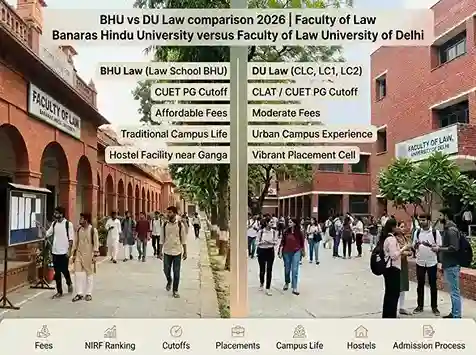
1. Overview | Faculty of Law BHU vs Faculty of Law DU
When law aspirants ask "BHU or DU for law?", they are weighing two very different institutional identities, campus ecosystems, and career trajectories | not just rankings and fees. Both the Faculty of Law at Banaras Hindu University (BHU) and the Faculty of Law at the University of Delhi (DU) are legendary institutions with more than a century of legal education tradition, producing generations of advocates, judges, legislators, and scholars who have shaped Indian law. But the experience, culture, cost, and career outcomes diverge significantly.
BHU Faculty of Law sits within Asia's largest residential campus | a 1,360-acre self-contained academic world in Varanasi, Uttar Pradesh. Founded in 1916, BHU is a Central University of national importance, internationally recognised and NAAC A+ accredited. Its Faculty of Law benefits from BHU's strong academic and research culture, and its students | drawn from across India | live, study, and socialise entirely within the campus. The programme is intensive, affordable (just ₹3.62 lakh total for 5 years), and strongly oriented toward judiciary, civil services, and academic careers.
DU Faculty of Law, established in 1924, operates across multiple law centres in Delhi | Campus Law Centre (CLC), Law Centre-I (LC-I), and Law Centre-II (LC-II). Situated in the capital, DU's law graduates have immediate access to the Supreme Court, High Court of Delhi, top law firms, and corporate legal departments. The BA LLB programme costs approximately ₹9.5 lakh total over 5 years | significantly higher than BHU, but reflecting Delhi's urban premium. DU law alumni have among the strongest private-sector placement records of any central university law programme outside NLUs.
2. BHU vs DU Law | Quick Comparison Table 2026
3. History & Legacy | Which Has a Stronger Pedigree?
Both institutions carry extraordinary institutional weight in Indian higher education | but their histories are distinct:
Neither BHU nor DU Faculty of Law has a weaker legacy. BHU's strength is in producing scholars, judges, and civil servants from a broad national base within a residential academic ecosystem. DU's Faculty of Law has produced more advocates currently practising before the Supreme Court and top High Courts than almost any other law institution in India. The pedigree is equivalent but the career trajectories of graduates diverge sharply | BHU toward judiciary and academia; DU toward litigation and private practice in Delhi.
4. Courses & Programmes Offered | BHU vs DU Law 2026
| Programme | BHU Faculty of Law | DU Faculty of Law |
|---|---|---|
| 5-Year Integrated UG | ✅ BA LLB (Hons.) | 74 seats | CUET UG | ✅ BA LLB (Hons.) | ✅ BBA LLB (Hons.) | Multiple centres | CLAT |
| 3-Year LLB | ✅ LLB (Hons.) | CUET PG | ✅ LLB | 3 law centres (CLC, LC-I, LC-II) | CUET PG | 900+ seats |
| LLM Programme | ✅ 1-Year LLM (25 seats) + ✅ 2-Year LLM | CUET PG | ✅ 2-Year LLM + ✅ 3-Year LLM | CUET PG |
| PhD in Law | ✅ Available | JRF/NET or BHU entrance | ✅ Available | JRF/NET or DU PhD entrance |
| Special Features | Strong Sanskrit and ancient Indian law perspective; residential focus; BHU-wide interdisciplinary access | BBA LLB (business law emphasis); 3 law centres across Delhi; proximity to Delhi courts |
| LLM Specialisations | Constitutional Law, Criminal Law, International Law, IPR, Corporate Law | Constitutional Law, Criminal Law, International Law, Corporate Law, IPR, Labour Law, Environmental Law |
DU's BBA LLB (Hons.) programme | combining a Bachelor of Business Administration with a law degree | is a significant differentiator for students targeting corporate and commercial law careers. BHU does not offer this combination. Conversely, BHU's ability to offer both a 1-year and 2-year LLM | providing flexibility based on prior qualifications | is an advantage at the PG level. The DU 3-year LLB programme also has far more seats (900+) than BHU, making it accessible to a larger number of graduates seeking a law qualification.
5. Fee Comparison | BHU vs DU Law 2026
This is one of the most decisive differences between the two institutions. BHU Faculty of Law is dramatically more affordable than DU Faculty of Law across every programme:
| Fee Head | 🕌 BHU Faculty of Law | 🏛 DU Faculty of Law | Difference |
|---|---|---|---|
| BA LLB (5-yr) Total Fee | ~₹3.62 Lakh | ~₹9.5 Lakh | DU costs ₹5.88L more |
| BA LLB Annual Fee | ~₹72,400/yr | ~₹1.9 Lakh/yr | DU ~2.6x more/yr |
| LLB 3-Year Total Fee | ~₹12,000 | ~₹18,030 | DU ₹6,030 more |
| LLM Total Fee | ~₹8,000 (2-yr) | ~₹12,040 (LLM) | DU ₹4,040 more |
| Hostel Fee | ~₹5,375/semester (official BHU hostel) | Varies (PG/DU hostel): ₹10,000–₹25,000+/mo in Delhi | Delhi PG costs 5–10x more |
| Cost of Living | Low (Varanasi, campus residential) | High (Delhi, off-campus) | Delhi significantly higher |
| True 5-Year Total Cost | ~₹6–7 Lakh (with living) | ~₹15–20 Lakh (with Delhi living) | BHU saves ₹8–13 Lakh |
While tuition fees at BHU are ₹5.88 lakh less than DU for BA LLB, the true cost difference over 5 years is far larger when you factor in the cost of living. At BHU, students live in the campus hostel for approximately ₹5,375 per semester | an extraordinarily affordable rate covering accommodation, food, and utilities. In Delhi, DU law students must arrange private accommodation (PGs, shared flats) near the law centres, typically spending ₹8,000–₹20,000 per month on rent alone. This adds ₹5–10 lakh over 5 years to the true cost of a DU law education | making the total investment gap between BHU and DU approximately ₹8–13 lakh over the full programme.
6. Admission Process | CUET (BHU) vs CLAT/CUET (DU)
The admission routes to BHU and DU law programmes differ significantly | a practical consideration for aspirants who need to decide which exams to prepare for:
| Programme | 🕌 BHU Faculty of Law | 🏛 DU Faculty of Law |
|---|---|---|
| BA LLB (5-yr) Admission | CUET UG | NTA conducted national exam; BHU allots seats from CUET UG merit list | CLAT (Common Law Admission Test) | conducted by Consortium of NLUs; DU participates as a non-NLU university accepting CLAT scores |
| LLB (3-yr) Admission | CUET PG | CUET PG | 3 law centres; cutoff based on CUET PG Law score |
| LLM Admission | CUET PG | CUET PG |
| PhD Admission | JRF/NET or BHU entrance test | JRF/NET or DU PhD entrance test |
| Eligibility (BA LLB) | Class 12 with min. 45% (40% SC/ST/PwD) | Class 12 with min. 50% (40% SC/ST/PwD) |
| Application Process | Apply through BHU central admissions portal after CUET UG results; select Faculty of Law in preference | Register for CLAT; during CLAT counselling or DU admissions, select Faculty of Law / law centres as preference |
If you are targeting BHU BA LLB, prepare for CUET UG | the NTA-conducted national exam. Note that CUET UG tests domain knowledge (Legal Studies for law) alongside General Test sections. CLAT preparation overlaps with CUET in reasoning and English but differs in that CLAT has no subject-specific domain paper. If you want to keep both BHU and DU (via CLAT) as options, preparing for both CUET UG and CLAT simultaneously is possible and recommended | CLAT covers English comprehension, GK, reasoning, and legal aptitude, while CUET UG includes domain-specific legal studies. Many candidates appear for both. For the 3-year LLB at DU or LLM at both BHU and DU, focus on CUET PG Law.
7. Cutoff Comparison | BHU vs DU Law 2026
* Cutoffs are based on CUET PG 2025 official data and BHU official admission merit lists. CUET UG cutoffs for BHU BA LLB are estimated ranges based on CUET UG score bands; exact cutoffs are released by BHU post-results.
8. Rankings & Accreditations | BHU vs DU 2025
| Ranking Agency | BHU | DU |
|---|---|---|
| NIRF 2025 | Overall | #11 | #15 |
| NIRF 2025 | University | #10 | #5 |
| QS World Rankings 2026 | Top 2% Globally (NAAC est.) | #220 |
| QS Asia Rankings | Top 200 | Top 150 |
| India Today | Top 10 universities | Top 5 universities |
| NAAC Accreditation | A+ (CGPA: 3.71) | A+ (CGPA: 3.61) |
| UGC Category | University of National Importance | Category I | Institution of Eminence |
| BCI Approval | ✅ BCI Approved | ✅ BCI Approved |
BHU's NIRF rank of #11 Overall is marginally stronger than DU's #15, but DU's NIRF rank of #5 in the University category (separate from overall) reflects its stronger standing as a pure university. Both are NAAC A+ with similar CGPA scores. Neither has a specific NIRF law category ranking as both are comprehensive universities (NIRF law rankings primarily cover dedicated law universities and NLUs). QS World Rankings favour DU (#220 vs BHU's top-2% claim), but for law programme evaluation, NIRF university sub-rankings and IIRF law-specific rankings are more relevant.
9. Placements & Career Outcomes | BHU vs DU Law
This is perhaps the most critical comparison point for students deciding between the two institutions. The placement philosophies, ecosystems, and outcomes differ substantially:
| Placement Parameter | 🕌 BHU Faculty of Law | 🏛 DU Faculty of Law |
|---|---|---|
| Median Package (UG est.) | ~₹4–6 LPA | ₹6 LPA (95 students placed, NIRF 2025) |
| Highest Package | ~₹12–18 LPA | ~₹18–20 LPA |
| Campus Placement Rate | Moderate (focuses on judiciary aspirants) | Stronger (Delhi market proximity) |
| Top Recruiting Sectors | Judiciary, Civil Services (UPSC/PCS), Academia, Litigation | Law Firms, Supreme Court Bar, Corporate Legal, MNCs |
| Law Firm Recruiters | Regional firms; some national firms | Tier-1 national firms; some global firms |
| Judiciary Success | Very strong | Allahabad HC Bar, state judiciary | Strong Delhi HC Bar, SC Bar |
| Civil Services (UPSC) Success | Very strong (BHU culture, coaching proximity) | Good but less culturally dominant |
| Academic / Research Careers | Strong (BHU PhD ecosystem) | Strong (DU research university) |
DU Faculty of Law has a measurable edge in private-sector law placements | a median of ₹6 LPA with 95 placed students and access to top Delhi law firms, Supreme Court chambers, and multinational corporate legal departments. BHU Faculty of Law's placement data is less centralised (as many students self-place or target the judiciary), but its culture of producing judges and UPSC officers is genuinely strong. If your career goal is a top law firm, Delhi HC, or Supreme Court practice | DU is the better choice. If your goal is the district judiciary, UPSC, state civil services, or academic law | BHU is equally or more competitive.
10. Campus Life & Infrastructure
11. Hostel & Residential Life | BHU vs DU
| Parameter | BHU Hostel | DU Hostel / Accommodation |
|---|---|---|
| Hostel Type | On-campus mandatory hostel (BHU Campus) | DU hostel (limited) + private PGs/flats |
| Availability | Available to all enrolled students | Limited; most students in private PGs near law centres |
| Hostel Fee | ~₹5,375 per semester (male hostel) | Private PGs: ₹8,000–₹20,000/month in Delhi |
| Mess / Food | Campus mess; affordable; included | Self-arranged; Delhi food costs higher |
| Safety | Controlled residential campus; 24×7 security | Depends on individual PG arrangement |
| Community | Strong residential community; lasting bonds | More independent urban living |
| Annual Hostel Cost | ~₹10,750/year (hostel charges only) | ~₹1.2–3 Lakh/year (private accommodation) |
12. Faculty & Research Quality | BHU vs DU Law
Both institutions have distinguished faculties | but the research culture and faculty profiles differ in emphasis:
13. Scholarships & Financial Aid | BHU vs DU
| Scholarship Type | Available at BHU | Available at DU |
|---|---|---|
| Central Government SC/ST Scholarships | ✅ NSP portal | ✅ NSP portal |
| Post Matric Scholarship (OBC) | ✅ State government (UP) | ✅ Delhi government / Central |
| Merit-cum-Means (Minority) | ✅ NSP | ✅ NSP |
| University Merit Scholarship | ✅ BHU internal scholarships | ✅ DU merit-based scholarships |
| Research Fellowship (JRF/UGC) | ✅ PhD scholars | ✅ PhD scholars |
| EWS Financial Assistance | ✅ Central/State schemes | ✅ Central/State schemes |
| PwD Concession | ✅ Fee concession | ✅ Fee concession |
14. Final Verdict | Who Should Choose BHU vs DU Law?
After a comprehensive comparison across 13 parameters, here is our honest, point-by-point verdict for different types of law aspirants:
15. BHU vs DU Law | Frequently Asked Questions
Neither is categorically better | they serve different career goals. DU Faculty of Law is better for law firm careers, Supreme Court practice, and private-sector legal work, benefiting from Delhi's legal market proximity. BHU Faculty of Law is better for judiciary aspirants, UPSC/civil services candidates, and students seeking an affordable residential central university experience. On rankings, BHU is #11 NIRF Overall vs DU's #15. On placements, DU has stronger law firm outcomes. On affordability, BHU is dramatically cheaper (₹3.62L vs ₹9.5L total 5-year fee). Your career goal should determine the choice.
The total fee for the 5-year BA LLB (Hons.) programme at BHU is approximately ₹3.62 lakh for the complete 5-year course. At DU, the total BA LLB (Hons.) fee is approximately ₹9.5 lakh. However, the true cost difference is much larger when cost of living is included | BHU's campus hostel costs only ~₹10,750/year, while DU students must pay ₹1–3 lakh/year for private accommodation in Delhi. Total real cost of 5 years is approximately ₹6–7 lakh at BHU vs ₹15–20 lakh at DU when living expenses are factored in.
BHU BA LLB (Hons.) admission is through CUET UG (Common University Entrance Test | Undergraduate), conducted by NTA. BHU allots 74 BA LLB seats based on CUET UG merit. DU BA LLB (Hons.) admission is through CLAT (Common Law Admission Test), conducted by the Consortium of NLUs. DU is a non-NLU participating institution in CLAT counselling. For 3-year LLB and LLM programmes at both BHU and DU, admission is through CUET PG.
BHU BA LLB (Hons.) is one of BHU's most competitive programmes under CUET UG. For General category candidates, a CUET UG score of approximately 400–500+ (out of 800) in the relevant domain and General Test sections is estimated to be competitive. Exact cutoffs are released by BHU through its official admissions portal after CUET UG results. For reserved categories, the cutoff is lower: approximately 350–420 for OBC NCL, 280–360 for SC. Note that CUET UG includes a domain-specific Legal Studies paper which law aspirants should specifically prepare for.
For a career in the judiciary | including district judge exams, Allahabad High Court, and All India Judges Examination | BHU Faculty of Law has a stronger track record and culture. The campus environment, proximity to the Allahabad High Court Bar, strong theoretical legal education, and BHU's broader UPSC/judiciary preparation ecosystem make it highly suited for aspirants targeting the judiciary. DU alumni also do well in the Delhi HC and Supreme Court, but the cultural emphasis at DU is more toward litigation and private practice than the lower judiciary. For judiciary aspirants, BHU is the recommended choice between the two.
Yes. BHU's 1,360-acre fully residential campus provides hostel accommodation to all enrolled students, including law students. BHU has separate hostels for male and female students. The hostel fee is approximately ₹5,375 per semester for male students (with comparable rates for female hostels). This exceptionally affordable residential facility | including campus mess, common rooms, and recreational areas | is one of BHU's greatest advantages over DU, where law students must typically arrange private accommodation in Delhi at 10–15 times the cost.