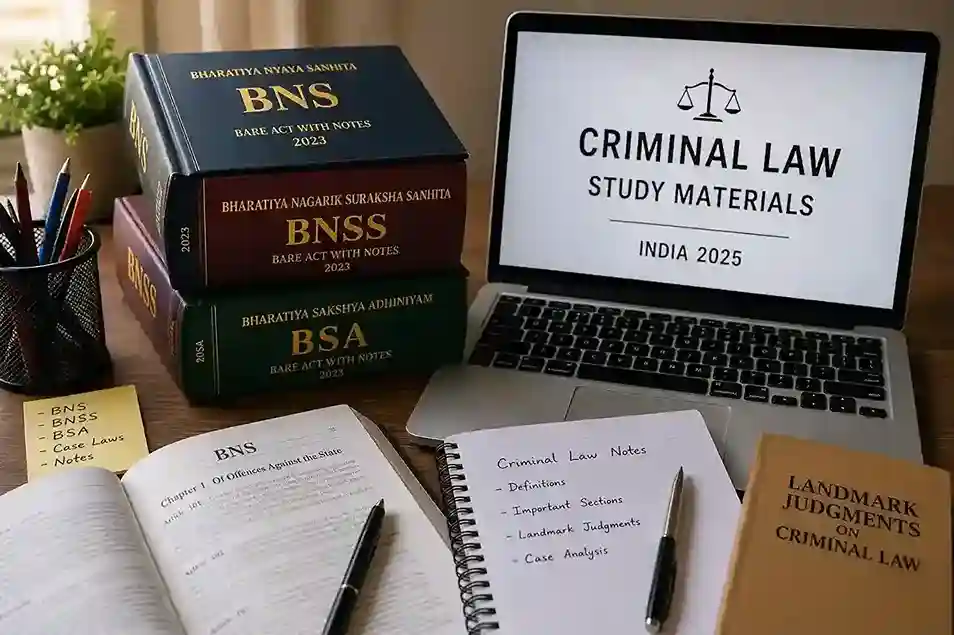
Everything about criminal law study in India | from LLB subjects and BNS reforms to career paths, entrance exams, top colleges, and salary figures in 2025.
Criminal law is the branch of law that defines crimes, sets punishments, and governs how the state investigates and prosecutes individuals accused of offences. In India, it covers substantive law (what is a crime), procedural law (how trials run), and evidence law (what proof is acceptable in court).
Criminal law sits at the centre of the Indian justice system. It protects individuals and society from harm. It also ensures that accused persons receive a fair trial.
India's criminal law framework changed significantly on 1 July 2024. Three new laws replaced colonial-era statutes. Any student studying criminal law today must know both the old and the new frameworks.
As a subject, criminal law appears across all levels of legal education | LLB, LLM, diploma courses, and doctoral research. It is one of the most demanding and most respected specialisations in Indian law.
This is the most important update for every criminal law student in India right now. The government replaced three colonial-era laws from 1 July 2024. Every criminal law curriculum now reflects these changes.
Defines crimes and prescribes punishments. 358 sections (down from 511).
Governs how investigations, trials, and appeals are conducted.
Regulates what evidence courts can accept, including digital records.
The old laws dated back to British rule. They used colonial language and reflected British priorities | not Indian ones. Several provisions were outdated. They did not account for cybercrime, digital evidence, or modern communication methods.
The BNS reduced India's core criminal law from 511 sections to 358 | a cleaner, more logical structure. It introduced new offences not found in the IPC. These include mob lynching, organised crime, and crimes involving digital platforms.
The BNSS introduced e-FIRs, mandatory timelines for investigation, and stronger victim protections. The BSA recognised electronic and digital records as primary evidence for the first time.
For students: The Bar Council of India updated the AIBE syllabus to include BNS, BNSS, and BSA. All law entrance exams from 2025 onwards test these new laws. Make sure your study materials are updated to reflect the July 2024 reforms.
Students can enter criminal law study at multiple levels. Each level builds on the previous one. Here is a clear breakdown of all pathways.
| Course Level | Programme | Duration | Entry Point |
|---|---|---|---|
| UG | 3-Year LLB | 3 years (6 semesters) | After graduation (any stream) |
| UG | 5-Year BA LLB / BBA LLB | 5 years (10 semesters) | After Class 12 |
| PG | LLM in Criminal Law | 1–2 years | After LLB with 55%+ marks |
| PG | PG Diploma in Criminal Law | 1–1.5 years | After LLB or graduation |
| Research | PhD in Criminal Law | 3–6 years | After LLM |
Ideal for students who already hold a bachelor's degree. You enter law school after graduation. Criminal law is a core subject in years two and three. Admission requires a graduation degree with minimum 45% marks. Many working graduates choose this route.
The preferred route for students entering law straight from Class 12. You study arts or business subjects alongside law for five years. National Law Universities offer this programme. Entry through CLAT is mandatory for NLU admissions.
The LLM is a postgraduate specialisation. It goes deeper into criminal jurisprudence, comparative criminal procedure, and human rights. Students who complete an LLM in Criminal Law qualify for senior litigation roles, judicial services, academia, and policy positions.
Top NLUs, NALSAR Hyderabad, GNLU Gandhinagar, and Symbiosis Law School offer strong LLM programmes in criminal law. Duration is typically one or two years depending on the university.
Criminal law is not one subject. It covers four major pillars, each with its own legislation and case law. Modern syllabi have been updated to include the 2024 reforms.
| Year / Semester | Criminal Law Subject | Key Focus Areas |
|---|---|---|
| Year 1 (Sem 1–2) | Foundations of Law / Jurisprudence | Concept of crime, legal theory, distinction between civil and criminal wrong |
| Year 2 (Sem 3–4) | Criminal Law I | BNS (formerly IPC) | General principles, elements of criminal liability, offences against person and property, mens rea, actus reus |
| Year 2 (Sem 3–4) | Law of Evidence | BSA (formerly IEA) | Relevancy, admissibility, burden of proof, digital evidence, expert testimony |
| Year 3 (Sem 5–6) | Criminal Law II | BNSS (formerly CrPC) | FIR, arrest, bail, charge sheet, trial, appeal, revision, e-FIR procedure, Zero FIR |
| Year 3 (Sem 5–6) | Criminology & Penology | Theories of crime, punishment, prison reforms, victim rights, restorative justice |
Two foundations of criminal liability. Mens rea is the guilty mind. Actus reus is the guilty act. Most crimes require both. Understanding this distinction is essential from day one.
Cognisable offences allow police to arrest without a warrant. Non-cognisable offences require court permission. This distinction shapes how every criminal case begins.
In bailable offences, the accused has a right to bail. In non-bailable offences, bail is at the discretion of the court. The BNSS has made significant changes to bail provisions.
A Zero FIR can be filed at any police station, regardless of jurisdiction. The BNSS formally recognised this mechanism. It prevents delays in registering serious crimes.
A person who apprehends arrest can apply for bail in advance. It is granted by the Sessions Court or High Court. BNSS retained this right with modified conditions.
The BSA treats electronic records | including emails, CCTV footage, chat logs, and metadata | as primary evidence. This is a major shift from the old Indian Evidence Act.
Eligibility differs by programme level. Here are the exact requirements for each.
| Programme | Minimum Qualification | Minimum Marks | Age Limit |
|---|---|---|---|
| 5-Year BA LLB / BBA LLB | Class 12 (any stream) | 45% (40% for SC/ST) | Under 20 years (NLU general) |
| 3-Year LLB | Bachelor's degree (any discipline) | 45% (40% for SC/ST) | No upper age limit at most universities |
| LLM in Criminal Law | LLB (3-yr or 5-yr integrated) | 55% in LLB | No standard age limit |
| PG Diploma | Graduation or LLB | 50% in qualifying exam | No standard age limit |
| PhD in Criminal Law | LLM with 55%+ marks | 55% in LLM | No age limit |
Bar Council requirement: To practise as a criminal advocate in any Indian court, you must hold a valid LLB degree and pass the All India Bar Examination (AIBE). Without AIBE clearance, you cannot appear in courts as an advocate. The AIBE now tests BNS, BNSS, and BSA.
Admission to top law colleges is competitive. Knowing the right exam matters more than knowing all the colleges.
| Exam | Full Form | Programme | Conducting Body |
|---|---|---|---|
| CLAT | Common Law Admission Test | BA LLB (UG) and LLM (PG) | Consortium of National Law Universities |
| AILET | All India Law Entrance Test | BA LLB at NLU Delhi only | National Law University Delhi |
| LSAT-India | Law School Admission Test | BA LLB and LLB at private colleges | Law School Admission Council |
| AIBE | All India Bar Examination | Enrolment as advocate (post LLB) | Bar Council of India |
| State Exams | TS PGLCET, CUET, and others | LLB and LLM at state universities | Respective state authorities |
CLAT tests five areas: English language, general knowledge and current affairs, legal reasoning, logical reasoning, and quantitative techniques. The legal reasoning section directly tests your knowledge of basic criminal law principles.
CLAT 2026 was conducted in December 2025. The next CLAT cycle will be for 2026 admissions. Check the official Consortium website for updated dates and syllabi.
For LLM admission through CLAT-PG, you must already hold an LLB degree. The CLAT-PG tests core law subjects including criminal law, constitutional law, and jurisprudence.
The college you choose shapes your practice network, internship access, and job placement. NLUs hold the highest standing in Indian legal education. Here are the top institutions for criminal law study.
| College | Location | Programme | Admission Exam |
|---|---|---|---|
| National Law School of India University (NLSIU) | Bengaluru, Karnataka | BA LLB, LLM | CLAT |
| NALSAR University of Law | Hyderabad, Telangana | BA LLB, LLM | CLAT |
| National Law University Delhi (NLU Delhi) | New Delhi | BA LLB, LLM | AILET |
| Gujarat National Law University (GNLU) | Gandhinagar, Gujarat | BA LLB, BBA LLB, LLM | CLAT |
| Symbiosis Law School | Pune, Maharashtra | BA LLB, LLM | SET / SLAT |
| Faculty of Law, Delhi University | New Delhi | 3-Year LLB, LLM | DUET / Merit |
| Alliance School of Law | Bengaluru, Karnataka | BA LLB, LLM | Alliance Entrance Test |
For Gujarat students: GNLU Gandhinagar is ranked among the top 5 NLUs in India (NIRF). It offers a dedicated criminal law specialisation in its LLM programme. Gujarat domicile candidates can access reserved seats through the Home State quota in CLAT counselling.
Criminal law opens more career paths than most students expect. Litigation is just one of them.
Represent accused persons in District Courts, High Courts, and the Supreme Court. Build your practice through junior positions with senior advocates. Reputation drives income at this level.
Represent the state in criminal trials. Appointed by state governments. Public prosecutors appear regularly in Sessions Courts and High Courts. Starting pay ranges from Rs. 5 lakh to Rs. 8 lakh per year.
Appear for state Public Service Commission judicial exams. Criminal law is a major tested subject. Judges in District Courts handle the largest share of criminal cases in India.
The Central Bureau of Investigation and state police departments employ legal officers. Roles involve advising on criminal procedure, preparing charge sheets, and handling prosecution support.
Work with legal aid organisations, human rights bodies, and prisoner welfare groups. These roles carry high social impact. Salary is lower than private practice but meaningful work is constant.
Teach criminal law at university level after LLM and NET or SLET clearance. Government law college positions offer Rs. 8 lakh to Rs. 18 lakh per year with job security and respect.
Large corporations need lawyers who handle criminal investigations, ED cases, CBI inquiries, and economic offences. This niche pays well and is growing fast with India's evolving white-collar crime landscape.
Write for legal publications, think tanks, and policy bodies. Criminal law expertise is valuable in analysing new legislation like BNS and BNSS. Graduate-level salaries start around Rs. 4 lakh to Rs. 6 lakh per year.
Criminal law income varies widely. A beginner earns very differently from a senior High Court advocate. Here is a clear picture by experience level.
| Role | Starting Salary | Mid-Career |
|---|---|---|
| Public Prosecutor | Rs. 5–8 LPA | Rs. 12–18 LPA |
| Criminal Defence Advocate | Rs. 3–6 LPA | Rs. 15–40 LPA |
| Judicial Officer (Magistrate) | Rs. 6–10 LPA | Rs. 15–25 LPA |
| CBI / Enforcement Legal Officer | Rs. 5–8 LPA | Rs. 12–20 LPA |
| Corporate Criminal Defence | Rs. 8–15 LPA | Rs. 25–60 LPA |
| Law Professor (Criminal Law) | Rs. 8–12 LPA | Rs. 15–22 LPA |
Salary figures reflect 2025 market data. NLU graduates consistently command higher starting packages than graduates of non-NLU colleges. Private practice income depends heavily on specialisation, court level, and client base.
The path is structured. Each step builds directly on the previous one. Here is the complete roadmap.
Any stream | science, commerce, or arts | qualifies. Aim for at least 50%+ to keep options open. Start reading newspapers and legal news early.
Begin preparation at least one year before the exam. Focus on logical reasoning, legal reasoning, English, and current affairs. Criminal law basics appear in the legal reasoning section.
Criminal law subjects appear from year two onwards. Focus hard on BNS, BNSS, and BSA. Attend moot courts. Intern at criminal courts from year one.
AIBE tests practical knowledge of BNS, BNSS, BSA, and other core law subjects. Pass this to get enrolled as an advocate with the Bar Council of India. Without it, you cannot appear in courts.
Work as a junior under an experienced criminal lawyer for at least two to three years. This is where real courtroom learning happens. The stipend is modest but the experience is essential.
An LLM in Criminal Law qualifies you for senior roles, judicial appointments, academic positions, and policy research. It gives you a strong competitive edge in the job market.
Technical law knowledge is just the foundation. These practical skills separate good criminal lawyers from great ones.
Criminal cases turn on facts. You must analyse evidence, identify gaps, and construct logical arguments under pressure | often in court, in real time.
Criminal advocacy happens in court. Clear, persuasive oral arguments decide outcomes. Develop this skill through moot courts, debates, and regular court observation.
Cases depend on precedent. You must find the right judgments, apply them to current facts, and distinguish unfavourable case law. Research speed and accuracy matter.
Written submissions, bail applications, charge frames, and appeals all require precise legal drafting. Vague language in a document can lose a client's case.
Criminal trials are stressful. Witnesses contradict themselves. Judges challenge your arguments. You need the temperament to stay calm, think clearly, and respond decisively.
Criminal defence lawyers represent accused persons | sometimes unpopular ones. Strong professional ethics guide every decision. The Bar Council rules on professional conduct are binding.
| Subject Area | BNS, BNSS, BSA, Criminology, Evidence, Juvenile Justice, Human Rights |
| Core 2024 Reform | BNS replaced IPC; BNSS replaced CrPC; BSA replaced Indian Evidence Act (from 1 July 2024) |
| UG Entry | Class 12 → CLAT → 5-yr BA LLB; or Graduation → CLAT/State Exam → 3-yr LLB |
| PG Entry | LLB with 55% → CLAT-PG → LLM in Criminal Law |
| Licence to Practise | LLB + AIBE clearance + Bar Council enrolment |
| Career Paths | Advocate, Public Prosecutor, Judicial Officer, CBI Legal Officer, Corporate Criminal Defence, Academic |
| Fresh Salary | Rs. 3–7 LPA |
| Senior Salary | Rs. 40 LPA and above |
| Top Colleges | NLSIU, NALSAR, NLU Delhi, GNLU Gandhinagar, Symbiosis Law School |
Browse all law courses, entrance exam guides, and college profiles on the Digital Gujarat Law Portal.
All Law Courses