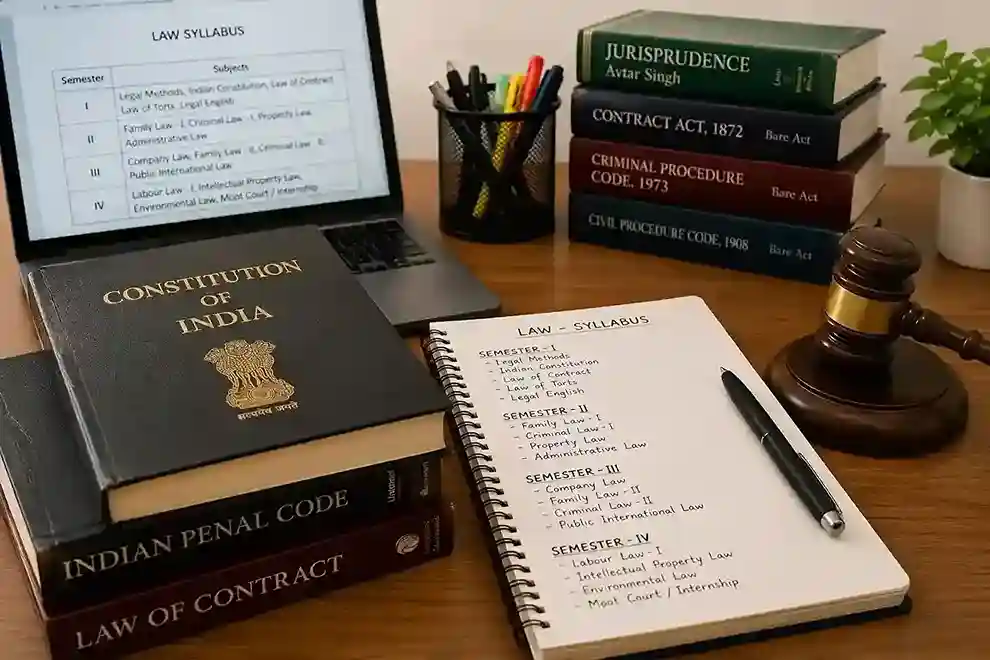
What Is a Law Degree in India?
A law degree in India prepares you for legal practice, the judiciary, corporate roles, and public service. Two main programmes exist. The first is the five-year integrated BA LLB. The second is the three-year LLB for graduates.
Both programmes fall under the supervision of the Bar Council of India (BCI). The BCI sets minimum syllabus standards, mandatory practical hours, and eligibility rules for all recognised law colleges across the country.
After completing either programme, graduates must clear the All India Bar Examination (AIBE) to obtain a Certificate of Practice. Only then can they appear in courts as advocates.
- After Class 12 (any stream)
- Min. 45–50% in Class 12
- Entrance: CLAT, AILET, LSAT India
- 10 semesters
- Combines arts + law
- After any bachelor's degree
- Min. 45–50% in graduation
- Entrance: DU LLB, MH CET Law, etc.
- 6 semesters
- Core law subjects only
- No upper age limit (Supreme Court 2017)
- Open to all streams (Science, Commerce, Arts)
- Distance law degrees not valid for BCI enrolment
The Supreme Court, in 2017, removed the upper age limit for law admissions. This opened the profession to career changers and working professionals choosing a three-year LLB path.
BA LLB Syllabus: Semester-Wise Breakdown
The BA LLB programme runs across ten semesters. The first two years cover foundational social science subjects alongside introductory law. From the third year, specialised legal subjects take centre stage.
Every semester carries both theory papers and practical components. The ratio of law to arts subjects increases as you progress through the programme.
First Year | Semesters 1 and 2
The first year builds your understanding of the society in which laws operate. You study political systems, economic principles, and basic legal theory side by side.
| Semester | Subjects | Type |
|---|---|---|
| Semester 1 | Legal Method Law of Contract I History I Political Science I English & Legal Language | Foundation |
| Semester 2 | Law of Torts Law of Contract II Sociology I History II Economics I | Foundation |
Second Year | Semesters 3 and 4
The second year introduces constitutional law, criminal law, and family law. These are the pillars of legal practice in India. Arts subjects continue in supporting roles.
| Semester | Subjects | Type |
|---|---|---|
| Semester 3 | Constitutional Law I Criminal Law I (BNS) Family Law I Political Science II Sociology II | Core Law Begins |
| Semester 4 | Constitutional Law II Criminal Law II (BNS) Family Law II Property Law Economics II | Core Law |
Third Year | Semesters 5 and 6
By the third year, arts subjects largely phase out. Procedural law enters the syllabus. You also study how evidence works in a courtroom | a skill you use every day in legal practice.
| Semester | Subjects | Type |
|---|---|---|
| Semester 5 | Jurisprudence Code of Civil Procedure (CPC) Administrative Law Evidence Law (BSA) Environmental Law | Procedural Law |
| Semester 6 | Criminal Procedure (BNSS) Labour Law I Company Law Tax Law Drafting & Pleading I | Procedural Law |
Fourth Year | Semesters 7 and 8
Specialisation begins here. International law, intellectual property, and corporate governance enter the picture. Clinical legal education picks up intensity.
| Semester | Subjects | Type |
|---|---|---|
| Semester 7 | Public International Law Intellectual Property Rights Labour Law II Professional Ethics & Court Craft Moot Court I | Advanced + Clinical |
| Semester 8 | Human Rights Law Banking & Finance Law Elective I Drafting & Pleading II Moot Court II | Advanced + Clinical |
Fifth Year | Semesters 9 and 10
The final year focuses on elective specialisations and practical output. Dissertation, client counselling, legal aid, and live internship placements round out the degree.
| Semester | Subjects | Type |
|---|---|---|
| Semester 9 | Elective II Elective III Legal Aid & Para-Legal Services Client Counselling | Specialisation |
| Semester 10 | Elective IV Dissertation / Research Project Internship (Court / Law Firm) | Specialisation + Output |
LLB Syllabus: Semester-Wise for the 3-Year Course
The three-year LLB is designed for those who already hold a bachelor's degree. It moves faster and goes deeper into law from the very first semester. There are no arts or social science foundation subjects.
The Bar Council of India requires completion of at least 20 core papers. Most universities go well beyond this minimum to ensure comprehensive coverage.
| Semester | Core Subjects | Focus Area |
|---|---|---|
| Semester 1 | Jurisprudence & Legal Theory Law of Contract I Constitutional Law I English for Law | Foundation |
| Semester 2 | Law of Contract II Constitutional Law II Law of Torts & Consumer Protection Family Law I | Foundation |
| Semester 3 | Criminal Law (BNS) Evidence Law (BSA) Property Law Family Law II | Core Law |
| Semester 4 | Criminal Procedure (BNSS) Civil Procedure Code Administrative Law Company Law | Procedural Law |
| Semester 5 | Labour Law Environmental Law Intellectual Property Rights Tax Law ADR & Arbitration | Specialisation |
| Semester 6 | Professional Ethics & Court Craft Drafting, Pleading & Conveyancing Moot Court & Legal Aid Internship Elective | Clinical + Practical |
Most universities split assessment as 70% semester-end examinations and 30% internal assessments. Internal marks come from assignments, presentations, moot arguments, and attendance. Some National Law Universities follow a different ratio | check your specific university guidelines.
Core Law Subjects: What You Actually Study
Each major subject covers a specific area of law. Here is what each one contains at a practical level.
Jurisprudence and Legal Theory
This subject asks the big question: what is law? You study the nature, purpose, and meaning of law. You examine different schools of legal thought | natural law, positivism, and sociological approaches. You also learn how law relates to morality, justice, and society.
Constitutional Law
India's Constitution is the backbone of the entire legal system. You study its structure, the fundamental rights in Part III, the directive principles in Part IV, and the powers of the Union and state governments. Landmark Supreme Court judgments are central to this subject.
Contract Law
The Indian Contract Act, 1872 governs agreements between parties. You study offer and acceptance, consideration, free consent, and remedies for breach. The subject also covers the Sale of Goods Act, 1930 and the Indian Partnership Act, 1932. Limited liability partnerships also feature in the curriculum.
Criminal Law
In 2023, three new criminal laws replaced older colonial-era acts. The syllabus now covers the updated framework. You study offences against the body, property, and the state. General exceptions like consent and private defence are part of the course.
Law of Torts and Consumer Protection
This subject deals with civil wrongs that are not breaches of contract. Negligence, defamation, nuisance, and strict liability all feature here. The Consumer Protection Act, 2019 is now an important part of this subject cluster.
Family Law
India has personal laws based on religion. You study Hindu Marriage Act, Muslim personal law, Christian personal law, and special marriage law. Succession, adoption, maintenance, and guardianship are all covered.
Property Law
The Transfer of Property Act, 1882 governs how property moves between people. You study sale, mortgage, lease, exchange, and gift. The Specific Relief Act, 1963 connects here and teaches you when a court can compel performance of a contract rather than just award damages.
Evidence Law (Bharatiya Sakshya Adhiniyam)
You learn what can and cannot be used in court to prove a fact. Documentary evidence, oral evidence, expert opinion, and electronic records all have their own rules. The burden of proof | who must prove what | is a critical concept in this subject.
Civil Procedure Code (CPC)
The Code of Civil Procedure, 1908 sets out how civil suits move through the courts. You study filing a suit, service of summons, pleadings, discovery, trial, appeal, and execution of decrees. Res judicata and estoppel are key doctrines here.
Administrative Law
This subject covers how government power is controlled by law. You study judicial review, rule of law, natural justice, delegated legislation, and administrative tribunals. It connects directly to constitutional law and public interest litigation.
Company Law
The Companies Act, 2013 is the primary text. You study incorporation, share capital, directors' duties, meetings, accounts, and winding up. Corporate governance and SEBI regulations also appear in advanced semesters.
Labour Law
Labour law covers the relationship between employers and employees. The Factories Act, Industrial Disputes Act, and Employees Provident Fund Act are key. The new Labour Codes | consolidating 29 central labour laws into four codes | are now part of updated syllabuses.
Environmental Law
You study the Environment Protection Act, 1986 and the Water and Air Acts. The role of the National Green Tribunal and how environmental impact assessments work are also covered. Constitutional provisions on the right to a healthy environment form the foundation.
Intellectual Property Rights (IPR)
IPR covers patents, trademarks, copyrights, geographical indications, and trade secrets. India's obligations under the TRIPS Agreement (part of WTO) shape domestic IP law. This is one of the fastest-growing areas of legal practice.
Alternative Dispute Resolution (ADR)
Courts in India face huge case backlogs. ADR | mediation, arbitration, conciliation, and negotiation | provides faster options. The Arbitration and Conciliation Act, 1996 (amended in 2021) is the main legislation. Many students go on to specialise here.
Three New Criminal Laws Now in the Syllabus
In 2023, India replaced three colonial-era criminal laws. The changes took effect from July 1, 2024. All law students who started their course in 2024 or later now study these new laws as core subjects.
Reorganises criminal offences. Adds community service as a punishment. Introduces stricter penalties for organised crime and terrorism. Redefines several offences including those related to sexual violence and property.
Allows FIRs to be filed digitally from any location. Extends police custody in phases up to 60 days for serious offences. Introduces trial-in-absentia provisions. Focuses on speed and victim-oriented justice delivery.
Strengthens electronic evidence rules. Defines electronic records more broadly to include emails, server logs, and digital documents. Aligns evidence standards with modern technological realities in court.
Students preparing for the All India Bar Examination (AIBE) must now answer questions based on BNS, BNSS, and BSA. If you studied the old laws, you need to bridge your knowledge to the new framework. The Bar Council of India has updated the AIBE syllabus to reflect these changes.
Elective Subjects: Build Your Area of Focus
Most law programmes allow students to choose two to four elective subjects in the final years. Your choice of electives shapes your career direction. Here are the most common options available at recognised law schools in India.
- Mergers and Acquisitions Law
- Securities & SEBI Regulations
- Banking and Finance Law
- Competition Law
- Corporate Governance
- Trial Advocacy
- Criminology
- Juvenile Justice Law
- Forensic Evidence
- Prison Reforms & Rights
- Cyber Law and Cybercrime
- Artificial Intelligence and Law
- Patent Law and Practice
- Data Protection Law
- Media and Entertainment Law
- Human Rights Law
- International Humanitarian Law
- Constitutional Remedies
- Public Interest Litigation
- Health Law and Bioethics
Technology law and data protection are among the fastest-growing elective choices as of 2026–27. The Digital Personal Data Protection Act, 2023 has made this area especially relevant for students planning a corporate law career.
Practical Training: The Part That Actually Gets You Hired
Theory alone does not make a lawyer. The Bar Council of India mandates clinical legal education as a non-negotiable part of any recognised law degree. This section explains what practical training actually involves.
Moot Court
Moot court is a simulated court proceeding. You research a legal problem, draft written arguments, and then present your case before judges | often real advocates or professors. This builds oral advocacy skills faster than any other method. Most universities require at least two moot court participations as part of the degree.
Internship
The BCI requires law students to complete supervised internships. For a five-year programme, at least 20 weeks of internship are recommended across the course duration. Placements can be with district courts, high courts, law firms, corporate legal departments, NGOs, or government legal cells. Records of internship work are submitted to the university for assessment.
Legal Aid Clinics
Legal aid clinics let students provide basic legal help to people who cannot afford a lawyer. This is done under faculty supervision. It builds both legal skill and professional responsibility | two qualities every employer looks for.
Client Counselling
Client counselling sessions teach you how to interact with a real person who has a legal problem. You learn to listen, identify the actual legal issue beneath what the client says, advise on options, and manage expectations. This is a skill that no textbook can teach.
Drafting, Pleading, and Conveyancing
This practical subject teaches you to write legal documents. You draft plaints, written statements, petitions, wills, contracts, and deeds. Legal writing is one of the most tested skills in law firm interviews. Investing time in this subject pays back many times over.
In interviews at law firms and for judicial service positions, moot court experience and internship records come up in almost every discussion. A student with strong practical training but average marks often gets further than one with excellent marks but no courtroom exposure.
How You Are Assessed in a Law Degree
Assessment in Indian law programmes combines continuous internal evaluation with semester-end examinations. The split varies by institution but a common pattern is 70% end-semester and 30% internal marks.
Internal Assessment (30%)
Internal marks come from written assignments, class tests, seminar presentations, moot court participation, client counselling records, and attendance. Missing internal deadlines can affect your final grade significantly.
Semester-End Examination (70%)
End-semester exams are usually three-hour written papers. Questions test both knowledge of the law and the ability to apply it to problem-based scenarios. Good answers cite relevant sections of acts and refer to landmark case law.
Practical Subjects
Practical subjects like moot court, legal aid, and drafting have separate grading criteria. Performance is evaluated on preparation, skill, and documentation. These grades count towards your overall degree classification.
After Graduation: The AIBE
Once you complete your law degree, you must pass the All India Bar Examination before you can practice in court. The AIBE is an open-book exam conducted by the Bar Council of India. It tests your knowledge across all major law subjects, including the new criminal laws. Passing it earns you a Certificate of Practice.
Career Paths After a Law Degree in India
A law degree opens more paths than most students realise at the start. Your choice of electives, internships, and practical exposure during the degree shapes which direction you go.
Law graduates in India also qualify for the UPSC Civil Services Examination. The overlap between the BA LLB syllabus and UPSC General Studies | particularly in polity, governance, and social issues | gives law graduates a structured advantage in civil services preparation.
Entrance Exams for Law Admissions in India
Getting into a top law school requires clearing a competitive entrance examination. Different exams serve different institutions. Here is how to read the landscape.
CLAT | Common Law Admission Test
CLAT is the gateway to all 24 National Law Universities (NLUs) across India. It tests English language comprehension, legal reasoning, logical reasoning, quantitative techniques, and general knowledge. NLU Delhi is the only National Law University that does not use CLAT | it uses AILET instead.
AILET | All India Law Entrance Test
AILET is conducted by National Law University Delhi. It is considered among the toughest law entrance exams in the country. The structure is similar to CLAT but with a different level of question difficulty and a smaller intake.
LSAT India
LSAT India is used by Jindal Global Law School and several other private law schools. It focuses on analytical and logical reasoning skills rather than legal knowledge. International students also use LSAT scores for applications abroad.
State-Level Exams
Many states conduct their own law entrance tests. MH CET Law serves Maharashtra. SLAT (Symbiosis Law Admission Test) covers Symbiosis institutions. TG LAWCET covers Telangana. Gujarat has its own admission process under the Gujarat Secondary and Higher Secondary Education Board framework. Check your target state's specific admission schedule.
DU LLB
Delhi University's Faculty of Law conducts a separate entrance exam for its three-year LLB programme. The exam covers legal awareness, legal aptitude, general knowledge, and English comprehension. DU's law faculty is one of the highest-ranked in India under NIRF.
Frequently Asked Questions
What is the difference between BA LLB and LLB?
BA LLB is a five-year integrated programme that combines arts and law subjects. You join directly after Class 12. LLB is a three-year professional degree that you join after completing any bachelor's degree. Both lead to eligibility for Bar Council of India enrolment after passing the AIBE. The BA LLB route is the more popular option since it gets you into law earlier.
What subjects are covered in LLB first year?
In the three-year LLB, the first year covers Jurisprudence and Legal Theory, Law of Contract I and II, Constitutional Law I and II, Law of Torts, Family Law I, and English for Legal Communication. In the BA LLB, the first year also includes Political Science, History, Sociology, and Economics alongside introductory law subjects.
What are the new criminal laws now included in the syllabus?
Three new laws replaced the old criminal law framework from July 1, 2024. Bharatiya Nyaya Sanhita (BNS) replaced the Indian Penal Code (IPC). Bharatiya Nagarik Suraksha Sanhita (BNSS) replaced the Code of Criminal Procedure (CrPC). Bharatiya Sakshya Adhiniyam (BSA) replaced the Indian Evidence Act, 1872. Students admitted in 2024 or later study these new laws as core subjects.
Is moot court compulsory in law college?
Yes. The Bar Council of India mandates clinical legal education as part of every recognised law programme. Moot court, legal aid clinics, client counselling, and supervised internships are all required components. Universities track your participation and award marks for practical performance.
Which entrance exam do I need for admission to NLUs?
The Common Law Admission Test (CLAT) is the entrance exam for all National Law Universities except NLU Delhi. NLU Delhi uses AILET. Private law schools like Jindal Global Law School use LSAT India. State law colleges use state-level exams like MH CET Law (Maharashtra) or TG LAWCET (Telangana).
Can I study law through distance education in India?
No. The Bar Council of India does not recognise law degrees obtained through distance education for the purpose of enrolment as an advocate. You must study in a regular full-time mode at a BCI-recognised institution. Some universities offer distance learning for post-graduate legal programmes for working professionals, but these are different from the qualifying LLB degree.
What can I do after completing a law degree other than practicing in court?
There are many paths beyond courtroom practice. You can work in corporate legal departments, join law firms in non-litigation roles, become a legal researcher, teach law, work with NGOs or human rights organisations, join government services as a legal advisor, or sit for UPSC Civil Services. A law degree also provides a strong foundation for judicial service examinations at the state level.
How many papers are in the full LLB 5-year syllabus?
The Bar Council of India requires at least 36 core papers in the five-year integrated programme. Most universities offer more than this minimum to provide comprehensive legal training. The ten semesters typically carry six subjects each in the early years, reducing to four or five subjects per semester in the final two years as electives and practical subjects take over.
What This Syllabus Means for Your Legal Career
The law course syllabus in India is not a list of books to memorise. It is a structured journey from understanding society to mastering the rules that govern it.
The first two years of a BA LLB lay down why laws exist. The middle years teach you what the laws say. The final years teach you how to use them in practice | in courts, in contracts, and in negotiations.
The three new criminal laws | BNS, BNSS, and BSA | show that the syllabus changes with the country. Students today are learning an India-first legal framework that has moved away from colonial-era legislation.
Your practical training | moot courts, internships, legal aid | is where academic knowledge becomes professional skill. These components are not supplementary. They are the reason employers and courts take you seriously.
Whether you want to argue in the Supreme Court, advise a Fortune 500 company, protect human rights, or serve as a district judge, the syllabus you are studying builds the foundation for all of it.
Choose your electives with your career in mind. Use your internship weeks to explore the area of law that genuinely interests you. And know that every subject in this syllabus | even the ones that feel abstract | connects to a real decision someone makes in a courtroom or a boardroom someday.
If you are looking for scholarship support to fund your law education in Gujarat, visit our Law Scholarships page. We track government and private scholarship opportunities updated for the 2026–27 academic year.