Affiliated: University of Mumbai | BCI Approved
University: Delhi University | BCI Approved
1. Overview | Two Institutions, 170 Years of History
The comparison between GLC Mumbai and DU Law is a uniquely Indian legal education debate | it is not a comparison of two competitors trying to do the same thing, but of two complementary legends that have shaped India's legal profession from opposite ends of the subcontinent for over a century.
Government Law College (GLC) Mumbai was established in 1855 | nearly a century before India's independence | making it one of the oldest law schools in Asia. It sits at Churchgate, South Mumbai, in literal walking distance of the Bombay High Court, one of India's most prestigious courts. GLC has educated generations of Senior Advocates, High Court judges, legal academics, and the stalwarts of Mumbai's corporate Bar. Its alumni read like a who's who of Indian legal history.
Delhi University Faculty of Law and Campus Law Centres came later | established in 1924 | but quickly became the centre of gravity for legal education in India's capital. As the law school of the University of Delhi, it operates across the Faculty of Law (South Campus) and Campus Law Centres I and II (North Campus) | collectively offering the largest government law school seats in Delhi. Proximity to the Supreme Court of India and the Delhi High Court gives DU Law students a unique exposure to India's highest level of judicial activity.
2. Quick Side-by-Side Comparison Table
| Parameter | GLC Mumbai | DU Law (FoL + CLC) | Edge |
|---|---|---|---|
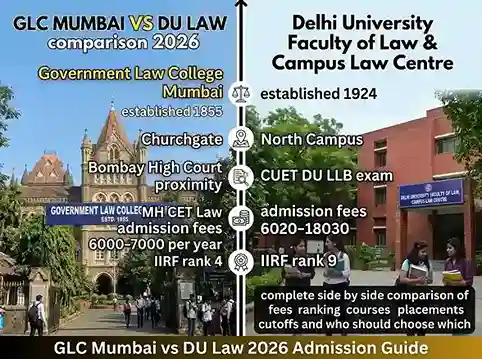
| Established | 1855 (171 years) | 1924 (102 years) | GLC |
| Institution Type | State Government (Maharashtra) | Central Government (Delhi University) | Tie |
| IIRF 2025 Rank (Law) | #4 | #9 | GLC |
| NAAC Grade | B+ | DU overall A++ (law centre-wise varies) | DU |
| LLB (3-yr) Annual Fee | Gen | ₹6,000–7,000/yr | ₹6,010/yr (1st year fee) | Near Tie |
| LLB (3-yr) Total Fee | Gen | ₹19,430–21,000 | ~₹18,030 total | Near Tie |
| SC/ST Annual Fee | ₹400–500/yr only | Subsidised (varies by category) | GLC |
| LLB Admission Exam | MH CET Law (State CET) | DU LLB Entrance Exam | Both State-Specific |
| BA LLB / BBA LLB (5-yr) | BLS LLB (5-year) offered | BA LLB + BBA LLB (from 2023–24 via CLAT) | DU |
| LLM Admission | Merit / University of Mumbai | CUET PG (National exam) | DU |
| Total Seats (Law) | 1,090+ | 1,109+ (all 3 centres combined) | Comparable |
| Location | Churchgate, South Mumbai | walking dist. from Bombay HC | North Campus Delhi | near Delhi HC and Supreme Court | Both Strategic |
| Alumni Legacy | Senior Advocates, HC Judges, Mumbai Bar elite | SC Judges, DU academics, Delhi legal fraternity | Both Outstanding |
| Infrastructure | Older building; compact campus; strong moot court tradition | University campus setting; larger resources | DU |
| Open / Flexible Attendance | Known for flexible attendance | ideal for interns | Standard DU attendance norms | GLC |
3. GLC Mumbai | Complete Profile
The Government Law College (GLC) Mumbai is more than a law school | it is an institution woven into the fabric of Indian legal history. Founded in 1855 under British India and run by the Government of Maharashtra, it is affiliated with the University of Mumbai and approved by the Bar Council of India. For 171 years, it has been the primary feeder institution to the Bombay Bar | producing some of the finest advocates, judges, and legal thinkers in the country.
What makes GLC Mumbai truly unique is its location and culture. Situated at Churchgate, just minutes from the Bombay High Court, GLC students absorb legal practice almost by osmosis | they observe hearings, interact with senior advocates, and begin building their professional network from Day 1 of their law studies. The college has a famously flexible attendance policy, which allows students to pursue internships, mooting, and professional opportunities without sacrificing their degree progress.
GLC Mumbai Courses & Fees 2026
| Course | Duration | Seats | Annual Fee (Gen) | Annual Fee (SC/ST) | Admission |
|---|---|---|---|---|---|
| LLB (3-Year) | 3 Years | 320+ | ₹6,000–7,000 | ₹400–500 | MH CET Law + CAP |
| BLS LLB (5-Year Integrated) | 5 Years | ~480 | ~₹6,148/yr | ₹400–500 | MH CET Law 5-yr |
| LLM | 1–2 Years | Limited | ~₹6,000–8,000 | Subsidised | Merit / MU |
| PG Diploma (Securities Law) | 1 Year | 60 | ₹28,000 total | | | Merit / Application |
| PG Diploma (Intellectual Property Rights) | 1 Year | 50 | ₹10,635 total | | | Merit / Application |
| Diploma (Graduate Diploma in Law) | 1 Year | Variable | Variable | | | Merit / Application |
What Makes GLC Mumbai Distinctive
Walking distance from one of India's most prestigious courts. Students routinely observe live hearings, interact with Senior Advocates, and begin building their professional identity from Year 1.
GLC Mumbai is well-known for a flexible attendance framework that allows students to pursue internships, moot court competitions, and professional activities simultaneously | a major practical advantage.
A significant portion of GLC's faculty comprises practicing lawyers, retired judges, and legal practitioners from the Bombay Bar | bringing real courtroom cases into the classroom in a way few law schools can match.
At ₹400–500 per year for SC/ST/OBC students, GLC Mumbai offers one of the most accessible high-quality legal educations in the country | making it genuinely equitable in its approach.
4. DU Law | Complete Profile (Faculty of Law + Campus Law Centres)
Understanding "DU Law" requires understanding that it is not a single institution but a network of three law centres under the University of Delhi: the Faculty of Law (South Campus, established 1924), Campus Law Centre I (CLC-I) (North Campus), and Campus Law Centre II (CLC-II) (North Campus, established 1971). Together they form the largest government law education network in Delhi.
Delhi University's Faculty of Law began in 1924 and has produced India's most distinguished jurists | Chief Justices, Attorney Generals, Solicitor Generals, and leading academics. The Faculty of Law's location on South Campus places it in close proximity to the Supreme Court of India and the Delhi High Court | giving students extraordinary access to top-level judicial proceedings.
Flagship DU law institution. Offers BA LLB (Hons), BBA LLB (Hons) | 5-year programmes via CLAT. LLM and PhD. Strong research culture and academic legacy.
Offers LLB 3-year programme via DU LLB Entrance Exam. 553 seat intake. Average median salary ~₹10.75 LPA. Located in North Campus, the intellectual heart of Delhi University.
Established 1971. Offers LLB and LLM. 556 seat intake. Average median salary ~₹11.83 LPA. Popular for its morning timing (8 AM–2 PM) that allows professional work alongside studies.
DU Law Courses & Fees 2026
| Course / Centre | Duration | Seats | Annual Fee (Approx.) | Admission Route |
|---|---|---|---|---|
| BA LLB (Hons) | Faculty of Law | 5 Years | ~100 | ~₹6,020/yr | CLAT UG |
| BBA LLB (Hons) | Faculty of Law | 5 Years | ~100 | ~₹6,020/yr | CLAT UG |
| LLB (3-Year) | Campus Law Centre I | 3 Years | 553 | ~₹12,040–18,030 total | DU LLB Entrance Exam |
| LLB (3-Year) | Law Centre II | 3 Years | 556 | ~₹12,040–18,060 total | DU LLB Entrance Exam |
| LLM | Faculty of Law | 1–2 Years | Limited | ~₹6,020/yr | CUET PG |
| PhD (Law) | Faculty of Law | 3–5 Years | Limited | Variable | DU PhD Entrance + UGC NET |
| Diploma Programmes | 1 Year | Variable | Variable | Merit / Application |
5. Fees Comparison | GLC Mumbai vs DU Law
Both GLC Mumbai and DU Law are government institutions with heavily subsidised fees | making them among the most affordable quality legal education options in India. Here is the comprehensive fee comparison:
| Fee Head | GLC Mumbai | DU Law | Verdict |
|---|---|---|---|
| LLB Annual Fee (General) | ₹6,000–7,000 | ~₹6,010 (first year) | Near Tie |
| LLB Total Fee | 3 Years (Gen) | ₹19,430–21,000 | ~₹18,030 (CLC I & II) | Both Ultra-Affordable |
| SC/ST Annual Fee | ₹400–500 only | Subsidised (DU norms) | GLC Cheaper for Reserved |
| 5-Year LLB Programme | BLS LLB | ₹30,740 total | BA LLB / BBA LLB | ~₹6,020/yr via CLAT | DU More Accessible |
| LLM Annual Fee | ~₹6,000–8,000/yr | ~₹6,020/yr (Faculty of Law) | Near Tie |
| PG Diploma Fees | ₹10,635 – ₹39,500 (varied options) | Variable by programme | GLC More PG Diploma Options |
| Application Fee (CET) | MH CET Application ₹800 (Gen) / ₹400 (Reserved) | DU LLB Entrance / CUET | variable | Comparable |
6. Admission Process | MH CET Law vs DU LLB Entrance / CUET
The admission processes for GLC Mumbai and DU Law are fundamentally different | each tied to its respective state/city's legal education framework. Here is the complete breakdown:
| Admission Step | GLC Mumbai (MH CET Law) | DU Law (DU LLB Entrance / CUET) |
|---|---|---|
| Step 1: Register | Register for MH CET Law at cetcell.mahacet.org. General fee: ₹800; Reserved: ₹400. | Register for DU LLB Entrance Exam at du.ac.in. For 5-year integrated: apply through CLAT. |
| Step 2: Appear for Exam | MH CET Law | conducted by Maharashtra State CET Cell. Tests Legal Aptitude, English, Logical Reasoning, GK, and Maths. Separate exams for 3-year and 5-year programmes. | DU LLB Entrance Exam (for 3-year LLB) | conducted by NTA/DU. CLAT (for 5-year BA LLB/BBA LLB). CUET PG (for LLM). |
| Step 3: Results & Merit | Percentile-based merit list released by Maharashtra State CET Cell. | Score/rank-based merit from DU entrance exam or CLAT/CUET. |
| Step 4: CAP / Counselling | Centralised Admission Process (CAP) managed by Maharashtra DHE. Option entry: list preferred colleges. GLC Mumbai is highest demand | requires top percentile. | DU centralised counselling. Candidates select Campus Law Centre I or II (for 3-year LLB) or Faculty of Law (for 5-year or LLM). |
| Step 5: Document Verification | Report to GLC Mumbai with MH CET scorecard, HSC/degree marksheets, caste/domicile certificate, CAP allotment letter. | Report to respective DU law centre with DU entrance exam scorecard, qualifying degree marksheet, category certificate. |
| Key Eligibility (LLB 3-yr) | Graduation with 45% (General). Maharashtra domicile advantage. | Graduation with 50% (Gen), 45% (OBC/PwD), 40% (SC/ST). |
| Key Eligibility (5-yr LLB) | BLS LLB: Class 12 with 45% (Gen). | BA LLB/BBA LLB: Class 12 | CLAT-based (competitive national exam). |
7. Cutoff / Admission Difficulty
Both GLC Mumbai and DU Law (Campus Law Centres) are extremely competitive. GLC Mumbai consistently records the highest closing percentile in Maharashtra's MH CET Law CAP rounds, while DU's law centres see competitive DU LLB entrance exam scores from applicants across India.
| Category | Closing Percentile (Approx.) |
| OMS (Other Maharashtra State) | 99th+ percentile |
| Open (Maharashtra Domicile) | 98th+ percentile |
| OBC (Maharashtra) | 95th+ percentile |
| SC (Maharashtra) | 85th+ percentile |
| ST (Maharashtra) | 75th+ percentile |
* Estimated based on typical CAP round closing data. Official cutoffs published by Maharashtra State CET Cell after each CAP round.
| Category | Difficulty Level |
| General (LLB 3-yr) | Highly Competitive |
| OBC | Competitive |
| SC / ST | Accessible |
| BA LLB / BBA LLB (5-yr) | Via CLAT | National level |
| LLM (CUET PG) | Competitive (national) |
* Official cutoffs published by University of Delhi after each counselling round. Check the official du.ac.in portal for current-year data.
8. Rankings | IIRF, NAAC, The Week
| Ranking Agency | GLC Mumbai | DU Law (Faculty of Law) |
|---|---|---|
| IIRF 2025 (Law) | #4 in India | #9 in India |
| The Week 2025 (Law) | #10 in India | Varies (institution ranked broadly) |
| NIRF 2023 (Law) | Variable (state college | not always separately ranked) | ~#22 (Faculty of Law) |
| NAAC Accreditation | B+ | DU overall: A++ | CLC: BCI accredited |
| QS World Ranking | Not separately listed | University of Delhi | 201–250 (Law subject) |
| India Today Law Rank | Ranked consistently in top government law colleges | Ranked consistently in top 10 |
9. Courses Offered | GLC Mumbai vs DU Law
| Programme | GLC Mumbai | DU Law (Faculty of Law + CLC) |
|---|---|---|
| LLB (3-Year) | ✅ Yes | 320+ seats | MH CET Law | ✅ Yes | 1,109 seats (CLC I + II) | DU LLB Exam |
| BA LLB (5-Year Integrated) | BLS LLB (5-yr) | approx. 480 seats | ✅ Yes | Faculty of Law | Via CLAT from 2023–24 |
| BBA LLB (5-Year) | Not offered | ✅ Yes | Faculty of Law | Via CLAT from 2023–24 |
| LLM (Masters in Law) | ✅ Yes | Merit-based / MU | ✅ Yes | Faculty of Law | Via CUET PG |
| PhD (Law) | Limited / through MU affiliation | ✅ Yes | Faculty of Law | Research-focused |
| PG Diploma in Securities Law | ✅ Yes | 60 seats | ₹28,000 | Not offered in same format |
| PG Diploma in IPR | ✅ Yes | 50 seats | ₹10,635 | Some IPR course coverage through law curriculum |
| Certificate / Diploma | Multiple PG certificates available | Limited certificates via Faculty of Law |
| Research / Academic Focus | Primarily teaching-focused | Strong research culture | Faculty of Law publishes research |
10. Placements, Alumni & Career Outcomes
Neither GLC Mumbai nor DU Law operates in the traditional "campus placement" model of NLUs or private law schools. Their career outcomes are driven primarily by the strength of the legal ecosystem in which they are situated | and both cities provide exceptional ecosystems.
- Bombay Bar Practice: GLC's most natural career path | Bombay High Court litigation. Hundreds of current Bombay HC advocates are GLC alumni.
- Corporate Law Firms: Strong placement at AZB (Bandra-Kurla Complex), Cyril Amarchand Mangaldas, Khaitan & Co Mumbai, and other Mumbai-based firms.
- In-House Corporate Legal: Mumbai's concentration of BFSI, pharma, and tech companies creates strong in-house demand for GLC graduates.
- Judiciary: Several sitting Mumbai City Civil Court and Bombay HC judges are GLC alumni.
- Supreme Court: Several GLC Mumbai alumni have gone on to practice at the Supreme Court after years of Bombay HC experience.
- Supreme Court Bar: Proximity to the Supreme Court makes DU Law the premier feeder for Supreme Court practice in India.
- Delhi High Court Bar: CLC I & II graduates dominate the Delhi High Court's junior bar.
- Government Legal Services: Strong pipeline to Central Government law officers, ASGs, and Additional Solicitor Generals.
- Corporate Law Firms (Delhi): SAM, AZB Delhi, JSA, and Luthra & Luthra all recruit DU Law graduates.
- Median Salary: CLC I ~₹10.75 LPA | CLC II ~₹11.83 LPA (official placement data)
11. Location Advantage | Mumbai vs Delhi
| Location Factor | GLC Mumbai | Churchgate | DU Law | North Campus / South Campus |
|---|---|---|
| Proximity to High Court | Walking distance from Bombay High Court (~5 min) | Near Delhi High Court; Supreme Court accessible by Metro |
| Supreme Court Access | ~3 hours by flight / ~40 hrs by train | 30 minutes from Supreme Court of India (Metro) |
| Corporate Law Hub | BKC (India's financial district), Fort, Nariman Point | all accessible | Delhi NCR corporate sector | Gurugram, Noida, Connaught Place |
| City Legal Culture | Mumbai Bar | strong commercial/corporate litigation tradition | Delhi Bar | strong constitutional, criminal, and government law tradition |
| Internship Opportunities | Immediate proximity to 2,000+ law firms and chambers in Fort / Nariman Point area | Access to Supreme Court chambers, Delhi HC lawyers, government legal offices |
| Cost of Living | Higher | Mumbai is India's most expensive city | Lower | DU campus area is relatively affordable |
| Accommodation | No residential campus | students arrange PG/hostel in South Mumbai (expensive) | DU North Campus has university hostels and affordable PG options nearby |
12. Strengths & Weaknesses of Each College
- Asia's one of the oldest law colleges | 171 years of institutional legacy
- Walking distance from Bombay High Court | unmatched practical legal exposure
- Flexible attendance policy | ideal for student internships and professional activities
- Ultra-affordable SC/ST fees (₹400–500/year) | most equitable in Maharashtra
- Exceptional visiting faculty | active practitioners and retired judges as teachers
- IIRF #4 ranking despite being a teaching-only institution | testament to outcomes
- 18 programmes including multiple PG Diplomas (Securities Law, IPR)
- Located in South Mumbai | India's commercial capital, corporate law heartland
- Older, compact campus | limited modern infrastructure
- No PhD programme (relies on Mumbai University affiliation)
- Primarily Maharashtra-focused admission (MH CET Law)
- No formal campus placement cell like NLUs
- High cost of living in South Mumbai area
- Part of University of Delhi | QS-ranked institution with global recognition
- Proximity to Supreme Court of India | unique constitutional law exposure
- 5-year integrated BA LLB/BBA LLB via CLAT | nationally accessible
- LLM via CUET PG | nationally competitive postgraduate pathway
- Strong research culture at the Faculty of Law
- Three centres = more seats, more specialisation options
- Government legal services pipeline | ASGs, government attorneys
- DU campus hostels | more affordable student accommodation
- Three separate centres with varying quality and reputation
- NIRF ranking (~#22) appears lower due to research-weight metrics
- Less flexibility than GLC for student internship management
- Competition for quality DU Law seats is intense (10,000+ students)
- No formal PG Diploma options comparable to GLC's Securities Law / IPR programmes
13. Verdict | Who Should Choose Which?
| If You Are… | Choose GLC Mumbai | Choose DU Law |
|---|---|---|
| Career Goal | Bombay HC litigation, Mumbai corporate law, BFSI legal | Supreme Court practice, Delhi HC, government legal services |
| Location Preference | Mumbai or Western India | Delhi or North India |
| Internship During Studies | GLC | more flexibility for concurrent internships | DU | standard academic schedule |
| Budget (SC/ST) | GLC | ₹400–500/yr is exceptional value | DU | also subsidised but slightly higher |
| 5-Year Integrated Law | BLS LLB (GLC/Maharashtra) | state-level admission | BA LLB/BBA LLB via CLAT | nationally competitive, more recognisable |
| Research / Academia | Limited | teaching-focused college | DU Faculty of Law | stronger research environment |
| Corporate Legal (National) | Strong in Mumbai; weaker for Delhi/Bangalore firms | National exposure through CLAT/CUET routes and Delhi NCR market |
| Judiciary / Civil Services | Strong Maharashtra judicial services pipeline | Strong for central government legal services, UPSC |
14. Parameter-Wise Score Card (Out of 10)
15. Frequently Asked Questions | GLC Mumbai vs DU Law
Neither is universally "better" | they are equally exceptional in their own contexts. GLC Mumbai is better for: Mumbai/Western India careers, Bombay High Court litigation, corporate law in BFSI/pharma, and students who want unprecedented access to live legal practice from Day 1 (the college is minutes from the Bombay HC). DU Law is better for: Delhi/North India careers, Supreme Court and government legal services, research/academia, and students who prefer CLAT or CUET-based 5-year integrated or postgraduate admission. The real decision is the city you want to build your legal career in | both colleges will serve you exceptionally well within their respective ecosystems.
Both institutions are extremely affordable. GLC Mumbai: LLB 3-year annual fee ~₹6,000–7,000 (General); SC/ST only ₹400–500 per year; BLS LLB 5-year total ₹30,740. DU Law: LLB annual fee ~₹6,010 (first year); total for 3 years ~₹18,030 (Campus Law Centres); BA LLB/BBA LLB via CLAT at ~₹6,020/year; LLM ~₹6,020/year. Both represent some of India's most affordable quality legal education | fee should not be the deciding factor between these two colleges. Verify current fees at the official websites (glcmumbai.ac.in and du.ac.in).
GLC Mumbai admission for LLB (3-year) and BLS LLB (5-year) is through MH CET Law (Maharashtra Common Entrance Test for Law), conducted by the Maharashtra State CET Cell. After results, candidates register for the Centralised Admission Process (CAP) managed by Maharashtra DHE. GLC Mumbai is the highest-demand college in Maharashtra | requiring top percentile scores in MH CET Law. Eligibility: Graduation with 45% for 3-year LLB; Class 12 with 45% for 5-year BLS LLB. Check cetcell.mahacet.org for registration dates and application process.
DU Law admission: For LLB (3-year) at Campus Law Centres I and II | through the DU LLB Entrance Exam (conducted by University of Delhi/NTA). For BA LLB / BBA LLB (5-year) at the Faculty of Law | through CLAT UG scores (introduced from 2023–24). For LLM | through CUET PG (Common University Entrance Test Postgraduate). Eligibility: Graduation with 50% (General) for LLB 3-year; 10+2 for 5-year integrated; LLB with 50% for LLM. Check du.ac.in for official admission schedules and application forms.
GLC Mumbai does not offer a BA LLB or BBA LLB in the format offered by NLUs or private universities. The 5-year integrated programme at GLC Mumbai is called BLS LLB (Bachelor of Legal Science + LLB), which combines legal science with law. It is approved by the Bar Council of India and the University of Mumbai. The flagship programme remains the 3-year LLB. In contrast, DU Law's Faculty of Law now offers BA LLB (Hons) and BBA LLB (Hons) through CLAT scores from the 2023–24 academic year.
Both colleges lack formal campus placement cells in the NLU sense, but DU Law campuses publish median salary data: Campus Law Centre I ~₹10.75 LPA; Law Centre II ~₹11.83 LPA. GLC Mumbai does not publish formal placement data | students largely self-place through Mumbai's legal ecosystem (Bombay HC bar, law firms in BKC and Fort, corporate legal departments). In terms of alumni outcomes, both have produced India's top legal professionals. GLC Mumbai has an edge for corporate and Bombay HC litigation; DU Law has an edge for Supreme Court practice and government legal careers.