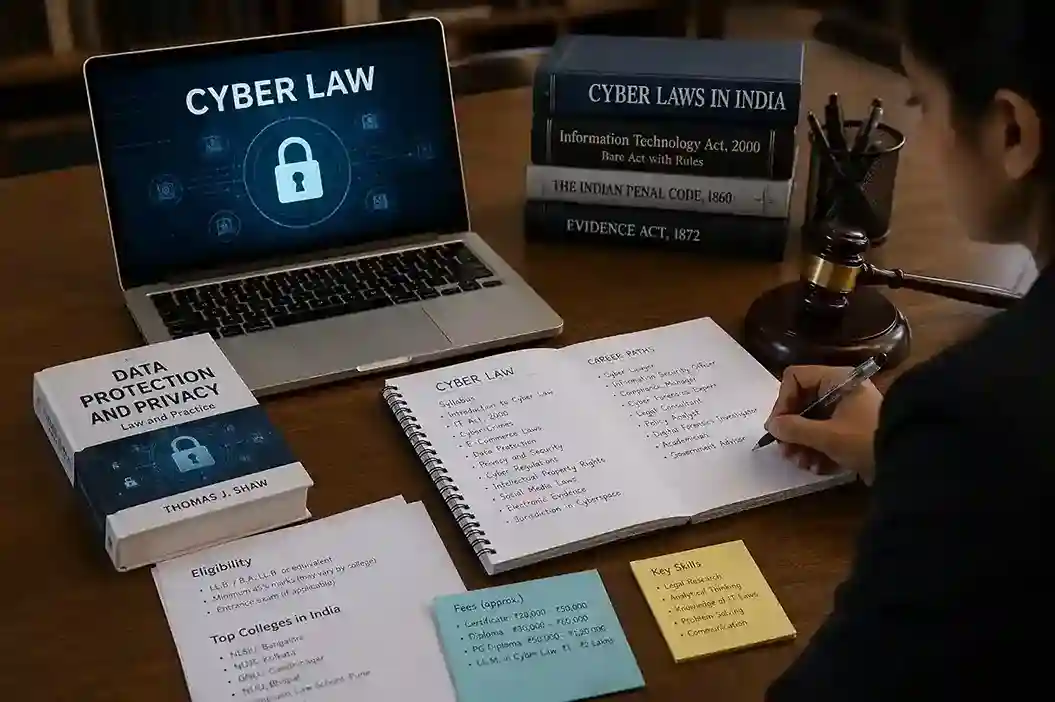
1. What is cyber law
Cyber law is the set of rules that apply to the internet, computers, and digital data. It covers hacking, online fraud, data theft, and digital evidence. It also covers e-commerce contracts, digital signatures, and online speech.
In India, this area sits mainly under the Information Technology Act, 2000. The Act was amended in 2008 to add stronger penalties for cybercrime. It does not use the term "cyber law" anywhere. But its sections form the backbone of how courts treat online offences.
Cyber law is not one single subject taught in isolation. It pulls from criminal law, contract law, intellectual property, and constitutional law. A cyber law student learns how old legal ideas apply to new digital problems.
If a crime happens through a computer, network, or phone, cyber law decides how it gets investigated, proven, and punished. If a business collects or sells user data, cyber law decides what it can and cannot do with that data.
2. Why this field matters right now
India notified the Digital Personal Data Protection Rules in November 2025. These rules give full effect to the Digital Personal Data Protection Act, 2023. Together, they form India's first complete law on personal data.
The rollout happens in stages. The Data Protection Board started functioning from November 2025. Consent manager registration begins in November 2026. Full compliance duties, including breach reporting and data fiduciary obligations, kick in by May 2027.
This staged rollout means companies need legal help right now to prepare. Every business that collects user data, from banks to food delivery apps, must build compliance systems before the deadlines hit. That demand creates real jobs for people trained in this area.
At the same time, cybercrime cases keep rising across Indian courts. Online fraud, identity theft, and data breaches now appear in criminal dockets every week. Police cyber cells need legal experts who understand both law and basic technology.
This combination, new data rules plus rising cybercrime, is why cyber law has moved from a niche elective to a serious career track.
3. Types of cyber law courses
India has no single undergraduate degree called "cyber law." Instead, four course formats exist, each suited to a different stage of life.
Some BA LLB and BBA LLB programmes also offer cyber law as an elective in the final years. This gives undergraduate students early exposure without a separate course. For a full breakdown of integrated law degrees, see our CLAT guide for BA LLB admissions.
4. Who can apply
Eligibility depends entirely on which course type you pick. There is no single rule for all of them.
| Course | Minimum Qualification | Background Needed |
|---|---|---|
| Certificate | Class 12 pass | None | open to all streams |
| Diploma | Class 12 pass | Basic computer awareness helps but is not required |
| PG Diploma | Graduate, any stream | Law or IT background preferred, not always required |
| LLM in Cyber Law | LLB (3-year or 5-year) | Law degree mandatory; 45–50% marks usually required |
For the LLM route, most universities ask for at least 45 to 50 percent marks in the LLB. Some reserve a few extra percentage points of relaxation for SC and ST candidates. Always check the exact cutoff on the university's own admission page before applying.
5. Fees by course type
Fees vary widely, and the gap between a government college and a private institute can be large. Here is what students typically pay.
- Certificate courses cost between ₹3,500 and ₹70,000 for the full term.
- Diploma courses run from roughly ₹9,000 to ₹70,000, depending on the institute's reputation.
- PG diploma and LLM programmes cost between ₹18,500 and ₹2,50,000 for the whole course.
- Government law colleges almost always charge less than private universities for the same course.
- Distance and online certificate options, including some from open universities, cost less than classroom programmes.
Government law colleges, including university-run law departments, often charge a fraction of what private institutes charge for similar course content. If budget matters most, start your search there before looking at private options.
6. Where to study
Around 90 colleges in India offer full-time cyber law programmes at some level. The list includes both government and private institutions.
| Institute | Course Offered | Type |
|---|---|---|
| National Law School of India University, Bangalore | LLM with cyber law focus | NLU |
| NALSAR University of Law, Hyderabad | LLM, certificate programmes | NLU |
| Ram Manohar Lohiya National Law University, Lucknow | LLM in cyber law | NLU |
| National Law Institute University, Bhopal | LLM, cyber law electives | NLU |
| Indian Law Institute, New Delhi | 3-month certificate course | Deemed university |
| Government Law College, Mumbai | 6-month diploma | Government |
| Asian School of Cyber Laws | Certificate and diploma, open to class 12 pass | Specialised institute |
| Vishwakarma University, Pune | 1-year LLM in cyber law | Private university |
| Oriental University, Indore | 1-year diploma | Private university |
| Amity University | LLM, certificate options | Private university |
NLUs generally offer the strongest academic depth and the best placement support. Check our complete list of NLUs in India if you plan to enter through an LLB first. For students who want shorter, faster exposure, specialised institutes like the Asian School of Cyber Laws accept students right after class 12.
7. What you actually study
The syllabus changes by course level, but a few core topics repeat across almost every programme.
- The Information Technology Act, 2000, and its 2008 amendment.
- Types of cybercrime: hacking, phishing, identity theft, and online fraud.
- Digital evidence: how courts accept and verify electronic proof.
- Electronic contracts and digital signatures.
- E-commerce law and consumer protection online.
- Data privacy and protection, including the Digital Personal Data Protection Act, 2023.
- Intellectual property issues linked to the internet, such as domain disputes.
- Basics of cybersecurity and computer forensics, taught at a conceptual level.
- Social media regulation and intermediary liability rules.
LLM programmes go deeper into case law and international comparisons, including frameworks like the GDPR in Europe. Shorter certificate courses stick to practical basics: what the law says, and how it applies in common situations.
8. How admission works
The admission process depends on the course type you choose.
9. Jobs after the course
Cyber law opens doors across government, private firms, and independent practice. The field rewards people who combine legal knowledge with comfort around technology.
Bangalore, given its high concentration of tech firms, sees the largest hiring volume for cyber law roles. Mumbai and Delhi follow closely, driven by banking, fintech, and government legal departments. For broader career options after a law degree, see our guide to legal career paths.
10. What you can earn
Pay depends on your role, your experience, and whether you work independently or for a firm.
Pay rises faster for people who keep up with new rules. The DPDP Act and its rules will keep evolving through 2027 as compliance deadlines arrive. Lawyers who track these changes early tend to get hired faster and paid more.
11. Skills that help beyond the syllabus
A cyber law course teaches the rules. But real success in this field needs a few extra habits.
- Reading IT Act amendments and new rules as soon as they are notified, not months later.
- Basic comfort with how networks, apps, and data storage work, even without coding skills.
- Following global frameworks like the GDPR, since many Indian companies serve international clients.
- Clear writing, since compliance work involves drafting policies that non-lawyers must understand.
- Patience with slow-moving cases, since cybercrime investigations often take longer than typical disputes.
None of these skills are taught fully in a classroom. Students build them through internships, reading legal updates, and following how courts decide cyber cases.
12. Picking the right course for you
The right choice depends on where you are right now, not on which course sounds most impressive.
Start with a regular BA LLB or BBA LLB and pick cyber law as an elective later. This gives you a full law degree plus the specialisation, rather than a short course with limited recognition.
Go for the LLM in cyber law. It carries the most weight for litigation, teaching, and senior compliance roles, and it builds directly on your existing legal training.
A certificate or diploma course adds legal context to your technical skills. This combination is exactly what compliance teams look for when hiring.
A short certificate course gives you working knowledge of data rules and online risk, useful even outside a legal career.