Updated June 1, 2026 · NIRF 2025 + Official NALSAR Data
⚡ Quick Answer | NALSAR Faculty
NALSAR University of Law, Hyderabad has 105 total faculty members as per NIRF 2025 | comprising 51 permanent/regular faculty, 25 ad hoc/contractual faculty, and 29 visiting or other members. The student-faculty ratio is approximately 15:1. Faculty members include internationally published researchers, UN and government consultants, and practitioners across corporate law, constitutional law, environmental law, cyber law, criminal justice, and aerospace law. The university holds a NAAC A++ grade (3.52) | the highest accreditation tier | reflecting the quality of its teaching, learning and research environment. Faculty-led research centres number over nine, and visiting/adjunct faculty include practitioners with Harvard, Supreme Court of India, and global organisation backgrounds.
When choosing a law school, most students focus on CLAT cutoffs, fees, and placement packages. But faculty quality is the variable that determines what you actually learn over five years | and at a school like NALSAR, which has consistently ranked in India's top three law institutions, the academic staff is the institution's most significant asset. This guide decodes NALSAR's faculty structure so you can make a truly informed decision.
Faculty Overview: Key Statistics (NIRF 2025)
105
Total Faculty (2024–25)
NALSAR's faculty strength has grown significantly | from 79 members in 2023–24 to 105 members in 2024–25, a 33% increase in a single year. This expansion reflects a deliberate hiring strategy: the university has been actively recruiting both experienced senior professors and fresh faculty directly from top NLUs and research institutions, creating what students describe as an optimal blend of seniority and new energy.
| Faculty Category | Count (2024–25) | Count (2023–24) | Growth |
|---|
| Regular / Permanent Faculty | 51 | ~38 | +34% |
| Ad Hoc / Contractual Faculty | 25 | ~22 | +14% |
| Visiting / Guest / Other | 29 | ~19 | +53% |
| Total Faculty | 105 | 79 | +33% |
| Total Students | 704 | 674 | +4% |
| Student-Faculty Ratio | ~15:1 | ~8.5:1 | More faculty proportionally |
📈
What the Growth Signals: The near-doubling of visiting faculty and rapid increase in regular faculty both signal institutional confidence and strategic investment. NALSAR has been on an active hiring spree | recruiting faculty who are themselves products of top NLUs. This matters for students because newer, younger faculty often bring current industry knowledge, recent academic publications, and more accessible teaching styles, while senior faculty provide depth and institutional wisdom.
Faculty by Designation
NALSAR's faculty hierarchy mirrors the UGC academic structure | Professors, Associate Professors, and Assistant Professors | with additional categories for Professor Emeritus and Adjunct/Visiting faculty.
| Designation | Description | Key Requirement | Count (Approx.) |
|---|
| Professor | Senior faculty | minimum 10 years teaching/research; original contribution to field; national/international recognition | PhD + 10 yrs PQE + publications | ~10–12 |
| Professor Emeritus | Retired senior professors retained for their scholarly contribution and institutional memory | Distinguished career + university appointment | ~1–2 |
| Associate Professor | Mid-career faculty | typically 5–8 years experience; active researchers; often directors of academic centres | PhD + 5 yrs PQE + research output | ~8–12 |
| Assistant Professor | Early-career faculty | fresh PhD holders from NLUs and top universities; teach foundation and advanced courses | LLM + NET/SLET/GATE or PhD (stage I) | ~25–30 |
| Adjunct / Visiting | Practitioners, judges, international scholars visiting for courses, guest lectures, research collaboration | Invitation by university | 29 |
Notable Faculty Profiles
NALSAR's faculty roster includes scholars whose research has shaped Indian jurisprudence, practitioners who have advised international organisations, and young academics who are building cutting-edge research programmes. Below are detailed profiles of the university's most prominent academic staff members.
Professor Emeritus & Centre Director
Prof. Amita Dhanda
B.A. · LL.B. · LL.M. · Ph.D.
Specialisation
Legal Theory · Human Rights · Disability Law · Gender Studies
Prof. Dhanda is one of India's foremost legal scholars in disability law and legal theory. She is Director of the Centre for Disability Studies and the Centre for Legal Philosophy and Justice Education at NALSAR. She was appointed to India's National Advisory Council for implementation of the Right to Education Act in 2010. She has authored pioneering work on the legal status of persons with mental disability and has written on decolonisation of legal knowledge. She began her career at the Indian Law Institute, Delhi.
Centre for Disability Studies
Centre for Legal Philosophy
Professor & Centre Director
Prof. K. Vidyullatha Reddy
B.A. · LL.B. · LL.M. · Ph.D.
Specialisation
Environmental Law · Climate Change Policy · Natural Resources Law
Prof. Reddy leads the Dr. S.P. Chatterjee Centre for Environmental Law, Climate Change and Policy Research at NALSAR. Her expertise covers environmental governance, ecological law, climate policy frameworks, and the intersection of sustainable development and constitutional rights. She brings a policy-oriented perspective to environmental legal education that bridges theory and practice.
S.P. Chatterjee Centre | Environmental Law
Professor & Centre Director
Prof. Aruna B. Venkat
B.A. (Sociology, Delhi University) · LL.B. · LL.M. · Ph.D. (Delhi University)
Specialisation
Family Law · Child Rights · Health Law · Substance Abuse Policy
Prof. Venkat is the Director of the Centre for Family and Matrimonial Causes (CFMC) at NALSAR. Her research spans environmental health, alternative energy law, child abuse and neglect, and substance misuse from a legal perspective. She brings an interdisciplinary socio-legal approach to family law education, grounded in both legal doctrine and empirical social research.
Centre for Family and Matrimonial Causes
Professor & Centre Director
Prof. K.V.K. Santhy
B.Sc. · LL.M. · Ph.D. (Osmania University)
Specialisation
Criminal Law · Cyber Law · Forensic Sciences · Digital Evidence
Prof. Santhy directs the Centre for Cyber Laws and Forensic Sciences at NALSAR | one of the few dedicated cyber law academic centres in India. With expertise in criminal law, digital forensics, and cybercrime regulation, she has built a distinctive interdisciplinary centre that addresses some of the most rapidly evolving areas of contemporary law. Her work connects criminal procedure with the realities of digital evidence and technology-facilitated crime.
Centre for Cyber Laws & Forensic Sciences
Professor (on Extraordinary Leave)
Prof. V. Balakista Reddy
B.A. · LL.M. (International Law, Osmania) · M.Phil. · Ph.D. (JNU)
Specialisation
International Law · Aerospace Law · Defence Law · Air and Space Law
Prof. Reddy heads the Centre for Aerospace and Defence Law (CADL) at NALSAR | one of the most specialised legal research centres in India. His PhD from Jawaharlal Nehru University focused on International Air and Space Law. With over 15 years of teaching and research experience, he advises governmental and academic bodies on aerospace and defence legal frameworks. CADL is widely regarded as a premier centre for this niche but strategically critical legal field.
Centre for Aerospace and Defence Law
Professor & Centre Director
Prof. Anup Surendranath
PhD
Specialisation
Criminal Justice · Death Penalty · Human Rights · Constitutional Law
Prof. Surendranath directs the Criminal Justice Centre at NALSAR. He is known for his rigorous academic work on India's death penalty jurisprudence, criminal procedure reform, and the relationship between constitutional rights and the criminal justice system. His research has contributed to public interest litigation and policy advocacy in the criminal justice space. He brings a compelling combination of doctrinal rigour and real-world engagement to the Centre's work.
Criminal Justice Centre
Professor & Centre Director
Prof. P. Srinivas Subba Rao
PhD
Specialisation
Law & Entrepreneurship · Access to Justice · Legal Education Research
Prof. Subba Rao directs the Centre for Law, Entrepreneurship and Action Research (CLEAR) at NALSAR. CLEAR focuses on the interface between legal frameworks and entrepreneurial activity, making it uniquely positioned in India's growing startup ecosystem. The Centre also conducts action research on access to justice and legal aid.
CLEAR Centre
Associate Professor & Centre Director
Dr. Neha Pathakji
PhD
Specialisation
Legal Philosophy · Jurisprudence · Justice Education
Dr. Pathakji serves as Associate Professor and Director of the Centre for Legal Philosophy and Justice Education. Her work bridges philosophical foundations of law with practical legal education, and she has contributed to developing the jurisprudence curriculum at NALSAR into one of the most intellectually rigorous in India. As a younger faculty member, she also represents NALSAR's commitment to bringing fresh academic perspectives into established departments.
Centre for Legal Philosophy
Notable Adjunct / Visiting Faculty
NALSAR's adjunct and visiting faculty programme brings in practitioners, scholars, and policymakers from national and international institutions. This bridges the gap between academic law and real-world legal practice.
Adjunct / Visiting Professor
Dr. Anurag Bhaskar
BA LLB (RMLNLU) · LLM (Harvard Law School) · PhD (OP Jindal Global University)
Specialisation
Constitutional Law · Social Inclusion · Ambedkarite Jurisprudence
Dr. Bhaskar serves as Adjunct/Visiting Professor and Director of the Dr. B.R. Ambedkar Chair on Constitutional Law and Social Inclusion. He previously served as Director of the Centre for Research and Planning at the Supreme Court of India. His book The Foresighted Ambedkar was published by Penguin Random House India in 2024. He received the Bluestone Rising Scholar Award from Brandeis University. His writings have been cited in three Supreme Court judgments.
Dr. B.R. Ambedkar Chair
Adjunct Faculty
G.S. Sachdeva
Expert in Air and Space Law
Specialisation
Air and Space Law · Aerospace Regulation · International Aviation Law
G.S. Sachdeva is a renowned expert in air and space law whose expertise is drawn upon by academic and governmental organisations. He contributes to NALSAR's Centre for Aerospace and Defence Law (CADL) as an adjunct faculty member, bringing practical regulatory expertise to the classroom.
Centre for Aerospace and Defence Law
Other Core Faculty at NALSAR
| Faculty Member | Designation | Qualifications | Specialisation Area |
|---|
| Prof. K.V.S. Sarma | Professor | Ph.D. (Consumer Protection Law) | Consumer Protection Law · Commercial Law |
| Prof. N. Vasanthi | Professor | B.Com (Hons) LL.B · LL.M · Ph.D (Osmania) | Constitutional Law · Gender Studies |
| Dr. Anirban Chakraborty | Associate Professor | PhD | Law (Specialisation | official website) |
| Dr. Manisha Sethi | Associate Professor | PhD | Socio-legal Studies · Human Rights |
| Dr. Rajesh Kapoor | Associate Professor | PhD | Law |
| Mr. Anshuman Shukla | Assistant Professor | B.Sc. · LL.B. · LL.M. | Legal Theory · Public Law |
| A. Kishore Kumar | Assistant Professor | LL.M. | Law |
| N. Manohar Reddy | Assistant Professor | LL.M. | Law |
| Dr. Ishita Das | Assistant Professor | PhD | Law |
| Dr. Vengalarao Pachava | Assistant Professor | PhD | Law |
| Dr. Raju Guntukula | Assistant Professor | PhD | Law |
| T. Raghavendra Rao | Assistant Professor | M.L. · Ph.D. (Environmental Law, Andhra University) | Environmental Law |
| Prof. G. Mallikarjun | Assistant/Associate Professor | B.Sc. · LL.B. · LL.M. · Ph.D. | Law |
| Prof. D. Bala Krishna | Faculty | B.Sc. · LL.M. · M.S.W. | Modern Crimes · Penology · Juvenile Justice |
Faculty-Led Research Centres at NALSAR
NALSAR's research centres are among the most distinctive features of the institution. Each centre is faculty-led, focuses on a specific area of law or interdisciplinary research, and often involves students in substantive research work, publications, and policy engagement. These centres are a primary reason why NALSAR produces graduates with depth of specialisation beyond what a general curriculum provides.
♿
Centre for Disability Studies
Director: Prof. Amita Dhanda (Emeritus)
Research on the legal status and rights of persons with disabilities; disability law reform; the Rights of Persons with Disabilities Act and its implementation.
💻
Centre for Cyber Laws & Forensic Sciences
Director: Prof. K.V.K. Santhy
Cybercrime regulation; digital evidence law; forensic science in legal proceedings; data protection; artificial intelligence and law.
🌿
S.P. Chatterjee Centre for Environmental Law
Director: Prof. K. Vidyullatha Reddy
Environmental governance; climate change law; pollution regulation; biodiversity and conservation law; environmental justice.
👨👩👧
Centre for Family and Matrimonial Causes (CFMC)
Director: Prof. Aruna B. Venkat
Family law reform; matrimonial dispute resolution; child rights; adoption law; domestic violence and gender-based legal protections.
✈️
Centre for Aerospace and Defence Law (CADL)
Head: Prof. V. Balakista Reddy
International air law; space law; defence procurement law; satellite regulation; aerospace liability frameworks. One of very few dedicated centres of this type in India.
⚖️
Criminal Justice Centre
Director: Prof. Anup Surendranath
Criminal procedure reform; death penalty jurisprudence; prisons and punishment; policing and accountability; victim rights.
🚀
Centre for Law, Entrepreneurship & Action Research (CLEAR)
Director: Prof. P. Srinivas Subba Rao
Law and startup ecosystems; access to justice research; legal aid design; empirical legal research methodologies.
📜
Centre for Legal Philosophy & Justice Education
Directors: Prof. Amita Dhanda · Dr. Neha Pathakji
Jurisprudence; philosophy of law; justice education methodology; socratic legal pedagogy; comparative legal theory.
🔵
Dr. B.R. Ambedkar Chair on Constitutional Law
Director: Dr. Anurag Bhaskar (Adjunct)
Constitutional law; social inclusion; Ambedkarite jurisprudence; caste and equality law; anti-discrimination frameworks.
🔬
Research Output: NALSAR faculty publish an average of 2–3 research papers per faculty member per year as per NIRF data submissions. This is one of the metrics that contributes to NALSAR's sustained NIRF top-3 positioning. Students at NALSAR benefit from an environment where faculty are actively publishing, presenting at conferences, and engaging with live legal questions | keeping classroom content connected to the cutting edge of legal scholarship and policy.
Teaching Methodology at NALSAR
Understanding how faculty teach | not just who they are | is critical for students choosing NALSAR over other NLUs.
NALSAR uses a semester-based evaluation system with each course assessed across three components: Mid-Semester examination (25 marks), Project/Research Paper (25 marks), and End-Semester examination (50 marks), totalling 100 marks per course. A minimum of 50 marks is required to pass any course. This structure forces consistent engagement rather than cramming at the end of the year | a pedagogically sound model that builds sustained legal reasoning skills.
Active Learning and Classroom Culture
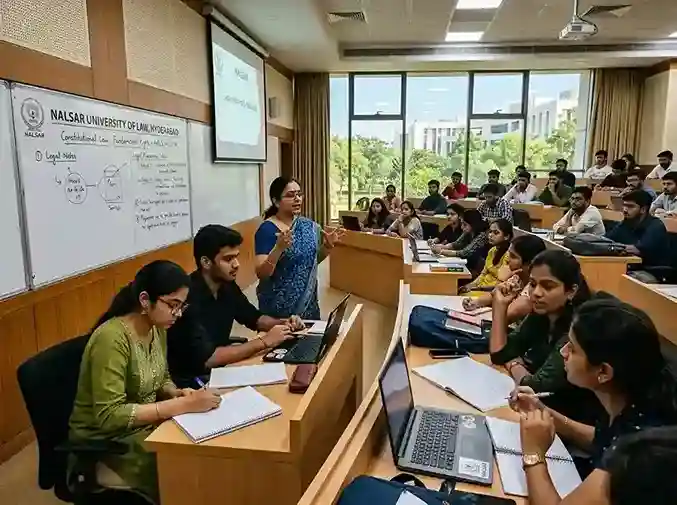
NALSAR faculty are known for classroom cultures that are discussion-intensive rather than passive-lecture oriented. Each batch is divided into two sections of approximately 70–80 students each, enabling more focused faculty-student interaction than is possible in large, undivided lecture halls. Faculty regularly assign case reading lists, hold moot sessions, and incorporate comparative legal analysis from multiple jurisdictions into their teaching. Guest lectures from practitioners | senior advocates, judges, corporate counsels, and policy experts | supplement the core faculty curriculum significantly.
Faculty Approachability
One of the most consistently noted features of NALSAR's faculty culture, reported across multiple student cohorts, is the accessibility of professors. Faculty members are described by students as genuinely willing to engage with queries beyond classroom hours | a characteristic that distinguishes NALSAR's learning environment from that of larger or more impersonal institutions. The residential campus setting contributes to this: faculty and students share the same physical space, creating informal interactions that supplement formal coursework.
What Students Say | Faculty Reviews
The following reflects synthesised themes from student feedback about the faculty learning experience at NALSAR Hyderabad, based on consistent patterns in publicly available student reviews.
★★★★★
"NALSAR has been on a hiring spree to bring in both senior and fresh faculty straight from National Law Universities themselves. With a mix of senior professors and young faculty, it provides an ideal teaching environment | a blend of flexibility and new tricks, coupled with experience and time-tested wisdom."
BA LLB (Hons.) Student · Batch of 2027
★★★★★
"Faculty at NALSAR are super humans | they know their subjects inside out. Those who have served as judges at smaller and higher courts teach case studies in a way that's unlike anything else. Subjects look easy because they discuss them, not just teach them."
NALSAR BA LLB Alumni · Verified Review
★★★★☆
"Faculty are helpful and knowledgeable, and they teach very well. You get to learn a lot. The limited batch size | two sections per batch | means you can actually approach professors after class and they respond without getting annoyed."
BA LLB Student · Batch of 2027 (Enrolled 2022)
★★★★★
"The professors here hold prestigious degrees from prestigious institutions, and their modesty is surprising. Having a few legal courses as part of our MBA study meant we got to learn from some of the best law professors in this country."
MBA (DOMS NALSAR) Student · 2025
NALSAR's NIRF Performance | Teaching & Research Parameters
NALSAR's strong NIRF rankings are partly driven by its performance on the Teaching, Learning & Resources (TLR) parameter, which directly reflects faculty quality. The university's NAAC A++ grade (the highest possible) further validates the institutional assessment of teaching and research quality.
NIRF Overall Score (Law, 2025)79.50 / 100
NAAC Grade Score3.52 / 4 (A++)
Faculty Research Publications (avg. per faculty)2–3 per year
Faculty Growth (2023–24 to 2024–25)+33% (79 → 105)
Student-Faculty Ratio~15:1
"Faculty quality at NALSAR scores very highly across student satisfaction surveys and independent rankings, driven by a combination of research output, accessibility, and the depth of subject matter expertise | particularly in emerging areas like cyber law, aerospace law, and environmental governance."
Why Faculty Should Influence Your College Choice
Students often treat faculty quality as a secondary consideration after CLAT cutoffs and placement packages. This is a mistake | for the following reasons:
🧠
Learning Quality Shapes Career Trajectory: At India's top law firms | CAM, AZB, Khaitan, Trilegal | recruiters consistently note that what separates NLU graduates is not just their law school's name but their depth of legal reasoning, research quality, and analytical precision. These skills are built in the classroom, shaped by the quality of faculty members who push students to think critically rather than recite doctrine.
🔍
Research Centres = Specialisation Signals: NALSAR's nine faculty-led research centres give students the opportunity to work on real research projects with national and international implications. A student who spends their third and fourth year working with the Criminal Justice Centre or the Ambedkar Chair on Constitutional Law graduates with genuine expertise | not just a degree. This specialisation is increasingly valued by top-tier recruiters and is a meaningful differentiator in campus placements.
🌐
Adjunct & Visiting Faculty = Global Network: NALSAR's adjunct faculty programme | which includes Harvard LLM holders, former Supreme Court officials, and international aviation law experts | gives students exposure to a network that goes well beyond what a regular curriculum provides. Interaction with visiting practitioners builds professional networks, recommendation letters, and internship opportunities that have tangible career value.
Frequently Asked Questions
How many faculty members does NALSAR Hyderabad have? +
As per NIRF 2025 data (submitted for the 2024–25 academic year), NALSAR University of Law Hyderabad has 105 total faculty members | comprising 51 regular/permanent faculty, 25 ad hoc/contractual faculty, and 29 visiting or other members. This is a significant increase from 79 faculty members in 2023–24, reflecting active hiring across all three categories.
What is the student-faculty ratio at NALSAR? +
The student-faculty ratio at NALSAR Hyderabad is approximately 15:1 as per NIRF data. Each batch is divided into two sections of approximately 70–80 students each for regular coursework. This enables meaningful faculty-student interaction | a significant advantage over larger institutions where sections may have 150+ students. The relatively compact batch size is one of NALSAR's most consistently praised features in student feedback.
Which are the strongest research areas at NALSAR? +
NALSAR's research strengths are concentrated in: Disability Law and Legal Theory (led by Prof. Amita Dhanda's centre), Cyber Laws and Digital Forensics (Prof. K.V.K. Santhy), Environmental Law and Climate Policy (Prof. K. Vidyullatha Reddy), Aerospace and Defence Law (Prof. V. Balakista Reddy), Criminal Justice (Prof. Anup Surendranath), and Constitutional Law (Dr. Anurag Bhaskar's Ambedkar Chair). These nine research centres give NALSAR a depth of specialisation that very few Indian law schools can match.
Is NALSAR's faculty quality better than other NLUs? +
NALSAR's faculty quality is consistently recognised as among the best in India, as reflected by its NIRF #3 ranking in Law and NAAC A++ accreditation (3.52/4 | the highest grade). The student-faculty ratio of 15:1, average research output of 2–3 publications per faculty per year, and the depth of its research centre ecosystem place it ahead of most NLUs in academic quality. While NLSIU Bangalore and NLU Delhi are closely competitive, NALSAR's combination of experienced senior professors, dynamic young faculty from NLUs, and an active visiting practitioner programme is a genuine differentiator.
Do NALSAR faculty also do consultancy and advisory work? +
Yes. Multiple NALSAR faculty members are actively engaged in advisory and consultancy work with government bodies, international organisations, courts, and regulatory agencies. Prof. Amita Dhanda has served on India's National Advisory Council. Prof. V. Balakista Reddy advises governmental and academic bodies on aerospace law. Dr. Anurag Bhaskar previously served as Director of the Centre for Research and Planning at the Supreme Court of India. This practitioner engagement keeps faculty research and teaching grounded in current legal and policy realities.
Can students work with research centres at NALSAR? +
Yes. NALSAR's research centres actively involve students in research work, publications, and policy engagement. Students can work as research assistants with centres like the Criminal Justice Centre, the S.P. Chatterjee Centre for Environmental Law, or the Ambedkar Chair. This hands-on research experience | working alongside faculty on real legal questions | is one of the most valuable components of a NALSAR education and frequently cited as a distinguishing factor in campus recruitment interactions.