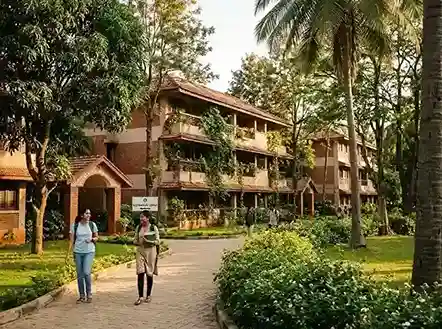
Overview of NLSIU Bangalore Hostel
The National Law School of India University (NLSIU), Bengaluru, is widely regarded as India's most prestigious law school, and its residential infrastructure reflects the same commitment to excellence that defines its academic reputation. Situated on a sprawling 23-acre green campus in Nagarbhavi, the university provides on-campus hostel accommodation to over 1,000 students across eleven distinct residential blocks | five dedicated to male students and six to female students | with two additional off-campus housing facilities located approximately 15 minutes away in RR Nagar.
Hostel life at NLSIU is not merely about shelter | it is the backbone of the institution's community culture. The campus is a self-contained academic ecosystem where students, faculty, and support staff coexist, enabling the kind of intellectual ferment and peer learning that makes NLSIU graduates exceptionally well-prepared for the demands of the legal profession. Whether you are an incoming BA LLB student for whom hostel residence is compulsory in the first year, an LLM scholar, or a doctoral researcher, NLSIU's residential facilities are designed to balance academic rigour with personal comfort and social growth.
The hostel blocks are named after India's iconic rivers and mountain ranges | a distinctive naming tradition that reflects NLSIU's founding vision of being a national institution that draws students from every corner of the country. This nomenclature is more than symbolic: NLSIU's residential community is genuinely one of the most geographically and culturally diverse on any Indian campus, creating an environment where students from Tamil Nadu, Assam, Maharashtra, Rajasthan, and beyond share common spaces, exchanging perspectives that enrich the law school experience far beyond what the classroom alone can offer.
Boys' Hostels at NLSIU Bangalore
NLSIU Bangalore has five on-campus hostels for male students, each named after a significant Indian river. These blocks collectively accommodate several hundred male students and are located in the northern portion of the campus, close to the main academic blocks. All boys' hostels share common infrastructure including round-the-clock water supply, laundry access, and campus-wide internet connectivity.
Ganga
One of the original and largest halls of residence for male students; houses the main boys' mess facility.
Cauvery
Named after the Cauvery river; a well-established block with shared dining access via the Cauvery mess.
Himalaya
Located near Gate 1, adjacent to the Brahmaputra block; serves mid-year and senior batches.
Hoogli
A residential block providing basic furnished accommodation with shared common spaces.
Brahmaputra
Situated near Gate 1 alongside Himalaya; part of the newer residential additions to the campus.
The Ganga and Cauvery blocks are particularly significant because they house the primary dining mess for male students, making them the social hub of the boys' residential life. Meals are served in these common dining areas on a scheduled basis, with students from all five boys' hostels accessing the mess facilities.
Girls' Hostels at NLSIU Bangalore
NLSIU Bangalore provides six dedicated residential blocks for female students, making it one of the few national law universities to offer a larger number of girls' hostel blocks than boys'. The girls' hostels are named after rivers, mountain ranges, and geographic landmarks of India, maintaining the institution's distinctive naming tradition.
Nilgiris
One of the primary halls of residence for female students; named after the Nilgiri Hills.
Narmada
Named after the Narmada river; provides comfortable accommodation with standard amenities.
Yamuna
A well-established residential block forming part of the girls' hostel cluster.
Gangotri
Named after the glacial source of the Ganges; a dedicated block in the women's residential zone.
Vindhyas (Annexe)
Named after the Vindhya mountain range; the Annexe block provides additional women's accommodation.
Annapurna (Mess Block)
Doubles as the primary girls' dining block; the Annapurna mess serves as the central dining facility for female students.
The Annapurna block serves a dual purpose | it is both a residential hall and the central mess facility for female students, making it a focal point of daily community life for women on campus. First-year female students are generally accommodated in designated blocks, ensuring that newcomers have the support of a cohesive peer group during their transition into law school life.
Room Types & Standard Furnishings
NLSIU Bangalore's hostel rooms are available in single, double, and triple occupancy configurations, allowing students some degree of preference depending on availability and year of study. The allocation of room type often depends on seniority, with first-year students more commonly placed in shared accommodations and senior students having greater access to single or double rooms.
What Each Room Provides
Every hostel room at NLSIU is furnished with a standard set of essential furniture and fittings provided by the university:
While the rooms are functional and purposefully designed rather than luxurious, they provide everything a law student needs to study, rest, and maintain a productive daily routine. The emphasis is on creating a distraction-free environment that complements NLSIU's demanding academic schedule.
NLSIU Bangalore Hostel Fees 2025–26
The hostel fees at NLSIU Bangalore are structured to be affordable relative to private accommodation options in Bengaluru. The fee structure covers residential charges and mess charges separately, giving students clarity on what each component includes. The fees below reflect the academic year 2025–26 structure; students should verify the latest figures with the official NLSIU admissions office at the time of joining.
| Fee Component | Amount (Per Year) | Notes |
|---|---|---|
| Hostel Residential Charges | ₹45,000 | Covers on-campus room, electricity, water & maintenance |
| Mess Charges | ₹67,500 | Covers 4 meals/day | breakfast, lunch, snacks, dinner |
| Total On-Campus (Hostel + Mess) | ₹1,12,500 | Most common for BA LLB & LLB students |
| Off-Campus Housing (inclusive) | ~₹1,88,200 | RR Nagar facility; all-inclusive with meals & amenities |
| Refundable Deposit (General) | ₹20,000 (approx.) | Returned on completion, subject to dues clearance |
| Refundable Deposit (SC/ST) | ₹15,500 | Concessional deposit for SC/ST category students |
Hostel residential charges cover the cost of accommodation within the university premises, including electricity, water supply, and general maintenance. Students who qualify for and choose off-campus housing are charged at a higher combined rate due to the furnished, hotel-style nature of those facilities. It is worth noting that NLSIU offers several scholarships and financial aid options, some of which may partially offset hostel and mess costs for eligible students.
Mess & Dining Facilities
Food is a subject of lively discussion in any law school, and NLSIU Bangalore is no different. The university runs dedicated mess facilities for both male and female students | the Ganga/Cauvery mess serves the boys' hostels, while the Annapurna mess block caters to female students. A Mess Committee | comprising both student representatives and university administration | is responsible for planning nutritious, balanced meal menus and overseeing the quality and hygiene of all food served.
Meal Schedule & Structure
The mess operates four meal sessions daily, ensuring that students have access to structured nutrition throughout their demanding academic day:
Dietary Preferences & Organic Produce
The mess caters to both vegetarian and non-vegetarian dietary preferences, with menus planned to reflect the diversity of NLSIU's national student body. One of the more notable aspects of NLSIU's dining commitment is its partnership with Spudnik Farms, an alumni-led network of Community-Supported Agriculture farms in and around Bengaluru. This partnership ensures that chemical-free and pesticide-free organic fruits and vegetables are used in preparing meals in both the men's and women's mess facilities | a commitment to quality that few Indian law schools can match.
A dedicated nutritionist collaborates with the university to maintain dietary quality and variety, ensuring that meals are balanced and suited to the physical and mental demands placed on law students. Additional paid items are available for students who wish to supplement their standard mess meals.
On-Campus Cafés & Food Outlets
Beyond the formal mess, NLSIU's campus has evolved into a more vibrant food ecosystem over recent years. Two notable cafés serve the student community:
Ashu's Café, relocated to the open area in front of the Brahmaputra and Himalaya hostels near Gate 1, serves snacks, beverages, and quick bites in a relaxed outdoor setting. Food Box Café, located near the library, operates from 10 AM to midnight | a crucial detail for students who study late and need sustenance during evening research sessions. The availability of a café open until midnight reflects the understanding that law school hours are not conventional office hours.
Hostel Amenities & Utilities
NLSIU's hostel infrastructure provides a comprehensive set of amenities that address the daily practical needs of resident students. Below is a detailed overview of what students can expect across the on-campus residential blocks:
Utilities
Common Spaces
The hostel Wi-Fi is available 24 hours a day across the residential campus, though students have noted that bandwidth can vary. Content filtering is applied on certain categories of websites. For academic research, the university's library provides high-speed dedicated internet access with connectivity to international legal databases, JSTOR, and other resources through the OPAC system.
Off-Campus Housing at NLSIU Bangalore
Recognising that its growing student intake may occasionally exceed on-campus residential capacity, NLSIU Bangalore operates two off-campus housing facilities located in RR Nagar, approximately 15 minutes by road from the main Nagarbhavi campus. These facilities are university-managed and provide a structured, safe residential environment for students who cannot be accommodated on campus.
Off-Campus Facility Features
The off-campus facilities are commonly referred to as the "Olive" residences and operate as hotel-style accommodations with a higher degree of comfort and privacy compared to the standard on-campus blocks. The all-inclusive fee for off-campus housing is approximately ₹1,88,200 per year, reflecting the enhanced amenities and the cost of external facility management. University transport arrangements help students commute between the RR Nagar facility and the main campus.
Health Centre & Medical Facilities
The health and well-being of resident students is a priority at NLSIU. The university operates a well-equipped Health Centre on campus, staffed by qualified medical professionals including a resident nurse. The Health Centre addresses routine medical needs, administers first aid, and provides primary care for common illnesses | a reassuring presence for students living away from home.
Institutional Hospital Partnership
For cases that require hospital-level attention, NLSIU has a formal institutional arrangement with S.K. Hospital, Nagarbhavi, which is situated close to the campus. This tie-up ensures that students requiring in-hospital care, specialist consultations, or emergency treatment can access medical services promptly and with the support of the university administration.
In cases of genuine medical emergencies within the hostel, the university's medical staff and hostel wardens are authorised to arrange an urgent vehicle to transport students to the hospital. Students are encouraged to report any health concerns | however minor | to the Health Centre without hesitation, and wardens are explicitly empowered to facilitate medical assistance at any time of day or night.
Mental Health & Well-being
Recognising the psychological demands of legal education, NLSIU provides dedicated mental health and counselling services to students. These services are accessible to all members of the university community and cover academic stress, personal challenges, and general well-being. Information about available mental health resources is communicated to incoming students as part of orientation, and the university maintains a visible commitment to destigmatising mental health support in the high-pressure environment of a top law school.
In-House Crèche
In a forward-thinking addition to its campus services, NLSIU has established an in-house crèche behind the Training Centre, supporting faculty members, staff, and the broader campus community who require childcare facilities. This reflects the university's understanding of the diverse needs of its residential population.
Sports, Fitness & Recreation
Physical well-being is as integral to the NLSIU experience as academic achievement. The campus offers a comprehensive range of sports and fitness facilities, ensuring that students have ample opportunities to unwind, stay active, and maintain a healthy lifestyle alongside their rigorous legal studies.
Outdoor Sports Facilities
Gym & Fitness Centre
NLSIU's gym was relocated and expanded to a 1,575-sq ft dedicated space in the Training Centre in 2021, replacing the older 990-sq ft facility. The updated fitness centre is equipped with modern exercise equipment, offering students a proper space for strength training, cardiovascular fitness, and general physical conditioning. The gym's improved layout and updated equipment reflect NLSIU's investment in student well-being beyond academics.
The university is also actively exploring collaborations to establish a specialised sports centre on campus in the near future, a development that would further strengthen NLSIU's sports and recreational infrastructure.
Security, Warden System & Student Safety
NLSIU Bangalore takes residential security seriously. The campus operates a round-the-clock security setup, with multiple layers of protection ensuring the safety of all residents.
The Residence Life Team
The hostel administration is managed by a dedicated Residence Life Team, which includes a Chief Warden, individual block wardens, and housekeeping and caretaking staff. Wardens reside on campus and are always available to address any problem, inconvenience, or health-related issue that students encounter. The approachable nature of the warden system is frequently cited as a positive aspect of hostel life by NLSIU students.
Floor Leader System
NLSIU runs a structured Floor Leader programme as part of its Residence Life Policy. Floor Leaders are selected through an application and interview process at the beginning of each academic year. They act as the first point of contact for residents on their respective floors, helping bridge the gap between students and the administration. Floor Leaders receive a 15% waiver on hostel residential fees and a certificate of recognition from the Chief Warden | a compelling incentive for leadership-oriented students.
Smart ID Card System
The university has introduced a smart ID card system for all students, faculty, employees, campus residents, and visitors. This system streamlines identification processes, digitises access controls, and enhances campus security. The smart cards simplify entry and exit management, ensuring that the residential campus remains secure at all times.
Lost & Found Policy
A formal Lost and Found Policy governs how items reported lost or found on campus are handled. This policy ensures accountability and facilitates the return of belongings to their rightful owners | a small but meaningful aspect of campus governance that students appreciate.
NLSIU Hostel Rules & Regulations
NLSIU's hostel rules are governed by its Residence Life Policy, a formal document that outlines the rights and responsibilities of all residents. The policy aims to create a respectful, disciplined, and safe residential environment that supports academic achievement without unnecessary restrictions on personal freedom.
- ◆ Quiet Hours: Noise, loud music, or use of speakers within residential blocks is restricted between 11 PM and 6 AM. These quiet hours are enforced to ensure that all students | especially those with early morning classes or intensive study schedules | can rest undisturbed.
- ◆ Anti-Ragging Policy: NLSIU maintains a strict zero-tolerance stance on ragging, bullying, hazing, and any form of harassment within the hostel premises. Students found supporting or engaging in such activities are subject to disciplinary proceedings under the university's conduct policies.
- ◆ Substance Prohibition: Smoking, consumption of alcohol, and use of narcotics or controlled substances are strictly prohibited within all hostel premises and the wider campus. Violations attract serious disciplinary consequences.
- ◆ Room Allocation: Students may not change their assigned rooms without prior written permission from their respective wardens. Unauthorised room swapping is considered a violation of residence policy.
- ◆ Room Inspections: The hostel team reserves the right to inspect any resident's room at any point in time, subject to appropriate notice and procedural fairness, to ensure maintenance standards and policy compliance.
- ◆ Vacation of Rooms: It is compulsory for all students to vacate and clear their hostel rooms before departing for semester-end breaks. Rooms must be left in the same condition as at the time of allotment.
- ◆ Notice Board Policy: In 2024, NLSIU introduced a new Notice Board Policy with standardised notice boards installed across campus. Any official communication within the hostel must adhere to these procedures.
- ◆ Weekend Permissions: Students wishing to spend weekends at home or outside the campus are required to fill out a permission form, which is a straightforward process. This applies primarily to first-year students for whom campus residence is compulsory.
- ◆ Complaints Mechanism: All hostel complaints are formally addressed by the Residence Life Team. Students are encouraged to report issues | from maintenance failures to interpersonal conflicts | through the official complaint channels, and all complaints are treated with seriousness and resolved promptly.
Campus & Social Life in NLSIU Hostels
If there is one aspect of NLSIU that distinguishes it from other national law universities, it is the intensity and richness of its campus community life. Because students live, eat, study, and socialise within the same 23-acre ecosystem, relationships formed at NLSIU tend to be exceptionally deep and enduring. The hostel corridors, common rooms, and open quads are where many of the most formative conversations, debates, and collaborations in Indian legal academia have originated.
Student-Led Organisations
Student life at NLSIU is organised by self-governing student groups, a structure that places significant responsibility | and significant freedom | in the hands of students themselves. This includes cultural events, student-led associations, food festivals, moot court societies, and more. The residential campus provides the physical and social infrastructure for these groups to thrive, with hostel common rooms and open spaces frequently transformed into venues for performances, debates, and informal seminars.
Diversity of the Residential Community
NLSIU's admissions process draws students from across the country through CLAT, which means its hostel population is genuinely diverse in language, culture, food habits, and regional background. This diversity | students from Kashmir and students from Kerala sharing a mess table, students from Maharashtra and Manipur collaborating on a moot court submission in the same corridor | is one of the most consistently praised aspects of NLS hostel life by alumni who go on to careers at the Supreme Court, in international law firms, or in government.
The residential community is further enriched by the fact that faculty members also reside on campus, creating an unusually permeable boundary between the academic and personal spheres. Students often recount informal conversations with faculty in the campus canteen or during evening walks as some of their most intellectually formative experiences at NLSIU.
Campus Environment
The 23-acre green campus | notable for its bird life, including a famous colony of egrets | provides a natural, calming environment that offsets the intensity of legal studies. The campus has been described as a "miniature India" by the university itself, and its self-contained nature | with a bank, ATM, health centre, gym, cafés, library, and sports facilities all within walking distance | means students rarely need to leave the campus for daily needs. The Nagarbhavi locality, however, also offers PGs, restaurants, and shops within a short distance for students who wish to explore beyond the campus gates.
Hostel Allotment & Registration Process
The process of registering for a hostel room at NLSIU Bangalore is integrated into the broader university admissions process, making it simpler than at many other institutions where accommodation is a separate application entirely.
How Allotment Works
For undergraduate BA LLB students, hostel allotment is completed at the time of filling admission forms and during the admission process itself. Students are allotted a hostel room as part of onboarding, which means they arrive on campus with their accommodation already confirmed | a significant relief for students coming from other states. First-year students are generally provided with separate accommodation to help them acclimatise to campus life as a cohort.
Allotment is based primarily on need and availability. Students who are permanent residents of Bengaluru may be able to commute from home, though first-year students are generally expected to reside on campus regardless of home address.
From Second Year Onward
From their second year onward, students have greater flexibility. They may continue in on-campus hostels (subject to availability), apply for off-campus housing at the RR Nagar facilities, or arrange their own accommodation in the Nagarbhavi area | which has an abundance of PGs and rental housing options given the density of educational institutions in the locality.
Hostel Vacancy Requirement
Students are required to formally vacate their hostel rooms before departing at the end of each semester. This ensures that rooms are properly maintained, inventoried, and prepared for the next occupants | a standard practice that reflects the institution's orderly approach to residential administration.